Tag: Mad Men (Page 9 of 15)

Let’s Have a Ball Down at the Globes (TV Edition)

The announcements have been made, and the nominations for the 67th Golden Globe Awards are now officially a matter of public record, but just in case you haven’t caught them elsewhere (which, to be fair, is highly possible), here’s my look at the TV series, mini-series, and movies which received nods, along with my personal picks for who should take home the win for each category.

Best Television Series – Drama

• Big Love (HBO)
• Dexter (Showtime)
• House (Fox)
• Mad Men (AMC)
• True Blood (HBO)

My pick: “Mad Men.” Regular readers of Premium Hollywood had probably already narrowed my pick down to two entries, anyway, since I’m the designated blogger for both “True Blood” and “Mad Men,” but while “True Blood” had a strong season that was tarnished slightly by an unsatisfying finale, “Mad Men” offered up a full-fledged game-changer for the conclusion of their third year. The most notable omission from this list, however, is “Sons of Anarchy,” which you could almost write off as being too harsh for the voters if you didn’t have a drama about a serial killer in the mix.

Best Performance by an Actress in a Television Series – Drama

• Glenn Close, “Damages” (FX)
• January Jones, “Mad Men” (AMC)
• Julianna Marguiles, “The Good Wife” (CBS)
• Anna Paquin, “True Blood” (HBO)
• Kyra Sedgwick, “The Closer” (TNT)

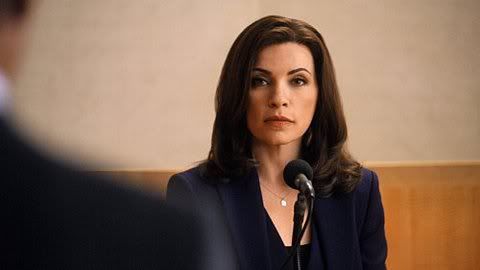
My pick: Julianna Marguiles. I know full well that it’s a dark horse pick that almost certainly won’t pay off, but “The Good Wife” has been my favorite drama of the new season, and Marguiles offers a multi-layered performance as Alicia Florrick, a woman having to struggle with the media shining the spotlight on her husband’s infidelity and political and legal misdealings while she’s trying to return to a career as a litigator. And am I the only one who scoffed somewhat at January Jones’ nomination? Of the three primary “Mad Men” actresses, she’s the last I would’ve nominated, and this is one case where I think most would agree with me.

Best Performance by an Actor in a Television Series – Drama

• Simon Baker, “The Mentalist” (CBS)
• Michael C. Hall, “Dexter” (Showtime)
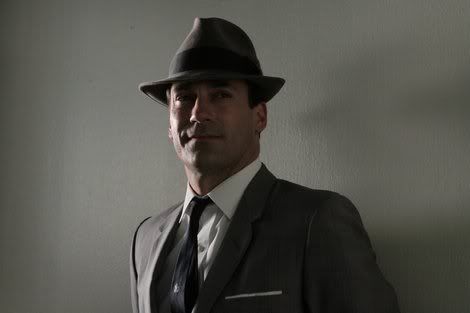
• Jon Hamm, “Mad Men” (AMC)
• Hugh Laurie, “House” (Fox)
• Bill Paxton, “Big Love” (HBO)

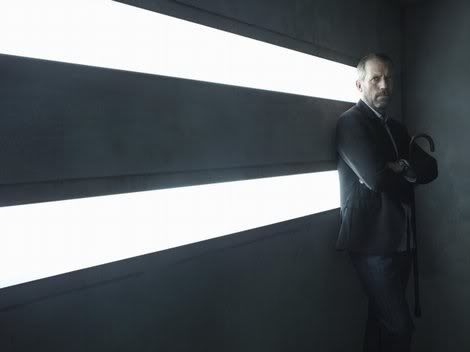
My pick: Hugh Laurie, “House.” God love Jon Hamm, but I said of the “House” season premiere back in September that it was “strong enough to warrant giving Hugh Laurie an Emmy nomination no matter what else he may do on the show during the course of the season’s subsequent episodes,” and I stand by that.

Continue reading »

TV in the 2000s: The Decade in Whedonism – 10 Small Screen Masterpieces from Joss Whedon

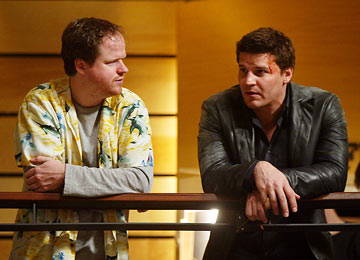
Like an awful lot of film and TV geeks, and just plain geeks, I’m a pretty big Joss Whedon fan. In fact, my devotion to his unique blend of fantasy and science fiction melodrama, sometimes arch old-school movie-style witty dialogue blended with Marvel comics repartee, strong characterization, and often somewhat silly plots has at times gotten almost embarrassing. A few years back some of my very adult friends were suggesting in concerned tones that I should really marry the man if I love him so much.

JossWhedonPaleyAxe_1211932727-000

More recently, I thought my fandom was under relative control. But now, I’ve been asked my opinion on the ten best examples of small-screen work in this decade from the creator and guiding force of “Angel,” “Firefly,” the already canceled “Dollhouse,” and, of course, “Buffy, the Vampire Slayer.” I only have to be thankful for the fact that first four seasons of “Buffy,” which contain most of that show’s greatest episodes, are disqualified because they appeared on TV sets before 2000. We take our mercies where we find them. (And, yes, if you’re about to catch up with these on DVD, there are a fair number of spoilers below for the various series, though I’ve tried to keep a few secrets.) One word of warning: my relative ranking of these shows is a matter of mood and borders on the random. In other words — don’t hold me to these choices!

Out of competition:

The Body” (“Buffy, the Vampire Slayer”) – This episode usually ranks extremely high when people make these kind of lists. Entertainment Weekly named it as pretty much the best thing Joss Whedon has ever done and maybe the best TV thing ever. The truth of the matter is that, yes, the episode where Buffy Summers (Sarah Michelle Geller) discovers the already cold body of her mother, Joyce (Kristine Sutherland, a wonderful asset to the show for the five previous years), dead from an entirely natural brain tumor, was probably one of the most remarkable episodes of television ever shown, and probably the only thing I’ve seen that comes close to capturing the essence of what it feels like when someone dies unexpectedly. The problem was, I didn’t find it depressing; I found it real. I didn’t feel any more like repeating the experience than I would the death of an actual loved one.

Whedon – who wrote and directed the episode himself – deserves all the credit in the world for the brave choices he made, including shooting the episode in close to “real time” and not using any music. If I have one complaint with , it’s his tendency to close emotional episodes with, dare I say it, somewhat drippy montages. His choice to eliminate music from the kind of “very special” show where other creators would lay in with three or four montages of Joyce frolicking in the woods or what have you, shows Whedon is, at heart, an outstanding filmmaker. I’ve never had a problem with his much-noted tendency to kill off sympathetic and/or popular characters. It might anger some fans, but especially if you’re dealing with inherently violent material, there’s something morally wrong about not dealing with the fact that good people are just as mortal as bad people. Still, I don’t enjoy watching this episode. If this were a movie, maybe I’d be more in awe or eager for profundity. However, if I’m going to be honest, I can’t call “The Body” a favorite and I can’t be sure it’s one of the “best.”

#10, Shiny Happy People (“Angel”) – Fans of the spin-off about Buffy’s ex, the vampire-with-a-soul detective (David Boreanaz), and various assembled demon-hunters and occasionally friendly demons, will be scratching their heads at this choice. It’s an unpopular episode from a widely and justly derided storyline involving a very weird affair between Angel’s unbalanced super-powered teenage son from another dimension, Connor (Vincent Kartheiser, now of “Mad Men“), and a suddenly evil Cordelia (Charisma Carpenter), a former high school mean girl turned lovably complex grown-up foil for her vampire boss. And, yeah, it was a little freaky for Cordy to give birth to a fully grown creature called Jasmine.

0000001044_20060919141143

However, as played by the wondrous Gina Torres of the then recently-canceled “Firefly,” Jasmine was freaky in a good way. A being whose god-like ability to create an instant sense of peace, happiness, and complete obedience, is somewhat set off by the fact that she’s actually a deformed and decaying, if not entirely evil, monster who must consume people to live, she was every charismatic leader and every great screen beauty rolled into one monstrous ball. More than anything else, “Shiny Happy People” reminded me of Don Siegel’s 1956 film verson of “Invasion of the Body Snatchers.” It was another believable demonstration of how we humans are only too willing to surrender our our humanity to the first apparently completely beauteous and 100% wise being who comes along. You know, like Oprah, only less powerful.

Continue reading »

TV in the 2000s: The Shows that Defined the Decade

A recent issue of Time magazine has the phrase “The Decade from Hell” emblazoned across its front cover. It’s referring to everything America has gone through in the past ten years, and it’s difficult to argue such an assertion: it’s been a shitty decade on a national level. During such times of stress, people inevitably turn to entertainment as a form of release, and although the methods in which we’ve distracted ourselves over the last ten years have unquestionably diversified, television remains the most easily accessible outlet for most Americans.

Within the format itself, the whole concept of reality TV must surely have been the biggest revolution of the decade. It’s really easy to bag on reality TV – mostly because the bulk of it is so damned unreal – but anybody who spends any time in front of the tube has surely had at least a couple of reality series they consider appointment TV. The two concepts that paved the way for everything else are undoubtedly “Survivor” and “American Idol.” The former, of course, opened the floodgates for the genre, and while it’s seen a considerable dip in the ratings department over the years, 12 million viewers isn’t a viewing figure to sneeze at. The latter, despite all the bitching and moaning and cries of “it’s not as good as it used to be” that accompany each new season, remains one of the most watched shows on the tube, likely due to the fact that it’s strictly a talent competition.

On “American Idol,” the only backstabbers are the judges, and since they aren’t part of the competition, their amusing duplicity is championed. The contestants, on the other hand, are innocents, and once the competition is underway, we’re given no peek into any possible backstage drama, which is a good thing, because by the time the audition rounds are over, we’ve had enough drama to last the whole season. Everything that comes after is all about who can best transfix us for three minutes a week via one pop ditty. It actually says something positive about the U.S. that “American Idol” remains our #1 form of reality entertainment, even if the actual reality is that the vast majority of Americans couldn’t care less about buying the winner’s album six months after they’re crowned.

You might think reality TV is a bunch of crap, and in most cases you’d be right, but the whole idea of it, to my mind, led to an important revolution, and that is serialized nighttime television (the classic “soap” formula notwithstanding). Reality shows taught viewers how to become invested in characters, how to be concerned for their eventual fate, and, most importantly, how to pay attention to an ongoing storyline, and the need to tune in every week. It didn’t take long for the networks to figure out that there was an audience for shows that didn’t continually hit the reset button. “24” must have been the first successful show of the decade to embrace the serial formula, and it embraced it whole hog. It required you to tune in for every episode, because each installment was another hour of a single day in the life of Kiefer Sutherland’s Jack Bauer. That “24” premiered less than two months after the terrorist attacks on 9/11 was pure happenstance. That it became enormously popular with viewers? Probably not so much. America needed some fictitious reassurance that there were folks on the job who could get shit done, and “24” filled the prescription.

Strangely, “24” didn’t open the network floodgates for more such programming right away. It took a few years, and then “Lost” made its mark. The number of “Lost” episodes I’ve seen could be counted on two hands, but that’s not because I didn’t like it, but because real life got in the way of it being appointment TV. Yet I viewed the pilot for “Lost” several months before its 2004 premiere, and when it ended I was convinced that I’d seen the second best TV pilot ever made. (“Twin Peaks” stills sits at #1.) The fact that a show as intricate as “Lost” still has a hardcore, central audience is perhaps a testament to that pilot. “24” started a new story with each new season; “Lost” required that you tune in for every episode of every season.

Another sci-fi series that did just that was “Battlestar Galactica,” a show that, due it being on a niche network (Syfy), never amassed a huge audience yet snagged boatloads of publicity and awareness nonetheless. It was no small feat to take an utterly laughable short-lived series from the late ‘70s and re-envision it for modern audiences, but Ron Moore and company did just that…and they did it far more successfully that anyone ever guessed possible. Most amazingly, the show taught us a lot about ourselves, by thoroughly defining what it means to be human, and as the damaged ‘00s dragged on, there may not have been a more important lesson to be learned.

On the same day I saw the “Lost” pilot, I saw another pilot for a completely different kind of series. While I didn’t rank it as one of the greats, there was one thing I was sure of: it would be a massive hit…and it was. “Desperate Housewives” was precisely the sort of vapid, soapy fare that had been absent for far too long on American TV. It clued into the seemingly bland suburban construct which surrounds so many Americans, via the Lynchian notion that “all is not what it seems.” Most anyone who lives a suburban life can no doubt relate to that idea, because wherever there are groups of people, there are bound to be some of them that are fucked up. “Housewives” is littered with fucked up suburbanites of all shapes, sizes and types, but they’re kooky and funny and there’s always some twinkly music playing in the background that in the end makes everything OK. It is not great television, but over the years it has, for the most part, been immensely watchable in the most disposable sort of way.

Around the same time period as “Housewives,” “Grey’s Anatomy,” made some major waves. It’s a series I have never watched and never plan to, but I’d be foolish to omit it from discussion since it brought two annoyingly obnoxious terms to the TV table: McDreamy and McSteamy. I haven’t heard either in a few years, but there was a time when they seemed to define everything that was wrong with television. I assume “Grey’s” fans have grown out of it…or maybe the show killed one of those guys off? I’ve no idea and can’t be motivated to investigate. Presently, there’s a brand new version of it going around, through cinema, via Camp Edward and Camp Nimrod. People can be so easily distracted it makes you wonder why some shows actually try harder.

Continue reading »
The Return of Bullz-Eye’s TV Power Rankings

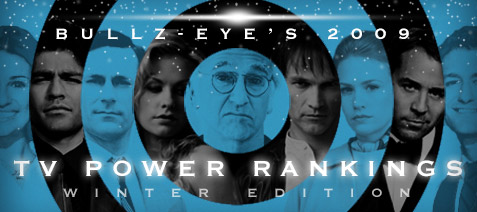
Ever since the writers’ strike, the television industry has been in a state of flux. Most networks still can’t figure out what works from what doesn’t, while the current economic climate has forced others to simply give up. Whether or not “The Jay Leno Show” is a success for NBC is debatable, but by surrendering the 10 p.m. time slot, they’ve greatly decreased their chances of bringing in new viewers. We would be exaggerating if we said the decision affected Bullz-Eye’s latest edition of the TV Power Rankings, but our Winter 2009 list does seem suspiciously familiar. Still, it isn’t without its surprises, as a longtime favorite returned from an extended hiatus to claim the top spot, while buzzworthy rookies like “Glee” and “FlashForward” also made impressive Top 10 debuts. At the end of the day, however, the real winner is HBO, who walked away with three of the four top spots, thus reestablishing themselves as the best network around.

A few examples from the piece:


5. Glee (Fox): There isn’t a show on this list that we love and hate with the same enthusiasm that we have for “Glee.” It contains some of the best-drawn characters in Fox’s history (aspiring diva Rachel Berry, adorable germaphobe Emma Pillsbury, cantankerous alpha female Sue Sylvester), and the iTunes chart-burning musical numbers, lip synching aside, are deliriously fun. Imagine, then, if they didn’t make these characters jump through such ridiculous hoops. Will’s wife is actually going to take her fake pregnancy to term? Emma agrees to marry Ken, but only as long as they never tell a soul? (Those plot threads brought to you by Bad Idea Jeans.) Yet for each blunder the show makes, they come up with something as brilliantly funny as Finn’s technique for not climaxing (he thinks about the time when he hit the mailman with his car), or the drama queen freak show that is Sandy Ryerson (a pitch-perfect Stephen Tobolowsky). Getting Josh Groban to do a cameo as a horndog version of himself, meanwhile – and hit on Will’s drunk mother – was a moment of “Arrested Development”-style genius. Yes, it’s made mistakes, but “Glee” gets a spot in our Top Five because no other show on TV sports dialogue like “mentally ill ginger pygmy with eyes like a bush baby.” But man, it would be a wonderful world if they did.David Medsker

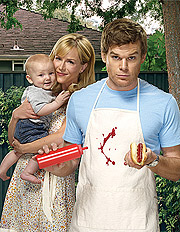
15. Dexter (Showtime): Like “The Sopranos,” Dexter always has a theme that is explored within a season as a backdrop to the episodic progression of the show. Last season, it examined friendship within the context of Dexter’s secret world, and Jimmy Smits was brilliant as his first and only pal. This year explores the facets of intimate relationships, and balancing work and the rest of your life as it relates to it. Dexter (played with brilliant sincerity and conviction by Michael C. Hall) is struggling to find balance between his work as a blood splatter analyst, a new dad of an infant, stepfather to his wife’s kids, and his hobby of killing and dismembering other bad guys, while his entertainingly foul-mouthed sister Deb implodes the most stable relationship of her life when she sleeps with returning lover and retired FBI agent Frank Lundy. John Lithgow is also scary good as the Trinity Killer, the latest object of Dexter’s attention. When Trinity kills Lundy and wounds Deb while making it look like another killer’s signature, Dex is commanded by the ghost of Harry to seek revenge, making this season as entertaining as any in the past – no easy feat considering how consistently good this show has been.R. David Smola

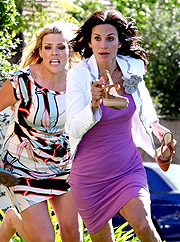
Honorable MentionCougar Town (ABC): Yeah, yeah, we know: the title’s a bit dodgy. But Bill Lawrence, who co-created the show with Kevin Biegel, has said, “The roll of the dice I’ve made is that the title is noisy and that people will be aware of this show.” True enough, though the fact that the series stars Courtney Cox would’ve probably done a pretty decent job of putting it on people’s radar, anyway. The pilot alone was strong enough to suggest that “Cougar Town” could prove to be the perfect series for female viewers who’ve outgrown “Sex and the City,” but with enough of a dysfunctional family element to fit perfectly into the closing slot in ABC’s new Wednesday night comedy line-up. Although the show continues to hone its comedic formula, the trio of Cox, Christa Miller and Busy Philipps clicked immediately (particularly the latter two, with their characters’ diametrically opposed personalities), and the relationship between the teenaged Travis and his man-child of a father rings true with its blend of unconditional love and complete embarrassment. Now that Jules’s fling with Josh is over, however, we’re curious to see who’ll be next on her slate to date — and how long this one will last.Will Harris

Returning in 2010Lost (ABC): Here we are, folks. After five seasons of confusing viewers with one of the most elaborate mythologies on television, “Lost” is finally in the home stretch. Want to know what the heck that smoke monster really is? How about the weird statue? Heck, what about the Dharma Initiative itself? All will supposedly be revealed in the sixth and final season of one of the smartest, most fearless shows network television has ever bothered to offer. Of course, this being “Lost,” we still have something to bitch about – namely, that the goddamn Olympics will interrupt the show’s final 18 episodes – but if we’ve waited this long to determine the ultimate fate of our favorite island castaways, what’s a few weeks of curling and cross-country skiing? We’ve all had our issues with the way “Lost” has unfolded over the years, and the show isn’t the phenomenon it was in its first couple of seasons. To cop one of the fall’s most popular phrases, though, this is it – and if there’s ever been a serialized drama with the guts to stick the landing and make its finale truly count, we’re betting it’s “Lost.”Jeff Giles

Check out Bullz-Eye’s TV Power Rankings in their entirety by clicking here or on the big-arse graphic you see before you. Also, be sure to check out the accompanying interviews with folks associated with the various shows, including David Goyer (“FlashForward”), Kurt Sutter (“Sons of Anarchy”), Jonathan Ames (“Bored to Death”), and Bryan Cranston (“Breaking Bad”).

Did any of your favorite shows miss the cut? Let us know by replying below!

Mouse reshuffles, Leo the lion on the block, and other tales

* In the real world Obama appears to be rethinking Afghanistan; in the cable TV world Lou Dobbs is relieving CNN of his xenophobia and is threatening to go into politics while The Onion has the real scoop. Meanwhile in the movie world, Disney’s new chairman, Rich Ross, is reorganizing. It sounds as if technology will be leading the way in the new regime. Also, the structure of the organization will resemble more a television network, we’re told, than a movie studio. Once upon a time that might have worried me, but these days TV is hardly any worse than movies. I’m not sure if that’s good news about TV or bad news about movies. (A little of both?)

* The lion of Hollywood has been a bit mangy for a long time now. Peter Bart reports that MGM is about to be sold and the whole thing, 4,000 titles and all, is worth about $1.5 billion, which would be a lot of money to you and me but to a once mighty film studio sure sounds paltray. One factor, even the older titles in the library ain’t what they used to be, either. The studio’s signature titles: “The Wizard of Oz,” “Gone With the Wind,” and “Singin’ in the Rain” are now available on Warner Brother’s DVD along with a good chunk of their best known classics.  The ghosts of Culver City’s glory days are restless tonight.

6a00d8341c630a53ef00e552b209198834-800wi

* Apparently being a movie critic these days is such an unstable, lousy position that some of the best known reviewers are jumping ship and becoming film festival programmers. Yesterday, it was Newsweek’s David Ansen. Today, it’s the L.A. Weekly/Village Voice’s Scott Foundas. Anne Thompson has the depressing news that might nevertheless be creating more opportunities for some of the better known online folks.

* The fruits of my compatriot Will Harris’s London sojourn are appearing in the form of some extremely worth-your-time interviews. First with writer/director Richard Curtis of the criticially underrated “Love, Actually” and the soon to be released “Pirate Radio.” Also roly-poly movie superstud and general all around good guy Nick Frost of “Shaun of the Dead,” etc., as well as “Pirate” newcomers Tom Sturridge and Talulah Riley gets the Harris treatment as well. Bob says collect ’em all.

Continue reading »

« Older posts Newer posts »

© 2026 Premium Hollywood

Theme by Anders NorenUp ↑