Category: TV Dramas (Page 52 of 235)

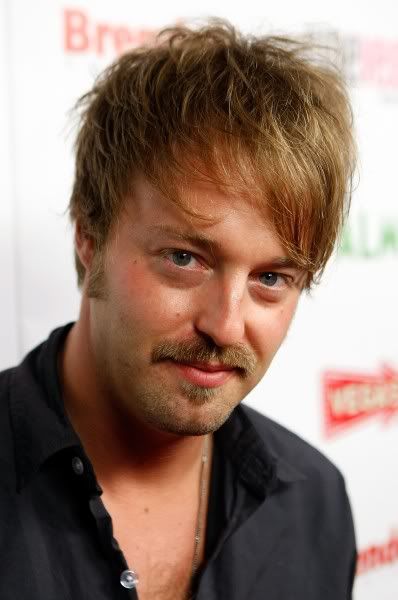
A chat with Joshua Leonard of “Humpday”

Joshua LeonardWhen you’re dealing with the press, what topic could possibly overshadow your new, Indie Spirit award-nominated and generally very well received comedy about two more or less ordinary straight dudes who decide to make a porno of themselves having sex…with each other? Well, “Humpday” star Joshua Leonard has had to deal with one of those “be careful what you wish you” show business situations in that the second film he was in about ten years back was an enormously profitable, zero-budget worldwide hit and horror pop-culture phenomenon – one that happens to be referenced in nearly every review of a certain recent zero-budget DIY horror hit.

Still, as one of the three actors/cum camera people/cum screenwriters who endured a deliberately scary and uncomfortable shoot in “The Blair Witch Project,” Leonard has leveraged his decade old flavor-of-the-month status into a solid career as a working actor with scores of credits ranging from the HBO movie “Live from Baghdad” to recent episodes of the new TV series, “Hung,” also on HBO. He’s also become a director. “Beautiful Losers,” a documentary he co-directed, is just hitting home video after a run on the festival circuit, and he recently completed shooting his dramatic feature debut as a writer-director, “The Lie.”

Still, he’s clearly very proud of his involvement in writer-director Lynn Shelton’s “Humpday” alongside costar and previously interviewed fellow film-maker Mark Duplass – now a very close real-life buddy — and happy to have contributed to a new tightly-plotted but improvised movie where there was absolutely no attempt made to convince the world he was dead. His portrayal of Andrew – puppyish Peter Pan, would-be artiste and compulsive traveler/bohemian – remains the extremely funny heart of the film. He’s also, I was happy to find, a really fun guy to talk to. He’s obviously a lot more smarter and 10,000 times more mature than his movie alter-ego, but he’s every bit as easy to hang out with – even on a twenty-minute phone call set up by a publicist.

PH: I don’t always say this, but I really did like “Humpday.” I thought you guys were great.

JL: Thanks, man. What have you hated recently?

PH: [Laughs] I’m a critic, we could blow out entire time talking about that.

JL: [Laughs] That’s what I want to know.

PH: Fortunately, nothing of yours. Okay, so I’m going to ask everyone I talk to on the movie this question….

Just before I saw the movie at the L.A. Film Festival, I had reviewed the DVD for “The Odd Couple.” It was kind of interesting because it was sort of two of the poles of the male bonding thing and of course the whole idea of “bromance” has been  out now. I was just wondering how you thought “Humpday” fit in with all these movies that have been out there on this general topic.

Continue reading »

TV of the 2000s: 5 British Series That Didn’t Translate Nearly As Well As “The Office”

In “Star Trek II: The Wrath of Khan,” Spock casually observed, “As a matter of cosmic history, it has always been easier to destroy than create.” As such, it should come as no surprise that, when the networks have the opportunity to avoid creating something new in favor of destroying something old, they damned well take it. As we continue our look back at the TV of the 2000s, we decided to revisit several of the networks’ attempts to adapt popular British series to match American sensibilities. As “The Office” has proven, they can sometimes make it work, but as these five shows remind us, they very often can’t.

5. Eleventh Hour (CBS): In 2006, ITV broadcast a four-part series entitled “Eleventh Hour,” starring Patrick Stewart as Professor Ian Hood, a special advisor of the British government’s Joint Science Committee who investigated threats related to various scientific developments and experiments. Each episode was 90 minutes in length, and it was received well enough in the UK that CBS immediately set forth on a quest to develop the concept into a weekly series in the States. Stewart was switched out for another talented Brit – Rufus Sewell – and even though he dropped his accent in favor of going “American” with his character (now renamed Jacob Hood), we were still optimistic about the series. Alas, despite an intriguing premise, the adaptation suffered from a couple of major problems.

First off, critics perceived the show as “troubled” before its premiere because of the delay in releasing the first episode for review, but, fair enough, many series have managed to survive that particular issue. The bigger problem came from CBS’s steadfast determination to make “Eleventh Hour” fit into the same procedural mold utilized by all of its other series. As such, the predominant thrust tended to be about the crime of the week, leaving not nearly enough focus on Dr. Hood, whose considerable knowledge on scientific matters makes him an enigma. Viewers should’ve been left wondering, “Who is this guy? What’s his story?” But just as we were starting to learn about Hood’s past and getting the impression that he might actually be able to find romance for the first time since the death of his wife, the series steered back into a let’s-stick-to-the-case mindset, making its cancellation after only 18 episodes less disappointing than it might otherwise have been.

4. Worst Week (CBS): The original series – which bore the slightly longer title of “The Worst Week of My Life” – had three incarnations. The first focused on the week leading up to the marriage of its two lead characters, the second shone the spotlight on the week before the birth of their first child, and the whole thing culminated in a three-part holiday special entitled “The Worst Christmas of My Life.” Anyone who enjoys a good bit of slapstick would see the merit in trying to adapt the series for an American audience, but after watching the pilot, I wrote, “Despite the first episode being thoroughly hilarious, it’s hard to imagine how they’re going to keep up that kind of momentum on a weekly basis.” What I didn’t write – but what I did indeed wonder – was why, given how much testing goes into television nowadays, they didn’t change the title. I mean, c’mon, if you watched the show, then don’t tell me you didn’t find yourself wondering from Episode #1 just how long they were planning to drag things out. In the end, “Worst Week” ran for 16 episodes, and given that its final episode* was entitled “The Epidural,” it’s clear that the series never had a chance to expand much beyond its source material. Not that they could’ve managed it much faster: getting from premiere to bringing the pregnancy to fruition within five months is certainly nothing to sneeze at. Still, with all British-adapted series, the rule of thumb is that you should create your own identity as quickly as possible…and they didn’t.

* As far as the show’s chronology is concerned, anyway. The actual final episode was entitled “The Party,” and it should’ve actually been the fifth episode. Instead, it was held back from the initial run and was later (and somewhat inexplicably) thrown into the network’s Saturday night schedule some four months after “The Epidiural” aired.

Continue reading »

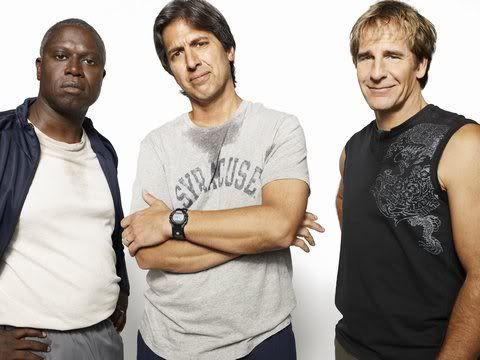
Greetings to the New Show: “Men of a Certain Age”

As I settled in to watch TNT’s new series, “Men of a Certain Age,” starring Ray Romano, Andre Braugher, and Scott Bakula, I was struck by a thought: when’s the last time TV offered us an hour-long about guys that was just about guys? The last one that leaps immediately to my mind is ABC’s “Big Shots,” which came and went within the span of a few months in the fall of 2007, but that series springboarded off the premise that all four guys were CEOs. Not bad a concept, perhaps, but by upping the income bracket of the characters, you’re significantly cutting into the number of people who can relate to it. How about a series that’s just about average guys doing average guy things? When was the last time we got one of those?

Beats me, but we’ve got one now…and it’s good.

The press release for “Men of a Certain Age” kicks off with the classic John Lennon lyric, “Life is what happens when you’re busy making other plans,” and although it’s been quoted plenty of times, it’s decidedly apropos for this series, which explores the lives of three guys in their 40s – one single, one married, one separated and likely headed for divorce – as they begin to examine who they are, how they got where they are, how the future looks, and what they can do to change it. If the acknowledgment that there are indeed things in their lives that need changing sounds like a spoiler, think about your own life and consider whether or not there’s anything you might like to change about. If there isn’t, then I envy you, but I can’t say the same, and I seriously doubt if I know anyone who can. At the very least, none of these men of a certain age can’t.

Continue reading »

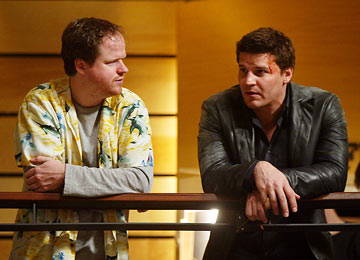
TV in the 2000s: The Decade in Whedonism – 10 Small Screen Masterpieces from Joss Whedon

Like an awful lot of film and TV geeks, and just plain geeks, I’m a pretty big Joss Whedon fan. In fact, my devotion to his unique blend of fantasy and science fiction melodrama, sometimes arch old-school movie-style witty dialogue blended with Marvel comics repartee, strong characterization, and often somewhat silly plots has at times gotten almost embarrassing. A few years back some of my very adult friends were suggesting in concerned tones that I should really marry the man if I love him so much.

JossWhedonPaleyAxe_1211932727-000

More recently, I thought my fandom was under relative control. But now, I’ve been asked my opinion on the ten best examples of small-screen work in this decade from the creator and guiding force of “Angel,” “Firefly,” the already canceled “Dollhouse,” and, of course, “Buffy, the Vampire Slayer.” I only have to be thankful for the fact that first four seasons of “Buffy,” which contain most of that show’s greatest episodes, are disqualified because they appeared on TV sets before 2000. We take our mercies where we find them. (And, yes, if you’re about to catch up with these on DVD, there are a fair number of spoilers below for the various series, though I’ve tried to keep a few secrets.) One word of warning: my relative ranking of these shows is a matter of mood and borders on the random. In other words — don’t hold me to these choices!

Out of competition:

The Body” (“Buffy, the Vampire Slayer”) – This episode usually ranks extremely high when people make these kind of lists. Entertainment Weekly named it as pretty much the best thing Joss Whedon has ever done and maybe the best TV thing ever. The truth of the matter is that, yes, the episode where Buffy Summers (Sarah Michelle Geller) discovers the already cold body of her mother, Joyce (Kristine Sutherland, a wonderful asset to the show for the five previous years), dead from an entirely natural brain tumor, was probably one of the most remarkable episodes of television ever shown, and probably the only thing I’ve seen that comes close to capturing the essence of what it feels like when someone dies unexpectedly. The problem was, I didn’t find it depressing; I found it real. I didn’t feel any more like repeating the experience than I would the death of an actual loved one.

Whedon – who wrote and directed the episode himself – deserves all the credit in the world for the brave choices he made, including shooting the episode in close to “real time” and not using any music. If I have one complaint with , it’s his tendency to close emotional episodes with, dare I say it, somewhat drippy montages. His choice to eliminate music from the kind of “very special” show where other creators would lay in with three or four montages of Joyce frolicking in the woods or what have you, shows Whedon is, at heart, an outstanding filmmaker. I’ve never had a problem with his much-noted tendency to kill off sympathetic and/or popular characters. It might anger some fans, but especially if you’re dealing with inherently violent material, there’s something morally wrong about not dealing with the fact that good people are just as mortal as bad people. Still, I don’t enjoy watching this episode. If this were a movie, maybe I’d be more in awe or eager for profundity. However, if I’m going to be honest, I can’t call “The Body” a favorite and I can’t be sure it’s one of the “best.”

#10, Shiny Happy People (“Angel”) – Fans of the spin-off about Buffy’s ex, the vampire-with-a-soul detective (David Boreanaz), and various assembled demon-hunters and occasionally friendly demons, will be scratching their heads at this choice. It’s an unpopular episode from a widely and justly derided storyline involving a very weird affair between Angel’s unbalanced super-powered teenage son from another dimension, Connor (Vincent Kartheiser, now of “Mad Men“), and a suddenly evil Cordelia (Charisma Carpenter), a former high school mean girl turned lovably complex grown-up foil for her vampire boss. And, yeah, it was a little freaky for Cordy to give birth to a fully grown creature called Jasmine.

0000001044_20060919141143

However, as played by the wondrous Gina Torres of the then recently-canceled “Firefly,” Jasmine was freaky in a good way. A being whose god-like ability to create an instant sense of peace, happiness, and complete obedience, is somewhat set off by the fact that she’s actually a deformed and decaying, if not entirely evil, monster who must consume people to live, she was every charismatic leader and every great screen beauty rolled into one monstrous ball. More than anything else, “Shiny Happy People” reminded me of Don Siegel’s 1956 film verson of “Invasion of the Body Snatchers.” It was another believable demonstration of how we humans are only too willing to surrender our our humanity to the first apparently completely beauteous and 100% wise being who comes along. You know, like Oprah, only less powerful.

Continue reading »

TV in the 2000s: The Shows that Defined the Decade

A recent issue of Time magazine has the phrase “The Decade from Hell” emblazoned across its front cover. It’s referring to everything America has gone through in the past ten years, and it’s difficult to argue such an assertion: it’s been a shitty decade on a national level. During such times of stress, people inevitably turn to entertainment as a form of release, and although the methods in which we’ve distracted ourselves over the last ten years have unquestionably diversified, television remains the most easily accessible outlet for most Americans.

Within the format itself, the whole concept of reality TV must surely have been the biggest revolution of the decade. It’s really easy to bag on reality TV – mostly because the bulk of it is so damned unreal – but anybody who spends any time in front of the tube has surely had at least a couple of reality series they consider appointment TV. The two concepts that paved the way for everything else are undoubtedly “Survivor” and “American Idol.” The former, of course, opened the floodgates for the genre, and while it’s seen a considerable dip in the ratings department over the years, 12 million viewers isn’t a viewing figure to sneeze at. The latter, despite all the bitching and moaning and cries of “it’s not as good as it used to be” that accompany each new season, remains one of the most watched shows on the tube, likely due to the fact that it’s strictly a talent competition.

On “American Idol,” the only backstabbers are the judges, and since they aren’t part of the competition, their amusing duplicity is championed. The contestants, on the other hand, are innocents, and once the competition is underway, we’re given no peek into any possible backstage drama, which is a good thing, because by the time the audition rounds are over, we’ve had enough drama to last the whole season. Everything that comes after is all about who can best transfix us for three minutes a week via one pop ditty. It actually says something positive about the U.S. that “American Idol” remains our #1 form of reality entertainment, even if the actual reality is that the vast majority of Americans couldn’t care less about buying the winner’s album six months after they’re crowned.

You might think reality TV is a bunch of crap, and in most cases you’d be right, but the whole idea of it, to my mind, led to an important revolution, and that is serialized nighttime television (the classic “soap” formula notwithstanding). Reality shows taught viewers how to become invested in characters, how to be concerned for their eventual fate, and, most importantly, how to pay attention to an ongoing storyline, and the need to tune in every week. It didn’t take long for the networks to figure out that there was an audience for shows that didn’t continually hit the reset button. “24” must have been the first successful show of the decade to embrace the serial formula, and it embraced it whole hog. It required you to tune in for every episode, because each installment was another hour of a single day in the life of Kiefer Sutherland’s Jack Bauer. That “24” premiered less than two months after the terrorist attacks on 9/11 was pure happenstance. That it became enormously popular with viewers? Probably not so much. America needed some fictitious reassurance that there were folks on the job who could get shit done, and “24” filled the prescription.

Strangely, “24” didn’t open the network floodgates for more such programming right away. It took a few years, and then “Lost” made its mark. The number of “Lost” episodes I’ve seen could be counted on two hands, but that’s not because I didn’t like it, but because real life got in the way of it being appointment TV. Yet I viewed the pilot for “Lost” several months before its 2004 premiere, and when it ended I was convinced that I’d seen the second best TV pilot ever made. (“Twin Peaks” stills sits at #1.) The fact that a show as intricate as “Lost” still has a hardcore, central audience is perhaps a testament to that pilot. “24” started a new story with each new season; “Lost” required that you tune in for every episode of every season.

Another sci-fi series that did just that was “Battlestar Galactica,” a show that, due it being on a niche network (Syfy), never amassed a huge audience yet snagged boatloads of publicity and awareness nonetheless. It was no small feat to take an utterly laughable short-lived series from the late ‘70s and re-envision it for modern audiences, but Ron Moore and company did just that…and they did it far more successfully that anyone ever guessed possible. Most amazingly, the show taught us a lot about ourselves, by thoroughly defining what it means to be human, and as the damaged ‘00s dragged on, there may not have been a more important lesson to be learned.

On the same day I saw the “Lost” pilot, I saw another pilot for a completely different kind of series. While I didn’t rank it as one of the greats, there was one thing I was sure of: it would be a massive hit…and it was. “Desperate Housewives” was precisely the sort of vapid, soapy fare that had been absent for far too long on American TV. It clued into the seemingly bland suburban construct which surrounds so many Americans, via the Lynchian notion that “all is not what it seems.” Most anyone who lives a suburban life can no doubt relate to that idea, because wherever there are groups of people, there are bound to be some of them that are fucked up. “Housewives” is littered with fucked up suburbanites of all shapes, sizes and types, but they’re kooky and funny and there’s always some twinkly music playing in the background that in the end makes everything OK. It is not great television, but over the years it has, for the most part, been immensely watchable in the most disposable sort of way.

Around the same time period as “Housewives,” “Grey’s Anatomy,” made some major waves. It’s a series I have never watched and never plan to, but I’d be foolish to omit it from discussion since it brought two annoyingly obnoxious terms to the TV table: McDreamy and McSteamy. I haven’t heard either in a few years, but there was a time when they seemed to define everything that was wrong with television. I assume “Grey’s” fans have grown out of it…or maybe the show killed one of those guys off? I’ve no idea and can’t be motivated to investigate. Presently, there’s a brand new version of it going around, through cinema, via Camp Edward and Camp Nimrod. People can be so easily distracted it makes you wonder why some shows actually try harder.

Continue reading »
« Older posts Newer posts »

© 2026 Premium Hollywood

Theme by Anders NorenUp ↑