Month: June 2010 (Page 3 of 17)

True Blood 3.3 – Lie Back, Sweetheart, And Think Of Estonia

I feel obliged to open this week’s blog by asking a question that’s been gnawing at me for the past two weeks: am I the only one who isn’t really caught up in Season 3 of “True Blood” in the same way as Season 2? At first, I blamed it on the fact that I was coming off the ridiculously-real feel of “Breaking Bad” and hadn’t yet re-acclimated myself to the town of Bon Temps, then I considered the possibility that it’s because no one thus far in Season 3 has really grabbed me the way Maryann the Maenad did when she first made the scene, but now I’m just wondering if it’s because the pop culture landscape is so riddled with vampires that I’m starting to feel the overkill. I’ll give the show credit this week for a consistently enjoyable episode, but I wish it hadn’t opened and closed with scenes that were so thoroughly disconcerting that they couldn’t help but leave a significant impact: to leave me thinking, “That’s not awesome. That’s just disgusting.”
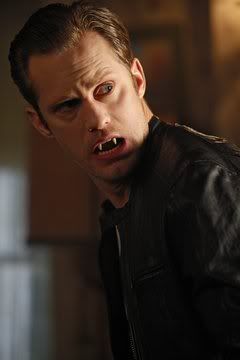
As for the opening, I obviously heard the gun go off at the tail end of last week’s episode, but I didn’t really think much about what the end result would be, as I was focused more on what Eric was about to do. As such, I certainly didn’t expect the end result to be Eric leaping in front of the bullet so that the werewolf would survive at least long enough for him to interrogate him for a bit. It was good to hear Sookie using her powers again, and the back-and-forth between the werewolf and Eric made me laugh, even if it was a predictable exchange (“You might as well go ahead and kill me now.” “As you wish.”), but you’ll forgive me, I hope, for my feelings on the throat-ripping scene, which was so gross as to deflate what otherwise would’ve been a smirk-worth comment from Eric: “Got your rug all well.” The duo quickly dispose of the corpse, with Eric acting surprisingly worried about the threat of werewolves. In addition to his not-very-couched hint about his feelings toward Sookie (“I don’t expect you to understand.” “I understand very well.”), I also thought it was interesting the way Eric recognized the werewolf’s accent. Who knew that vampires had an ear for such things?

The storyline within the King’s palace in Mississippi wasn’t nearly as interesting as the trip it served to take us on, but it was amusing to see His Majesty mock his “associate” and his tendency to overemphasize the importance of their nice things. The conversation between the King and Bill was somewhat educational, with the former asking Bill vampire to vampire about his feelings toward Sookie, basically saying that it wouldn’t be such a bad thing if Bill were to turn her. Bill’s not having any of that, though, and the next thing you know, he’s on a trip down memory lane, recalling the awful experience that he was forced to endure as a result of being turned by Lorena. Revisiting his first post-turning encounter with his family, having to look upon the body of his dead son and suffer through the emotional torture of his wife’s reaction to his vampirism…you wouldn’t wish that on anybody. And then for Lorena to tell him that he’d be doing Carolina a favor by basically wiping her memory? Rough stuff, to be sure. You can see why Bill pledged dedication to Mississippi, but you know Sookie’s going to have something to say about it.
Continue reading »

Stanley Kubrick vs. Martin Scorsese — it’s a bloody battle

This hypnotic video mash-up of the two titans of the last cinematic half-century reminds us that the art thing can be a bloody business and it’s probably best not to watch this in front of the kids or your vegan coworkers. I’ve seen almost all of these movies, most of them more than once or several times, and it even surprised me how vicious some of those moments can be. They can be pretty beautiful, of course. There’s also a spoiler for “The Departed” lurking in there for those who haven’t seen it yet.

As to who “wins,” that’s clearly not the intention of Leandro Copperfield (if that really is his name). It’s like a battle between fire and ice; which would win that battle?

Kubrick vs Scorsese from Leandro Copperfield on Vimeo.

H/t…actually, I lost my link with where I first saw this. It’s been making the blogs for several days now.

Hey, I’m back, sort of, with weekend box office results

I’m still keeping busy and enjoying the tail end of the Los Angeles Film Festival, which wraps in just a couple of hours, but I thought I’d see how quickly I can give you all at least some of this weekend’s genuinely fascinating box office results as gleaned from both Anne Thompson and Nikki Finke.

Toy Story 3

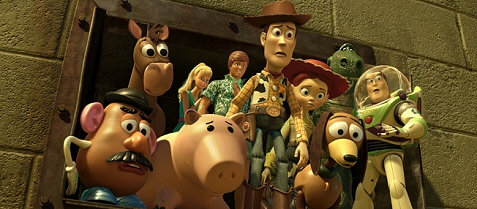
Well, it shouldn’t surprise anyone that the Pixar formula — i.e., dollops of laughter and heart (what a concept!) and now a dash of 3-D ticket prices — has once again worked wonders and “Toy Story 3” took on all comers, earning an estimated $59 million for Disney in its second weekend. Meanwhile, it was also a good weekend for the eternal appeal of low humor and, it seems Adam Sandler, at least when accompanied by four other comic known quantities of varying degrees of box office hotness. It was clear that the scatological-joke loving masses were only encouraged by, I’m guessing, entirely correct godawful reviews of Sony’s “Grown-Ups.”

Perhaps also reflecting a dearth of comedy right now, the film actually was a personal box office best — not adjusted for inflation — for Sandler, earning $41 million. Personally, though I like him in actual quality films like the, I think, severely underrated “Funny People” and the brilliant “Punch Drunk Love,” I’ve never gotten the comic appeal of Sandler, going back to his SNL days, and can’t even remember gong through a phase where I found farts inherently hysterical, so I can only throw up my hands here.

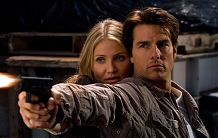
Tom Cruise and Cameron Diaz in
On the other hand, there is little joy in the five or six buildings the Church of Scientology owns on Hollywood Blvd, as the Tom Cruise (and Cameron Diaz) action comedy vehicle, “Knight and Day” earned an estimated $27.7 million. Not bad, actually, except considering Cruise’s far better past performances back in the day when stars like him could routinely “open” a film and, according to Finke, the budget for the film was either roughly $117 or $107 million, depending on whether you calculate tax breaks. In other words, Cruise’s thetans might take longer to clear.

In other news, I’m happy to say, that things are hopping on the indie scene. The new wartime documentary “Restrepo” and the Duplass Brother’s enjoyable entry into the semi-mainstream, “Cyrus,” are both doing quite well, as are other newish films.

On the other hand, the controversially violent “The Killer Inside Me” appears to be suffering, perhaps, from an older indie audience that might be turned off by the fuss, which some say has been exaggerated to a certain degree and appears to have surprised its skilled, if highly uneven, director Michael Winterbottom. Interesting how an adaptation of a once obscure fifty-eight year old pulp novel can still raise hackles. Also shows that while a perception of too-little blood and guts can harm a horror film, a perception of too much can perhaps harm even a “hard R” thriller/drama. Advice to the suits: know your audience.

As usual, Indiewire has the indie scoop.

Doctor Who 5.10 – Vincent and the Doctor

If somebody asked me to make a short list of my favorite writers and/or directors working today, Richard Curtis isn’t the first person who’d leap to mind. He might not even be the fifth. Despite that, I count myself as a big, big fan of his stuff, going all the way back to “Blackadder,” and right up to his most recent work, “Pirate Radio,” a movie which didn’t do well at the box office and got some fairly tepid reviews upon release. Like Curtis’s “Love Actually” before it, I suspect “Pirate Radio” (or “The Boat That Rocked,” for those of you in the U.K.) will go on to become a favorite of many, many people, because it’s an utterly charming, daffy piece of cinema that doesn’t want to do much more than entertain the hell out of you for a couple hours. And that it does. When it was announced that Curtis would be writing an episode for this season of “Doctor Who,” naturally I was interested in the prospect, but if I’m being totally honest, I didn’t expect all that much from it, and even less so once it came out that it would be about Vincent van Gogh.

For starters, Curtis has no track record writing science-fiction or fantasy (at least not the type one thinks of when bandying about such terms), and while it seemed gratifying to have such a high profile writer onboard, nothing in his works indicated that, with only 45 minutes to play, he’d likely create anything more than an amusing romp. Perhaps it was less Curtis himself, and more the new series having a pretty bad track record when it comes to tackling historical figures, regardless of who’s writing them. In fact, they typically seem to end up…amusing romps. Probably the best was the first one, “The Unquiet Dead,” which featured Charles Dickens, and from there they’ve kind of incrementally gone downhill. I didn’t think the formula could get much worse than “The Unicorn and the Wasp” with Agatha Christie, but along came “Victory of the Daleks” with Winston Churchill to prove me wrong. So imagine my surprise upon discovering that Curtis trashed my expectations by creating a deep, lovely, tortured thing of beauty that reduced me to tears. I have really got to start trusting this guy. His name is a stamp of quality no matter what “they” say.

(Editor’s note: I’ll second that, having interviewed Mr. Curtis in connection with the release of “Pirate Radio.” You can check out the conversation by clicking here.)

“Vincent and the Doctor” is the new standard by which these types of stories will, or at least should be measured. I have never quite understood the point of the Doctor meeting up with famous figures from the past only so that we can laugh at them and their quaint, backwards ways, all while cramming in little in-jokes that play off of what we know about these people from today’s perspective. Curtis presents us with a fictitious riff on van Gogh that lays waste to the previous approach. His story demands that we feel for van Gogh and his problems, which in turn gives the episode a gravitas that’s lacking in stuff like “The Shakespeare Code,” in which young Will was little more than a smarmy Casanova. Curtis comes from a place that has a huge amount of respect for this artist, as well as understanding that van Gogh’s troubled history was a big part of what made him the artist he was. Curtis also wisely avoids tackling the infamous ear-cutting incident, which is something a lesser writer would’ve worked into the story by having the alien lob it off or some such nonsense.

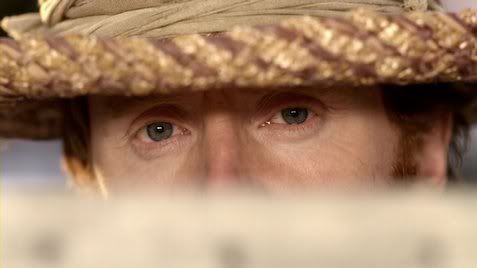
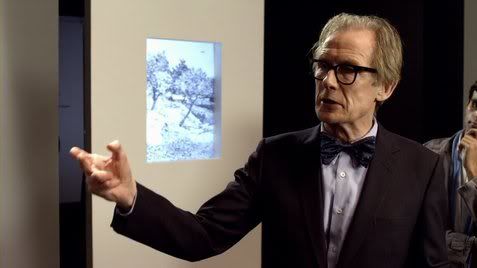
From the very first sequence, the reality of van Gogh (Tony Curran) painting “Wheatfield with Crows” is mixed with the fantastical element of the unknown in the field, disturbing the birds, and thus giving a reason for the crows in the painting in the first place. Quickly the action moves to the present at the Musée d’Orsay in Paris, and before you can say Bill Nighy, there he is, as Dr. Black. At first it seems a somewhat wasted cameo, but lucky for us Nighy returns before the episode is over. The Doctor has taken Amy to see the van Gogh exhibit at the museum. It seems he’s taken her numerous places since their last adventure, and he’s got a guilty conscience about the loss of Rory, who of course Amy no longer even remembers. The painting “The Church at Auvers” catches the Doctor’s eye, as there’s something in one of the church windows that he recognizes as “evil.” And so it’s off to 1890 to get to the bottom of it all.

Continue reading »

Red Carpet Chatter: Mike Nichols Gets His AFI Lifetime Achievement Award

nicholsenhance

Born in 1931 in what was very soon to become Hitler’s Germany, young Michael Peschkowsky was living in Manhattan by 1939. It was great luck both for the future Mike Nichols and for the country that accepted him.

Nichols is, of course, one of the most respected directors in Hollywood, and for good reason. He’s the original, craftsmanlike, and emotionally astute directorial voice responsible for such sixties and seventies classics as “Who’s Afraid of Virginia Woolf?,”  “Carnal Knowledge” and, of course, “The Graduate” (the source of his only directorial Oscar so far) as well as such eighties, nineties, and oughts successes as “Silkwood,” “Working Girl,” “The Birdcage,” and “Closer.” Even if some of the later films are not on the same level of quality as his earlier films — and several, especially his 1988 box office hit, “Working Girl,” stray into mediocrity — it’s still one of the most impressive and diverse careers of any living director in Hollywood.

That’s just on the big screen. On television, Nichols has rebounded in the eyes of many critics, directing two of the most acclaimed television productions of the last decade, 2001’s “Wit” with Emma Thompson, and the outstanding 2005 miniseries adaptation of Tony Kushner’s brilliant and mammoth epic play, “Angels in America.” With his 80th birthday just a year and a half away, he’s still working hard with two thrillers movies planned, including an I’ll-believe-it-when-I-see-it remake of Akira Kurosawa’s “High and Low” currently being rewritten by the decidedly counter-intuitive choice of Chris Rock.

Before he directed his first foot of film, Mike Nichols was a noted theater director. That in itself is not so unusual a root for directors to travel. What is different is that, before he was a noted theater director, he was half of one of the most influential comedy teams in show business history, Nichols and May. (His comedy partner, Elaine May, went on to become an important, if less commercially successful, writer and director in her own right.)

Still, from the moment he directed his first major play, Neil Simon’s “Barefoot in the Park,” Nichols mostly abandoned performing. Today, his highly regarded early work is mostly known only to fairly hardcore comedy aficionados.

elaine-may-006-500x375

Continue reading »

« Older posts Newer posts »

© 2023 Premium Hollywood

Theme by Anders NorenUp ↑