Category: Interviews (Page 11 of 69)

A Chat with Bill Rebane (“Monster A Go-Go”)

Although the competition for the honor of being declared “The Worst Movie Ever Made” is one of the strongest in all of popular culture, there are some titles which continue to come up again and again. “Monster A Go-Go” is one of them…and, unlike “Plan 9 from Outer Space,” it’s a film so bad that even the man who directed it is willing to concede that it deserves to take home the win. Premium Hollywood had the opportunity to chat with Bill Rebane, who helmed “Monster A Go-Go,” upon the release of a special edition DVD, and even though 45 years have passed since the film’s original release, he still stands by his position on the matter.

Bill Rebane: Hello, Mr. Harris! How are you?

Bullz-Eye: I’m good! How are you?

BR: Hanging in there!

BE: (Laughs) Same here! Well, it’s a pleasure to speak with you. I actually just finished watching the special edition of “Monster A Go-Go” this morning.

BR: Oh, I feel so sorry for you…
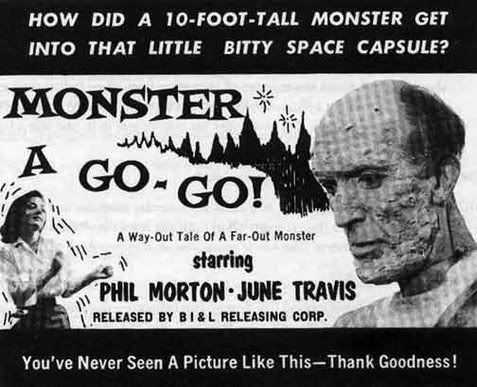
BE: (Laughs) Well, it’s funny: at first, I wasn’t sure how I was going to broach the subject of the film’s reputation, but throughout the special features, you pointedly say that it is the worst movie ever made.

BR: Well, that was my impression when I first saw it. Three years after I gave it to Herschel Lewis to finish, the first time I saw it, I said, “Oh, my God, this is the worst picture I’ve ever seen.” That’s not exactly what we had in mind when we started…

BE: So to jump to prior to “Monster A Go-Go,” how did you get into filmmaking in the first place? Were you a movie buff as a kid and worked your way into the business gradually?
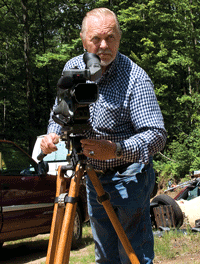
BR: Well, when I came to this country, I was obsessed with movies of that time, the old movies from Hollywood’s golden age, and I went to the theaters and spent maybe half a day…more than half a day…watching movies to learn English. I was a singer and dancer during that time. In fact, I actually started out wanting to make musicals. And then the occasion arose in Germany…I went back to Germany and worked with some filmmakers there, professionals, and learned a little bit, and came back to the States and started making short subjects.

BE: How did you make the move from short subjects to the feature-length?

BR: Well, it was timely. I was a realist. I was acutely aware of the marketplace, what was going, and it seemed very timely to do a science-fiction monster movie at that time for the drive-in theaters. We wrote a pretty cohesive script, a story-oriented project, and I dove into it. But I didn’t know that Chicago wouldn’t… (Hesitates) I made those short subjects with the union, and when they heard that I was making a feature film, they pretty much clamped down on me and said, “Yeah, you’re going to make it union, right?” I said, “Those were not my intentions.” And then they merrily went on to basically confiscate the whole budget, put it in Escrow, and they would take care of it. So we ended up with maybe two hours of good time of shooting, and the rest of it was spent on setting up heavy equipment. There wasn’t much of a break we got in those days. It’s not how independent pictures should be made to begin with. I lost the star, Peter Thompson, a week into production because of time constraints. And then I went on to a second part the same year, actually…1961, ’62…to do the rest of the picture with a non-union crew. And that’s how Herschel Lewis entered the picture. I hired him as a cameraman and a production manager, and we finished all the exteriors and everything that I thought we needed to do, except the actual final ending. We never got to that, which was about 10 minutes or 20 minutes of stuff, again running out of money. Herschel Lewis needed a picture for a double bill at drive-in theaters, and I turned the picture over to him for post-production, not knowing what he would do and what he could do. And about three years later, I looked at it. It was not the same title. It was now “Monster A Go-Go.” It had already run in some theaters in the South. And… (Starts to laugh) …I was more than surprised. I was a bit shocked. I said, “This has got to be the worst picture I’ve ever seen.”

Continue reading »

A chat with Gale Anne Hurd, producer of “The Walking Dead”

Gale Anne Hurd

There aren’t many producers around these days whose name can help sell a movie or TV show, but Gale Anne Hurd is the rare exception. Probably best known as one of the co-creators of “The Terminator” franchise, Hurd has been an important player in numerous mega- or merely major productions, including both “Hulk” and “The Incredible Hulk,” “The Abyss,” “Armageddon,” “The Punisher,” and the underrated 1999 comedy “Dick,” which starred Dan Hedaya as Richard Milhous Nixon and a young Kirsten Dunst and Michelle Williams as a couple of teenagers who wind up bringing down a presidency.

Clearly one of the more hands-on producers around, Hurd is pleasant and businesslike when talking to a member of the show-biz press, but clearly has the gumption to deal with the biggest and most difficult of personalities, which is how I segue into the obligatory mention of the fact that she spent the part of the late eighties and early nineties being married to first James Cameron and then Brian De Palma. Moreover, she began her career working for one the most fascinating and effective producers in the history of the medium, Roger Corman, but more of that in the interview.

Still, nothing she’s done is quite like her current project, the zombie horror drama and comic book adaptation, “The Walking Dead.” The AMC television series, adapted from a series of acclaimed comics by Robert Kirkman primarily by writer-director Frank Darabont (“The Shawshank Redemption,” “The Green Mile,” “The Mist”) is currently receiving maximum exposure on the web. The publicity train was only just getting started when I spoke to Ms. Hurd at a mammoth new San Diego hotel adjacent to the Comic-Con festivities last summer.

101_RT_PhotoSpread_BlackWomanZombie

I had typed my questions on my laptop, which I was afraid might be a little off-putting. So, after a quick greeting, I tried to explain why.

Continue reading »

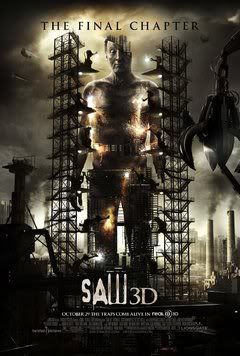
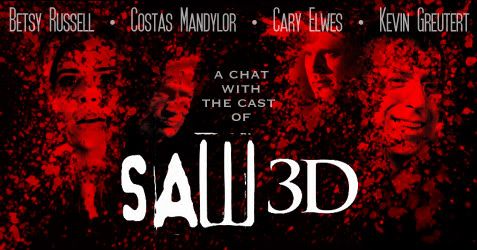
A Roundtable Chat with the Cast and Director of “Saw 3D”

In 2003, director James Wan and screenwriter Lee Whannell put together a short film featuring a man with a rusty metal “reverse beartrap” on his head and a creepy-looking puppet in hopes that someone would take a chance on this film script they’d written.

Someone did.

Eight years later, the “Saw” franchise is reportedly coming to a close, and although the history of the horror genre – specifically, the fourth “Friday the 13th” film – has taught us that no chapter is ever truly final, they’re at least trying to make us think they’re going out with a bang, eschewing a straightforward “Saw VII” and instead offering fans an additional dimension of gory fun with “Saw 3D.”

Although the studio is predictably taking a pass on providing press screenings for the film (since everyone knows it’s going to be critic-proof, anyway), director Kevin Greutert and a trio of actors from the cast – Cary Elwes, Costas Mandylor, and Betsy Russell – turned up at the New York Comic Con to do a series of roundtable interviews for members of the media.

The demand to chat with these folks were significant, as you might imagine, so in order to maximize our time while working with minimal space, both the interviewers and the interviewees were split into two groups, with the interviewees switching groups after 15 minutes.

First up, Costas Mandylor and Kevin Greutert…

Journalist: So there’s, like, a volcano eruption of 3D films out there now, with the whole “take that and run with it” Hollywood attitude. What sets this one apart from other 3D horror films?

Kevin Greutert: Well, for one thing, this film was actually shot in 3D. We didn’t do a post-conversion like a lot of the other movies that have come out lately. I think that shooting it in 3D makes all the difference in the world, so it just looks that much better. This was shot with state-of-the-art cameras that are a lot more lightweight than any previous 3D films, so we were able to preserve the “Saw” style of doing a lot of stuff handheld and keeping the camera moving around a lot and very dynamic. Because technology is advancing so quickly, we were able to just take advantage on all aspects.

Journalist: Has 3D changed the blocking of the set and what you’re actually doing in the film?

KG: Yeah, it affects the way we block the scene, because we want to maximize the feeling of depth in the image, even if it’s not an in-your-face moment where stuff’s flying into the camera. We still wanted it to look as rich and full of space as possible.

Journalist: At what point in the production process was the decision made that the film was going to be in 3D? Was that from the outset, or did that happen…

KG: It was decided…that was probably the very first decision made on the film, and I had actually hoped even before we made “Saw V” to direct “Saw VI” in 3D but wasn’t able to make that work. So by the time “Saw VII” came along, now there’s enough infrastructure in terms of theaters that are equipped with 3D equipment to go forward, and…yeah, no one ever thought twice about doing it in 3D.

Journalist: How does 3D enhance the storyline?

KG: Well, I don’t know how much it actually plays into the story. There’s a bit of self-reference in the opening scene of the movie, which is the first “Saw” scene that takes place in broad daylight, with a big crowd watching one of Jigsaw’s big contraptions at play. There’s, I think, a little bit of an implicit message about horror audiences watching voyeuristically. 3D, I think, just kind of takes that to another level.

Journalist: Costas, what keeps bringing you back to this franchise?

Costas Mandylor: You know what? In a way, luck. And the character seems to have worked. And, you know, when you collaborate with people like Kevin and a couple of the other guys before him, and you know what you’re doing together, it’s a comfortable situation where you don’t have to get really… (Hesitates) I mean, some guys in life are a pain in the ass, and they die. “Saw” does that really easy. I committed to it as best as I could, and spending time with Tobin (Bell) and seeing how committed he was to keeping a certain standard, not letting the fans down was really important to him, so it wasn’t just going to a gig, doing my thing, and leaving. I actually paid attention. There’s a great example of…when I first started, I think it was in “IV,” he had a great idea for a scene and he called me at, like, 11:30 at night. He goes… (Does a Tobin Bell growl) “Hey, Costas, are you awake?” Jigsaw’s calling me at midnight on the phone. I’m in trouble here. (Laughs) I went to see him…reluctantly…but we spent some time together, and the scene…that was a really long scene that we did, with the gun to the…? It just worked beautifully, because he put the effort in and forced me to be okay with putting in my ideas as well. So I’m still here ‘til the end of this one, and…we don’t even know the endings. But for now, I’m in.

KG: We have more control over Costas by not letting his character die. (Laughs) We hold that over his head every year.

Journalist: But that doesn’t keep Tobin from coming back!

KG: (Laughs) He has more screen time dead than he did alive!

Continue reading »

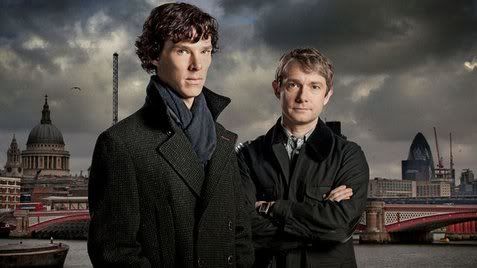
A Chat with Steven Moffat and Mark Gatiss (“Sherlock”)

The characters of Sherlock Holmes and his trusty associate Dr. John Watson have been interpreted every which way but loose since their original inception in 1887, courtesy of Arthur Conan Doyle, and with Guy Ritchie’s take on the Holmes mythos having only just hit theaters last year, it would seem to be a bit premature to put Baker Street’s most famous detective onto the small screen as well…but, then, “Sherlock” – premiering here in the States as part of PBS’s “Masterpiece” on Sunday, Oct. 24, bears precious little resemblance to Robert Downey, Jr.’s big-screen adventure. This is a modern-day look at the characters and their mythology, and for those who might be skeptical that they can successfully survive such a transformation, I believe you’ll be pleasantly surprised. I’ve only seen a portion of the first episode (“A Study in Pink”) thus far, but it was more than enough to sell me on tuning in on the 24th. Mind you, I also had the advantage of sitting down with the series’ executive producers, Steven Moffat and Mark Gattis, whose enthusiasm for the project proved decidedly contagious.

Bullz-Eye: Steven, you and I met in passing a few years ago at the “Jekyll” panel…a show which I loved, by the way…

Steven Moffat: Oh, thank you. Oh, good!

BE: …and, Mark, I didn’t realize it at the time, but I now know that you made an appearance in that series.

Mark Gatiss: That’s right!

BE: So, Steven, what do you enjoy about the challenge of contemporizing British icons? I mean, you can argue that Dr. Jekyll is an icon of sorts, but then you’ve got Doctor Who, and now Sherlock Holmes.

SM: Well, being honest, for me, there isn’t really…it looks like there’s a narrative through that, that I’m trolling for things, but I’m really, really not. “Jekyll” was a totally different experience to this, the one big difference being that it was a sequel set in the modern day. And, really, it looks as if I’ve just been doing that, but, really, seriously, it wasn’t that. This is a completely different experience, and the challenge of this…well, they’re just joys, aren’t they?

MG: It’s true, yeah.

SM: There are so many things that…well, once having started talking about this, we realized it was going to work, because he can still be coming home from Afghanistan, a flat share is what we now call sharing rooms, we’ve gone back to sending telegrams by sending texts…it’s just perfect.

Continue reading »

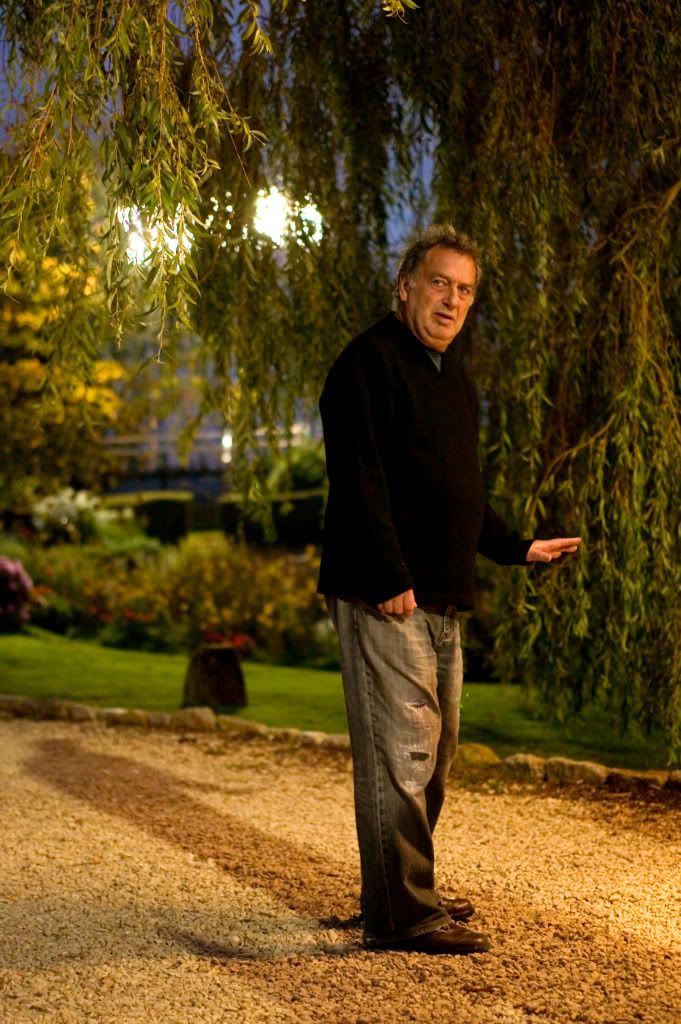
A roundtable chat with director Stephen Frears of “Tamara Drewe”

Stephen Frears on location for Anyone who thinks that the only interesting directors are the ones with obvious personal styles needs to take a long, hard long at the filmography of Stephen Frears. Something of a contemporary, English throwback to such versatile craftsmen of pre-auteur theory Hollywood as William Wyler, George Stevens, Robert Wise, and Michael Curtiz, the Cambridge-educated Frears began his career neck deep in the English New Wave cinema of the 1960s as an assistant director on Karel Riesz’s “Morgan!,” and Lindsay Anderson’s 1968 surreal youth revolt drama, “If…” Later moving on to directing for the BBC, his second theatrical feature, 1984’s “The Hit,” was mostly ignored despite an all-star cast, but did gain a cult following of which I am a proud member. Frears’ follow up collaboration with writer Hanif Kureishi, a then-bold cross-racial same-sex romance, “My Beautiful Laundrette,” co-starred a young Daniel Day Lewis and got more immediate results. It was a hit in arthouses on both sides of the Atlantic and helped make Lewis a star; it also paved the way for Frears’ smashing mainstream Hollywood debut, 1988’s Oscar-winning “Dangerous Liaisons.”

Since then, Frears has enjoyed success both here in the U.S. and at home in England with numerous BAFTAs and films as diverse as “High Fidelity” and “The Grifters” — for which he was nominated for an Oscar — as well as the ultra-English “The Queen” and “Mrs. Henderson Presents.” He’s dealt with modern-day cowboys (1998’s “The Hi-Lo Country”), English fascism (2000’s “Liam”), the monarchy (2006’s “The Queen”), and the illegal trade of human organs (2002’s “Dirty Pretty Things”). When George Clooney decided he wanted to try a live television remake of “Fail Safe” back in 2000, Frears handled the chore to no shortage of acclaim.

Frear’s latest, “Tamara Drewe,” has fared reasonably well with critics on the whole, though not so much with this particular longtime admirer. An adaptation of a graphic novel originally serialized in England’s The Guardian by cartoonist and children’s book author Posy Simmonds, the tale is a comic, modern-day homage to Thomas Hardy’s tragic 1874 novel, Far From the Madding Crowd starring Gemma Arterton as a formerly large nosed “ugly duckling” whose swannish post-operative return to her family’s estate sparks chaos at a writer’s retreat in ultra-picturesque rural England.

Apparently taking the casualness of California fully to heart, the 69-year-old Frears, who bears some resemblance to the late Rodney Dangerfield, arrived unshaven and in a t-shirt that had seen better days. If the “just rolled out of bed” look was disconcerting, however, we needn’t have worried. Frears was in good spirits and clearly enjoys sharing his views with the press.

Continue reading »

« Older posts Newer posts »

© 2026 Premium Hollywood

Theme by Anders NorenUp ↑