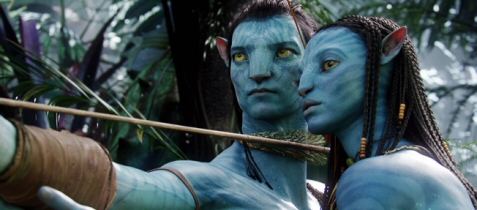
With “Avatar” holding remarkably well last weekend to the tune of over $50 million, there’s every reason to expect another very strong performance over the coming Martin Luther King Day holiday. Still, along with the holiday, this is also the first weekend since Christmas where James Cameron‘s science-fiction adventure is facing some new decent genre competition.
That comes via “The Book of Eli,” another “Mad Max”-esque post-apocalyptic neo-western, this time starring Denzel Washington and featuring a bit of a religious element. The Warner Brothers film is getting mixed reviews and only rated 45% on the Tomatometer. Beneath the surface, however, I’m sensing that the film actually provides a bit of fun and while star power hasn’t been good for much lately at the box office, my hunch is the combination of a tried-and-true action-flick premise and this particular star is just strong enough to be reasonably potent here.
 Directed by the Hughes Brothers who, rather unbelievably, haven’t released a theatrical film since 2001’s fairly decent “From Hell” disappointed at the box office, “Eli” is expected to earn about $30-40 million. Personally, I wouldn’t be surprised to see a very close result. Jolly Carl DiOrio nevertheless fully expects an “Avatar” victory and reminds us that it would be the first five-time #1 streak since “The Sixth Sense” wowed audiences back in 1999.
The week’s other major new release is “The Spy Next Door,” a family-oriented Jackie Chan vehicle from Lionsgate that has managed the neat trick of getting eactly 0% of critics to give it a positive review at Rotten Tomatoes. Still, if parents will fork over beaucoup bucks for a certain singing group from the genus rodentia, it’s just possible they’ll take one for the family team by sitting through this possible kiddie-pleaser as well. Jolly Carl is talking about as much as $20 million for “Spy,” presumably partly because of the family appeal of costars George Lopez and Billy Ray Cyrus. As an admirer of Chan’s great Hong Kong work, I have to say that I’m sorry he feels he has to has to work with the guy who brought us “Beethoven.”
That’s it for major new releases, but Peter Jackson’s movie version of Alice Siebold’s “The Lovely Bones,” is finally going wide this week. According to Box Office Mojo, it’ll be expanding from 13 theaters into 2,563, about 500-800 fewer than the major releases I’ve discussed so far. Considering the lackluster reviews and only so-so awards showing for this theoretical piece of awards-bait so far, I wouldn’t expect anything too huge here this weekend — though apparently younger females have been liking the film, or at least that’s who the film is being marketed to these days. In any case, a surprise Golden Globe or two at Sunday night’s show wouldn’t hurt it’s MLK day Monday. It could use a miracle or two.




 Love him or hate him, Wes Anderson knows how to make great movies. Though he’s remembered more for his quirky screenplays than his ability behind the camera, Anderson seems to have a hand in every single detail of his movies, and that’s a telltale sign of someone in love with their craft. He also boasts one of the best stables of actors in town (Bill Murray, Angelica Huston, the Wilson brothers, etc.), and more recently, nabbed such in-demand actors as George Clooney and Meryl Streep to voice a couple of talking foxes in a stop-motion animated film that’s actually better than Pixar’s latest. Add to that one of the best comedies of the decade in “The Royal Tenenbaums,” the cult favorite “The Life Aquatic,” and the criminally underrated “The Darjeeling Limited,” and his place on this list suddenly doesn’t seem so unwarranted.
 Sometimes working too much can have a counteracting effect, because while Clint Eastwood was able to bang out nine films over the course of the last decade, it’s his hit-and-miss track record that ultimately prevents him from finishing higher on the list. For every “Letters from Iwo Jima,” there’s a “Flags of Our Fathers,” and while films like “Million Dollar Baby,” “Mystic River” and “Gran Torino” are easily some of the best movies of their respective years, “Space Cowboys” and “Changeling” are some of the worst. His latest film, “Invictus,” falls somewhere in between, and that’s only because he makes the subject material better than it is. Still, if there’s anything we can learn from a guy like Eastwood, it’s that sometimes less is more.
 Apart from making three of the biggest movies of the decade, Peter Jackson also tackled a remake of one of the most iconic movie monsters of all time and a best-selling novel where the main character spends a majority of the story in heaven. If “The Fellowship of the Ring” hadn’t become a worldwide sensation, though, Jackson’s career could have gone down a very different path. After having been entrusted by New Line Cinema to shoot all three “Lord of the Rings” films back-to-back, Jackson returned the favor by delivering a worldwide sensation that kept the studio in business for a few more years (before merging with Warner Bros.), while making a name for himself as a visual maestro. That led to another pet project, “King Kong,” and eventually to a big screen adaptation of “The Lovely Bones.” Neither one is quite as good as the “LOTR” trilogy, but then again, neither are most movies.
 The Brothers Coen got off to a great start in 2000 with the musical comedy “O Brother, Where Art Thou?,” only to follow it up with duds like “Intolerable Cruelty” and “The Ladykillers.” Of course, I’ve resisted from even mentioning “The Man Who Wasn’t There” because, although not exactly a failure, it had absolutely no impact on me. They eventually turned things around with the 2007 Oscar winner, “No Country for Old Man,” which was not only one of the best films of their career, but of the decade as well. “Burn After Reading” saw them revisit their quirkier side, while “A Serious Man,” although much different from their other films in that it doesn’t feature a single big-name actor, is the kind of movie that you need to watch more than once to fully appreciate. That could be considered a negative in this day and age, but it’s exactly that disregard for mainstream audiences that makes their work so memorable.
