One side benefit of the busy, slightly weird and somewhat fouled-up time I’ve been having at the Los Angeles Film Festival is that I’ve only had time to watch films I’ve especially wanted to see. That’s prevented the joy (so far) of making an unexpected discovery, which is definitely part of the fun of film festivals. On the other hand, I’ve liked all the films I’ve seen (so far). “Black Dynamite,” a spoof of the seventies blaxsploitation genre, is one I’ve been wanting to see since the filmmakers’ commendably aggressive PR people sent me a trailer — and a very cool (but inexpensively seventies-esque) t-shirt — a couple of years back via my personal blog.
Fortunately, the wait, the slog through Hollywood traffic on the somewhat spooky evening of Michael Jackson’s death (not as bad as it could have been, actually), and even some technical problems on the first attempt to run through the film all proved to be very much worth it. Directed by Scott Sanders and co-written with actor and martial artist Michael Jai White (“Spawn,” “The Dark Knight“), this is just your basic story of a superhuman ex-CIA agent, able to take out a roomful of bad guys and satisfy a roomful of women, who sets out to avenge the death of his brother, stop the scourge of hard drugs at orphanages, and also deal with a brand of malt liquor that turns out to have a truly disturbing side effect.
The brilliance of Sanders and White’s approach here is the faithfulness they maintain to their source material while sending it up shamelessly. It happily exaggerates the cinematic flaws of actual blaxsploitation and its often unbelievable plots and absurd dialogue, taking several increasingly silly turns as the film unspools, but always with a completely straight face and an apparent complete lack of irony. The approach propels the comedy far further than less disciplined spoofs.
In a video interview conducted with writer David Poland after its debut at Sundance, Scott Sanders said he and White approached it not so much as a movie starring Michael Jai White as Black Dynamite and directed by Sanders, but a movie featuring Michael Jai White playing seventies-era ex-football player Ferante Jones playing Black Dynamite, and directed by Sanders “playing” a seventies director.
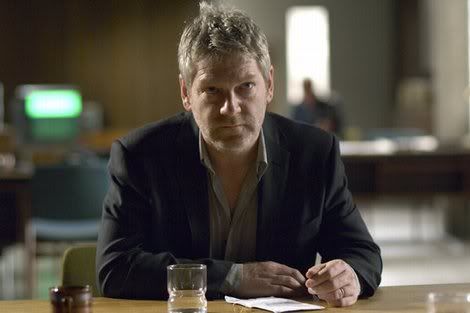
There are two bold strokes with which “Wallander,” a BBC produced crime series, is painted that set it apart from most other TV fare. The first is its intoxicating, borderline hallucinatory photography, which will grab your attention in the opening frames. A girl pushes her way through a golden field of crops carrying a plastic container of liquid. A car, driven by Kurt Wallander (Kenneth Branagh), speeds down the highway toward a farm. He pulls up and the farmer points to the field. “She’s out there.” He hands Wallander a pair of binoculars. “You see her?” Wallander makes his way through the dense field of yellow. The closer he gets, the more frightened the girl becomes. When he’s but a few feet from her, she opens the container and douses herself with gasoline, sets herself on fire, and explodes in a ball of flame. Wallander’s jaw hits the ground. He cannot believe what he’s just witnessed. Later on, when one of his fellow detectives suggests moving on from the suicide, since there’s no real crime involved, Wallander himself explodes, “A 15-year-old girl sets herself on fire and you don’t think it’s a crime!?” It’s something of an uncharacteristic moment for the normally subdued man, who keeps his emotions bottled up inside. Indeed, the only time his feathers ever seem to ruffle is in matters of pursuing justice.
But back to the photography. The entire opening sequence is bold and filmic, as is much of “Wallander.” The series is shot with the Red One, a digital camera with a sensor that, according to Wikipedia, “has about the same active area as a 35mm film frame masked to the 16:9 aspect ratio, allowing the same depth of field to be produced in conjunction with lenses designed for 35mm film.” In other words, this camera manages to make some damn pretty pictures – stuff you wouldn’t expect to see in a BBC produced show. It’s possible that at times the cinematographers even go a little overboard, but they probably had so much fun experimenting with the camera they should be forgiven such indulgences.
The second item of note is the fact that the show is in English. This wouldn’t be such a big deal if not for the fact that the show is set and filmed in Sweden, all of the characters are Swedish, and most noticeably, anytime any written language is shown, such as newspapers or e-mails, the words are in Swedish. But everyone in the series speaks English, and with a British accent no less. This took some time to get used to, but after a while the viewer is forced to submit to the gimmick, and it manages to somehow seem a mildly brilliant construct on the part of the producers. I kept thinking back to the early scene in “The Hunt for Red October” where all the Russians were speaking Russian until the picture subtly shifts and they all speak English; “Wallander” simply doesn’t have the shift. It’s a brave leap of faith that could easily have been avoided by tweaking the tales a bit, and simply setting them in England. Clearly the people involved in the making of this series have enormous respect for the source material, a series of hugely popular books by Henning Mankell, the “master of Swedish crime fiction” who, it turns out, is married to Ingmar Bergman’s daughter.
“If you’ve got any silver on you, now would be the time to reveal it.”
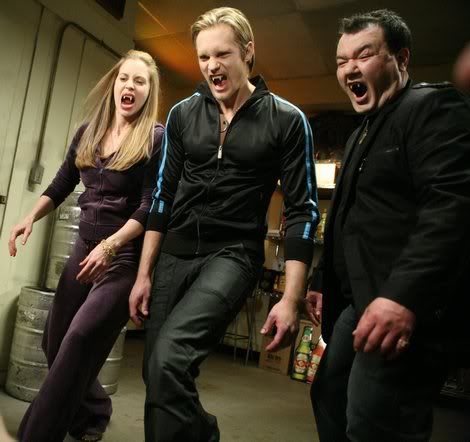
So sayeth Sheriff Eric to Lafayette, and given that he preceded the comment by throwing a redneck’s severed arm in his general direction, you can imagine that it’s a suggestion that Lafayette would’ve been quite willing to take, if only he had any on him. He doesn’t, though, assuring Eric that, even if he did have any, he wouldn’t be stupid enough to try and use it. Eric disagrees, but he hustles Lafayette off nonetheless, taking him on a trip to meet Pam. Lovely girl, that Pam. First, she gives Eric a serious “tsk-tsk” for all the blood he’s gotten in his hair, then does the same thing to Lafayette for immediately offering to give up the names of every single one of his clients in order to save himself. His response to her attitude results in the first glimpse of the real Lafayette that we’ve seen this season, and it was so funny that I’m going to quote it verbatim for your enjoyment:
“Oh, don’t get it twisted, honeycone: I’m a survivor first, a capitalist second, and a whole bunch of other shit after that, but a hookerdead last. So if I got even a Jew in an Al-Queda pep rally’s shot of getting my black ass up out of this motherfucker, I’m taking it. Now, what you wanna know?”
Awesome.
Give Lafayette credit for being embarrassed to give up Jason Stackhouse (though he did it, anyway, and it still didn’t do him a lick of good), and Eric for having the sense not to go after Jason. Once Lafayette’s back in the clink, though, he makes a move that’s damned near ingenious…although, if I’m to be honest, I first thought he was starving and resorting to cannibalism. But, no, he used the materials available to him – ewwwwwww – and made a break for it. And it looked like he was going to get away with it, too, until Ginger the Trigger-Happy Waitress took him down for the count with one shot. So do you think Eric’s going to turn Lafayette? Do fish swim…?
You’ve got to respect a show where a pair of character post-coitally discuss the merits of break-up sex versus you-thought-I-was-dead sex (according to Sookie, they’re both pretty good), then drift into a discussion about the surprising lack of differences between being a vampire and being a teenage girl. Sookie’s sympathetic about Jessica’s plight as a newly-turned vamp who’s just lost forever the chance to grow up, and when she sees the plea from her parents, it only gets worse. The two of them bond, possibly over their mutual ability to not laugh at Jessica’s pitch-perfect Bill impression, and the next thing you know, Sookie’s driving Jessica over to her parents’ house. C’mon, is there anyone who didn’t think this was going to end badly?
Awaiting the coming midweek arrival of the next big fanboy franchise entry, “Transformers: Revenge of the Carniverous Unicorns” or whatever it’s called, a couple of high concept comedies with theoretically strong potential sail into the nation’s multiplexes this weekend. While both should do okay business, the “meh” to “Cathy”-style “ack!” reactions from critics (I know we don’t really count but, hey, if you tickle us, do we not chuckle?) might indicate somewhat limited potential against the ongoing one-two punch of “The Hangover” and “Up.” I expect a close one. But then, I’m always wrong.
Of the two new comedies, “The Proposal,” starring Ryan Reynolds as a put-upon assistant cajoled into a sham marriage with his you-know-what-on-wheels boss played by Sandra Bullock, appears to be the somewhat stronger contender. This initially struck me as something of a gender-reversed redo of Mike Nichols’ similarly high-concept 1988 Melanie Griffith vehicle, “Working Girl,” with the executives originally played by Harrison Ford and Sigourney Weaver mushed into Bullock’s publishing bigwig. However, the reviews indicate something darker at times, but probably less entertaining for a mass audience. With a 44% “fresh” at Rotten Tomatoes, mirrored by our own David Medsker’s split critical decision, critics are turning no cartwheels. The Hollywood Reporter however suggests that the film has some pretty serious date-movie appeal and that might be enough for $20 million or so, which might be enough to hit the #1 spot. Certainly many women may feel that, to paraphrase Griffith 21 years back, Reynolds has a mind for comedy and a body for sin. It’s therefore a good bet they subtly encourage their significant others to attend with them, who themselves might not mind looking at the adorable, if now fully adult, Ms. Bullock for a couple of hours themselves. We shall see.
If critics were unconvinced by “The Proposal,” they were hurling ancient curses at what sure seemed to me like a promising comedy concept but, then, there’s the me-always-being-wrong thing. I speaketh of the hunter-gatherers-go-biblical “Year One,” directed by comedy veteran multi-hyphenate Harold “Egon Spengler” Ramis. The critics seem to agree that this vehicle for two of the best known names in youth-targeted comedy, Jack Black and the gifted savior of dry humor among the young, Michael Cera, is a million miles away from being Ramis’s best work. (That would include probably one of the beloved films of the last twenty years, “Groundhog Day” as well as the frat-boy touchstone, “Caddyshack.”) On the other hand, Variety offers the thought that it’s “tracking” is improving. I’m still trying to figure out what “tracking” actually means, but I guess that’s supposed to be a good thing.
Nevertheless, our own Jason Zingale heaps some pretty serious 1.5 star scorn on a film which mixes some fairly extreme-sounding scatological humor with some pretty big comic prey in taking on some of the best known characters from the ever-popular first half of Jehovah’s bestselling two-part epic. He’s hardly alone, as only 19% of the RT gang saw much of worth in it and some saw the opportunity to hurl a few would-be comic zingers of their own. CHUD’s Devin Faraci commenteth:
Year One is so dedicated to being historically accurate that it only uses jokes that are at least two thousand years old.
Entertainment Weekly‘s Owen Glieberman went the contrarian root and actually awarded the film a relative rave with a B- rating, and appears to be one of the few (only?) critics to heap praise on Jack Black’s performance while attacking the dryness of Cera. He also offers what the film’s many detractors will take as a terrifying thought:
Every era gets the prehistoric comedy it deserves.
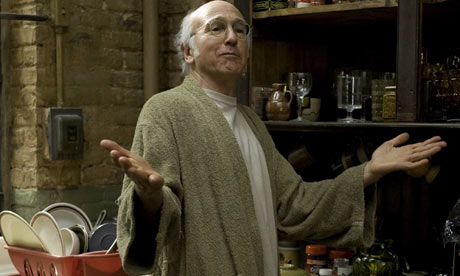
Meanwhile in arthouse land: The would-be prestige comedy “Away We Go” widens to 132 screens this weekend. Also, the week’s new limited release is yet another promising sounding attempt at America’s funnybone, the latest from Woody Allen (though apparently the original script dates back to the seventies), “Whatever Works” starring HBO’s own Larry David. Allen’s films are almost the definition of review-driven hits-or-misses and this one has engendered what is at best a split decision with 53% (only 9% among “top critics”!) at RT. That’s low enough to (forgive me, Lord, for what I’m about to say) curb filmgoer enthusiasm.
In a sense, there’s really no reason for me to write a full-length review of “Mistresses,” BBC America’s latest contribution to the guilty-pleasure pile.
When I was working my way through the four-disc set of the series, which includes the first two seasons of the show, I made a comment about my current viewing on my Facebook page. Jeanne Jakle, TV critic of the San Antonio Express News (not to mention significant other of our own Ross Ruediger), responded by saying that it possessed “just enough sluttiness and sleaziness to offset the soapiness,” adding that “the British accents made it seem classier than ‘Sex and the City.’”
Now, I don’t know about you, but these two phrases alone would’ve been enough to make me want to check it out. Still, the more discerning viewer might prefer to have a bit more information about the series before diving headlong into “Mistresses,” and we here at Bullz-Eye live to serve.
America has already endured its share of “Sex and the City” knockoffs, and the two with the highest profiles – “Cashmere Mafia” and “Lipstick Jungle” – have already been knocked off the air. In Britain, however, they’ve tried a different tactic, avoiding the lighthearted feel of Stateside series and staying almost entirely serious with their gaggle of gal-pals. There are four female characters in “Mistresses,” and although there are occasions where their storylines will leave you begging for a little humor, you can’t say that they don’t manage to remain enthralling as a result.
As a physician, Katie (Sarah Parish) is the closest thing the group has to a grown-up; too bad her idea of maturity involves sleeping with a married patient and, after he dies, finding her way into an affair with the man’s son. Trudi (Sharon Small) is a 9/11 widow who’s trying to raise her two children and considering stepping back into the world of dating, but she’s hesitant because she doesn’t want to fall in with someone who wants her solely for the sizable settlement she received after her husband’s death. Jessica (Shelley Conn) is a party girl and the queen of the one-night stands, which makes her the envy of the rest of the girls, but they’re a bit shocked when her flirtation with the same sex seems to be the love she never knew she was looking for. And lastly, there’s Siobhan (Orla Brady), the married one in the bunch. It almost goes without saying that she’s the unhappiest one of all, doesn’t it?
Just as the title of the series implies, there’s a fair amount of infidelity going on within “Mistresses,” though it’s different from character to character. Katie’s is the most obvious, of course, but the woman with whom Jessica is enthralled – Alex, played by Anna Torv (now best known for her role as Agent Olivia Dunham on “Fringe”) – is engaged to be married to another woman, and Siobhan seeks sexual gratification outside of her marriage when her husband’s desire to have a baby abruptly moves from overscheduled and unromantic coitus to a total lack of sex drive. And what of Trudi? Well, the problem here is that you can’t say too much about her situation without giving away the best (and, ultimately, the harshest) storyline of the season, so let’s just say that, yes, there’s cheating involved on her end as well.
If there’s a problem with the second season of the series, however, it’s that you can’t help but feel that either these are the unluckiest women in all of Britain when it comes to love, or they’re among the most foolish. It’s been said that those who cannot remember the past are condemned to repeat it, but, wow, talk about having problems with short-term memory! Katie has further problems with a younger man and a married man, while Siobhan still can’t manage to get things right in her marriage. You can almost excuse Trudi for her issues, though, given what she’s been through in the past. The real exception here is Jessica, whose unexpected actions in the season premiere set up her surprising storyline, and whose shenanigans during the course of the subsequent episodes definitely keep you guessing.
“Mistresses” isn’t groundbreaking television, but, well, it’s like Jeanne said: it’s unabashedly a soap opera, but you get a healthy soupcon of sexiness, and the accents class it up enough to make you feel okay about watching it. All told, the first season is by far the better of the two, but by then, you care enough about the characters to stick around through the second as well.
Special Features: Although we receive no commentaries, we do get two features, one for each season of the show included in “Volume One.” The first is “The Making of ‘Mistresses,’” which offers a half-hour look into Season One, while the second, “Sex, Lies, and Infidelity,” takes the Mistresses and their significant others and gets their opinions on the topics addressed in the show as well as their thoughts on their characters at the end of Season Two. Both are top-notch, which is just as we’ve come to expect from BBC-produced bonus material.



 If critics were unconvinced by “The Proposal,” they were hurling ancient curses at what sure seemed to me like a promising comedy concept but, then, there’s the me-always-being-wrong thing. I speaketh of the hunter-gatherers-go-biblical “