Category: Reviews (Page 41 of 120)

“Public Enemy” awaits a verdict; other stuff happens

* There seems to be some concern out in the world about just how well Michael Mann’s new Johnny Depp/Christian Bale vehicle, “Public Enemies,” will fare when it’s released on Wednesday. Mixed reviews, like the one posted today by Den of Geek’s Michael Leader seem fairly typical and it’s possible audiences will feel mehish on the project. (The Tomatometer is currently at a fair-to-middling 64%, but even some of the “fresh” reviews don’t read as outright positive.) Anne Thompson specifically wonders about just how Depp’s huge star power will register and Mann’s decision to shoot a period film in digital, though it’s not the first period action film to be shot that way (“The Last Samurai” comes to mind). Those still reasonably jazzed about the nouveau-gangster flick (and that includes me, even though I’m not a super big Michael Mann fan), may want to check out our “Between Good and Evil” feature over at Bullz-Eye.

* Speaking of Anne Thompson, she has a festival wrap-up posted (looks like we saw a pretty different selection of films). I’ll be writing about it one-more time tomorrow.

* Nikki Finke has the “actuals” in from “Transformers: Revenge of the Fallen.” It’s $390 million worldwide. I guess that’s enough. She’s also upset over some impending Oscar changes, including a rule that might limit the number of “Best Song” entries and having a separate, non-televised dinner for the humanitarian awards like the Thalberg, which I’ll personally miss, because I’m weird.
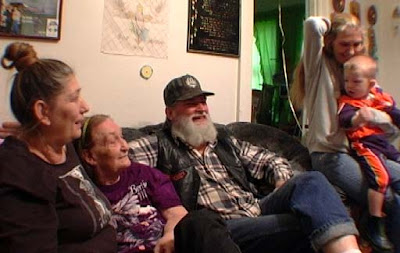
They’re “wild” alright, but are they “wonderful”?

Confession time: Being a bit sleep deprived and apparently under-caffeinated, I nodded off for probably 10-20 minutes of MTV/Dickhouse’s “The Wild and Wonderful Whites of West Virginia.” Therefore, I have to be a bit careful about making any sweeping statements about this documentary from filmmaker Julien Nitzberg, a sort of follow-up to Jacob Young’s 1991 short, “The Dancing Outlaw,” which became a viral cult hit. It’s safe to say that judging from what I heard from the crowd — many of whom were fans of the earlier documentary and/or the “Jackass” TV series (which has some fans in the cinegeek world, though I’ve never been moved to watch it) — I might have been the only person in the theater who didn’t have a great time with the film.

The earlier film deal with Jesco White, a gas-huffing Elvis Presley fan whose brain-damaged schizoid psychology and criminal tendencies tend to overshadow his talent as a “mountain dancer,” a sort of bluegrass forerunner to tapdancing. Executive produced by Johnny Knoxville, “The Wild and Wonderful Whites” deals with the ongoing struggles of Jesco’s extended family, led by super-tough, extremely shrewd, ultra-raspy voiced occasional singer Mamie White and on into the more violent third generation members of the clan. There are some captivating moments, in particular Jesco dancing to music provided live by punk country’s own Hank Williams III and the sugary soda-fueled gyrations of one of the youngest Whites, who just might be a dancing chip off the old Jesco White block.

However, apparently somewhat like Slant’s Nick Shager, I was largely left cold by the portion of the film I managed to stay awake through. I’m not sure I’d be as critical of its moral stance, or lack thereof, on the Whites, but I found myself wondering just what the vignettes about the various family members — who are perhaps too numerous for clarity — and their purportedly fun-loving dysfunction add up to. I’m not sure how I feel about the way director Nitzberg flirts with celebrating a clan whose members abuse themselves and each other to this degree. It’s still possible I might find something more there in a less tired state and, if this sounds in any way interesting, you’d be well advised to check out the not so safe for work trailer.

I should also add that, in terms of a crowd vibe, the mood at the Los Angeles Film Festival screening could not have been a happier or more upbeat one. I spoke to some really nice people there who really seemed to enjoy it and “get” the film a lot more than I — and the post-screening dancing by Jesco White, backed up by a terrific bluegrass trio, was something else.

Box office wrap-up: “Transformers” sequel blows up real good

The news this week is about as simple and unsurprising as you can get: “Transformers: Revenge of the Fallen” has done some pretty spectacular business, netting an estimate of $201.2 million, just shy of the all-time record $203.8 million “The Dark Knight” earned on its initial five-day release. Could that $2.6 million difference be the difference between outstanding reviews and really bad ones? Nah, but I still wouldn’t be surprised to see a big drop off here, or maybe that’s wishful thinking based on my oft-repeated feelings about this particular franchise.

As per Variety, “The Proposal” came in at the #2 spot, dropping 45% from its opening for $18.5 million in its second week. And this summer’s ongoing audience and critical favorites continue to do outstanding business. “The Hangover” is thought to have taken in $17.2 million in its third week, while “Up” continues to exercise the astonishing power of the Pixar touch in the #4 spot with about $13 million in its fifth week.

This week’s only non-“Transformers” wide release, “My Sister’s Keeper” (referred to by newly rich superblogger Nikki Finke as “simpering,” but which our own Jason Zingale actually kind of liked), came in at the #5 spot with an estimated $12 million. As we mentioned last time, that’s actually a couple million more than some expected.

John Krasinski and Maya Rudolph, It also wasn’t a bad weekend on the indie side. The critically acclaimed Iraq war action-suspense drama, “The Hurt Locker,” performed well in its four theaters on the coasts, netting about $3600 per screen. In wider release, the high pedigree prestige comedy, “Away We Go,” perhaps benefited from the TV appeal of stars John Krasinski and Maya Rudolph, and got into the #10 spot with $1.7 million in just under 500 theaters.

Back tomorrow with more on the about to be concluded LAFF

Shameless commerce with “I Sell the Dead”

I usually like my horror best when it’s well mixed with comedy. Moreover, this LAFF selection has gotten some good responses elsewhere, but I’m sorry to say that “I Sell the Dead” was my first real disappointment of the festival. It’s a fairly classic example of the kind of film where the cinematic “frosting” is sickly delightful, but where the actual movie “cake” beneath it is mostly a dud. Written, directed, and edited by Glen McQuaid on his first feature, the film is largely told in flashback as career grave robber/ghoul and alleged killer Arthur Blake (Dominic Monaghan, “Lost” and LOTR) is encouraged to recount his lengthy career by a fearsome but jovial cleric (geekfilm stalwart Ron Perlman).

Young Arthur (Daniel Manche) begins his profession under the tutelage of experienced corpse dealer Willie Grimes (cult/indie horror regular Larry Fessenden). Willie’s a rough sort and ready to do young Arthur in to curry favor with his fearsome main customer, an evil scientist who pays mostly in blackmail (the memorable Angus Scrimm, a.k.a., the terrifying “Tall Man” from the “Phantasm” series). But at heart he’s no murderer and the two become close friends as they eventually branch out from simple grave robbing to the commercial possibilities of dealing with the bodies of vampires, zombies, and assorted other deceased creatures, both undead and unusual. Eventually, Arthur’s ghoulishly sexy Lady MacBeth of a girlfriend (the terrific Brenda Cooney) complicates matters just a bit.

Writer/director/editor McQuaid is a designer and effects artist with a keen classic film and EC comics-inspired visual sense and a gift for horror-based humor, but the story he comes up with here is episodic at best and lacks anything resembling a spine. Moreover, while there are some wonderful gags and genuinely creepy moments starting about half-way through the film, it’s a long slog getting there and a fairly long feeling slog after.

I share McQuaid’s affection for the modestly budgeted horror/comedy/camp classics of old and “I Sell the Dead” is a nicely designed homage. However, without any clear emotional spine to the story, the director’s strong visuals and obvious enthusiasm for the genre, strong acting from the entire cast, and terrific score by composer Jeff Grace, sadly doesn’t add up to very much entertainment. Still, I know that fans of the endangered art of comic horror will want to seek this one out anyway. I hope they get more fun out of it than I did.

More LAFF: How do you mend a “Paper Heart”?

If documentaries necessarily involve a potential for abuse, simply because the perceived reality of film is so open to manipulation through editing and other tricks of the movie trade, documentary/fiction hybrids offer the opportunity for extreme confusion and manipulation. And, boy, is that the case here.

While the actual write-ups for “Paper Heart” were vague about the premise, a fellow LAFF-goer casually told me that it involved some kind of recreation of the romance between comedian/performance artist Charlyne Yi (“Knocked Up“) and the future of comic understatement, Michael Cera. Thus, watching the film, I became convinced I was seeing some kind of fictionalized retelling of a real-life romance. I am informed, however, in David Poland’s interview and from the post film Q&A that the relationship in the film is utterly and entirely fictional, so I assumed I was wrong again and the pair don’t date and never have. But after a bit more research I have information that indicates that Yi and Cera do have a relationship, just not in the one the movie. Except that the movie deals with what are Yi’s supposedly real feelings about love and how could that not affect her real or imagined romance with Cera? Of course, that’s none of my business and that’s probably a big part of the point.

The whole layers of fiction and reality thing got even more complicated when, at the post-screening Q&A, cowriter-director Nicholas Jasenovec stated categorically that story portions of the film were fictional while the documentary portions were not. Fine, but then a pre-teen boy who appears in the film opining on romance joins the discussion and, asked about he was found for “Paper Heart,” he and Jasenovic state that he was found through a casting process to join what appears to be a conversation with more or less random school children, and he is an actor.

When Jean Luc Godard uttered his most quoted line, that cinema was truth, 24 times a second, and every cut is a lie, I think this is kind of what he was talking about. But, so what?

Continue reading »

« Older posts Newer posts »

© 2026 Premium Hollywood

Theme by Anders NorenUp ↑