Category: Reviews (Page 22 of 120)

United States of Tara 2.1 – I Get Up, I Get Knocked Back Down Again

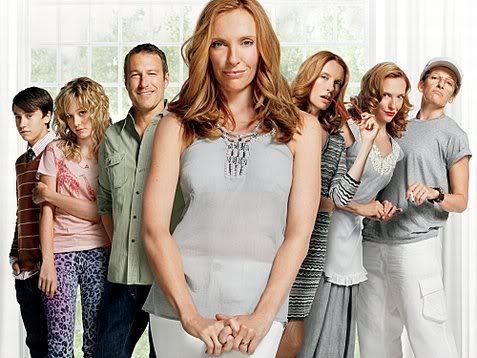
It may surprise you to see me kicking off a weekly look at Showtime’s “United States of Tara,” given that my DVD review of the show’s first season wasn’t exactly what you’d call glowing. If you can’t be bothered to click on the preceding link, allow me to summarize: I gave it a mere three stars out of a possible five, and the pilot alone left me in such a sour mood that it infiltrated my feelings about a great number of the subsequent episodes. Still, I plowed through the entire season – 12 episodes – and, by the end of the experience, I’d found that, although I still wasn’t necessarily a full-fledged “Tara” booster, I’d fallen for the storylines of the other characters (if not so much those of Tara and her alter-egos) enough to be intrigued about what Season 2 might hold.

Now, I’m not saying that the publicity department at Showtime read my review, but whether they did or didn’t, screener discs for the second season of “Tara” arrived in my mailbox last week…and since they’re here, thereby giving me the chance to watch and write about the episodes in advance of their air date, it’s too tempting an opportunity to resist. As such, I’m blogging about “United States of Tara: Season 2.”

So let’s get started, then, shall we?

Continue reading »

SXSW 2010: SATURDAY NIGHT

“Saturday Night Live” has been harshly criticized over the years for failing to deliver quality episodes each and every week, but have you ever stopped to think just how difficult that really is? In James Franco’s all-access documentary, “SATURDAY NIGHT,” audiences finally get a behind-the-scenes look at the arduous task of putting together a 90-minute live show. Capturing every step of the creative process – from the actors and writers pitching their ideas to the week’s host (in this case, John Malkovich) to putting on the final show – the film delivers an honest look at the high-stress, dog-eat-dog world of sketch comedy. With only 24 hours to conceive and write their sketches (and guys like Will Forte seemingly sleepwalking through most of it), it’s amazing that any of them can be funny at all. Perhaps more shocking, however, is that only nine of the 50 proposed ideas actually make it into the final show.

saturday_night

“SATURDAY NIGHT” focuses on just a handful of them, and it’s here that we see the evolution that each one goes through along the way, including rewrites and last-minute edits that come out of rehearsals. We also learn that while some sketches (like one lampooning the Empire Carpet commercials) bring down the house during the initial round of table reads, by the time it comes to performing it at dress rehearsal only hours before the live show, it falls flat with the audience, forcing the producers to pull it from the line-up. Franco gets some good interviews with the cast and crew, even putting himself on camera to discuss his own hosting experience, but he doesn’t really document anything that someone with the exact same access couldn’t do. “SATURDAY NIGHT” is still a fascinating study of a particular facet of the entertainment industry, and if there’s anything to take away from the documentary, it’s that these guys are only human. As one producer aptly declares when discussing future cast members: “If you’re a perfectionist, don’t come here, because nothing is ever perfect.”

Breaking Bad 3.1 – I Blame The Government

The first image that really catches our eye is that of some poor bastard hauling his dirty, grimy self across the ground. He looks, in a word, pitiful…and as we’ve just seen a truck driving along the dusty road and another man wandering about with seeming calm, we have to presume that the aforementioned gentleman on the ground has but a short amount of time left on this earth.

But, then, we start to get mixed signals when a second man is seen crawling in the dirt, then a third.

By the time the shot cuts to reveal a veritable legion of dirt crawlers, with the ominous score only serving to underline the palpable nervousness of the bystanders in the village (i.e. the ones sitting or standing rather than crawling), we have to ask: “What the hell’s going on here?”

A car pulls up. A man with silver skulls on the toes of his boots steps out. Make that two men. Are they twins?

Oh, but it’s too late to consider the genetic origins of these guys, because now they’ve started crawling. This is getting downright creepy…and that’s even before the group begins to rise to their feet and enter a highly disturbing candle-lit shrine, to which they add a sheet of paper.

It’s a Santa Muerte shrine. On the paper is a pencil sketch of Heisenberg. In short, these guys are praying that Walter White will be dead soon.

Season 3 is officially off to an awesome start. Welcome back, “Breaking Bad.”
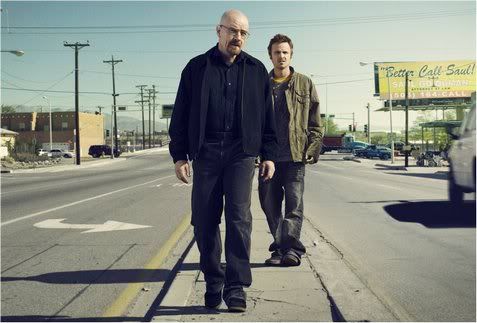
Given the end of Season 2, it’s no surprise that the first thing tackled post-credits is the inevitable repercussions of the airplane crash. You probably spotted the guest appearance by Ashleigh Banfield, but the other newscasters are actually from Albuquerque’s NBC affiliate, KOB. It’s an easy segue back into where we left off last season, offering a look into how it’s affected the residents of the city…including, of course, one W. White, who’s busy burning money on his barbecue grill. If there’s any sight more horrifying than watching cash go up in smoke, it’s got to be Walt having second thoughts and, in the process, setting his robe on fire. It was a must-do, though: right about now, the money is really the only thing in Walt’s life that he can stop from going up smoke.

Certainly, his marriage is shot to hell, a fact underlined by Skyler’s inaugural appearance in Season 3, which takes place as she’s attempting to kickstart the divorce proceedings between herself and Walt. It’s a meeting borne of emotion rather than intellect, however, with Skyler desperately trying to ignore the attorney’s comments and suggestions until the cumulative effect of her protestations finally begin the process of collapsing her resolve. The tension between her and Walt, Jr., doesn’t help the situation any, and once her sister starts to get on her case, Skyler can’t deny it any more: she’s got to ask Walt outright what the hell he’s got going on in his world that he’s been too afraid to reveal to her.

Continue reading »
SXSW 2010: Four Lions

Interested in testing the limits of the moviegoing public? Make a comedy about terrorism. At least, that’s what Christopher Morris has done with his feature film debut, “Four Lions,” a movie that will no doubt stir up controversy if it ever finds a distributor brave enough to release it in theaters. A pitch-black satire in the same vein as “Dr. Strangelove,” Morris has created a film so relevant to our current political climate that many will feel guilty just for watching it, let alone laughing at all the gut-wrenching humor along the way. For as risqué as the material may be, however, it’s impossible to deny that “Four Lions” is one of the funniest, most provocative comedies of the last decade – and one that has more to say than any of the numerous self-important war movies that Hollywood has been cranking out for years.

The film follows a group of wannabe suicide bombers from Britain who are so inept at being terrorists that they’re more dangerous to themselves than any potential target. Omar (Riz Ahmed) is the most level-headed of the bunch, but when he’s kicked out of an Al-Qaeda training camp in Pakistan because of his dim-witted friend, Waj (Kayvan Novak), they return home to find that their partners in crime, Fessal (Adeel Akhtar) and white Islamic convert Barry (Nigel Lindsay), have recruited a fifth member (Arsher Ali) to the cause. Desperate to save face, Omar informs the others that they’ve been ordered to blow themselves up at the London marathon.

four_lions

But for this team of bumbling idiots, that’s a lot harder than it sounds. When they’re not busy attaching bombs to crows, embarrassing themselves in jihad videos, or coming up with new methods of anti-surveillance, they’re bickering among themselves like old ladies. The power struggle between Omar and Barry provides the catalyst for most of these arguments, because while Barry might seem like the ideal person to be in charge, he has such radical ideas (like blowing up a mosque so that the peaceful Muslims rise up and join their fight) that it’s easy to see why he would fail as a leader.

The intensity of a character like Barry, however, is what ultimately makes “Four Lions” so successful, because Morris treats the material with such veracity that the jokes hit harder as a result. These guys might be complete imbeciles, but that doesn’t change the fact that they’ve managed to stockpile a dangerous amount of explosives capable of doing some serious damage. In fact, for all the comedy bred out of the film’s set-up, there are still quite a few unsettling moments scattered throughout, including a thrilling finale in the streets of London. Even more disturbing is the relationship between Omar and his family. His wife doesn’t only support what he’s doing, but seems to encourage it, while his son has become so familiar with the idea of jihad that his bedtime stories feature Simba and his fellow animal friends from “The Lion King” as suicide bombers.

It’s this kind of dark humor that makes “Four Lions” more of a tragicomedy than a satire, because even though the would-be terrorists can hardly be considered the heroes of the story, Morris makes them so likeable that you don’t want anything bad to happen to them. We know their intentions aren’t good, but because we’ve become so used to laughing at their blunders throughout the course of the film, we never really identify them as much of a threat. That’s mostly thanks to a brilliant script (co-written by Morris and two of the writers responsible for last year’s scathing political satire, “In the Loop”), which takes the buddy comedy formula and applies it to a hot-button topic with great aplomb. “Four Lions” may not be the first of its kind – Paul Weitz’s “American Dreamz” also flirted with the concept of mixing terrorism and comedy – but where that movie proved that no subject was taboo, Christopher Morris’ film demonstrates that sometimes it’s easier to get people to pay attention when you’re making them laugh.

SXSW 2010: Harry Brown

Most people will take one look at the premise of Daniel Barber’s “Harry Brown” and immediately liken it to a British version of “Gran Torino.” The two films certainly share a lot of similarities – both are about older men battling a gang of young punks, and both star one of the greatest actors of their generation – but where “Harry Brown” differs is in the violent behavior of its title character and his victims. The end result is a little more like “Death Wish,” and although it may be difficult to imagine someone as mild-mannered as Michael Caine in a vigilante role, it’s exactly what makes “Harry Brown” so damn entertaining.

You wouldn’t think he was even capable of such violence when you first meet Harry Brown (Caine), an army veteran whose days consist of meticulous visits his sick wife in the hospital and playing chess with his only friend, Leonard (David Bradley), at their favorite pub. But when his wife passes away and Leonard is killed by some local street thugs who had been harassing him for months, Harry finds himself all alone in a town dominated by crime. After the police detectives (Emily Mortimer and Charlie Creed-Miles) assigned to Leonard’s murder case fail to catch the kids involved, Harry takes it upon himself to track down those responsible and teach them a lesson in how to treat your elders.

harry_brown

It’s been a while since Michael Caine played the part of the action star, and while he’s not doing anything too physically demanding as Harry Brown, it’s a nice throwback to his earlier films. He’s like Jack Carter with an AARP card, and though he may seem harmless at first, once Brown picks up a gun, he immediately becomes the most dangerous man on the block. Only an actor like Caine could provide the gravitas needed to sell such a potentially outlandish role, but once you accept him as someone capable of committing such acts of violence, it allows for some of the more darkly comical moments to exist without coming off as parody. Unfortunately, Caine is the only bright spot in the cast. Emily Mortimer doesn’t have very much to do as the detective suspicious of Brown, while Liam Cunningham is underused as the owner of the pub.

That’s hardly the fault of the actors, however, as the film is primarily designed as a vehicle for its lead star. Some might even consider first-time director David Barber lucky for landing such a great actor to play the title role, but Barber brings his own strengths to the project as well. The decision to open the film with gritty handheld footage of an innocent woman being gunned down in the park is both unsettling and necessary to setting the stage for the story that follows, while Brown’s back-alley meeting with a couple of drug-addicted gun dealers makes for one of the most suspenseful cinematic moments in recent memory. This is the kind of movie that not only gets your heart beating, but spurs applause from the audience with each vengeful kill. It’s definitely not one of Caine’s better films, but “Harry Brown” is a real crowd-pleaser nonetheless.

« Older posts Newer posts »

© 2026 Premium Hollywood

Theme by Anders NorenUp ↑