Category: External TV (Page 229 of 419)

TCA Tour, Jan. 2009: “Make ‘Em Laugh: The Funny Business of America”

Dying is easy, and comedy is hard, but if you really want hard, try putting together a six-hour documentary about comedy in motion pictures and on television without having someone complain about what’s been left out. Can’t be done…and hasn’t been done, if I’m to be perfectly honest. There’s just too much comedy out there. But with that said, PBS’s effort, “Make ‘Em Laugh: The Funny Business of Comedy,” is a damned good attempt at accomplishing the feat, and more importantly, the show’s executive producer, Michael Kantor, is fully willing to concede the impossibility of covering everything.

“Max Welk, who was one of our consultants, is maybe 90 years old, kept saying the two funniest people he ever saw were Jack Benny, who could walk on stage and say nothing and an audience would laugh, and Wheeler and Woosley,” said Kantor. “Jeff Abraham lobbied for the Ritz Brothers. So it was very difficult. Rather than tell the kind of…not standard story, but natural story of, okay, here were the different studios that sprang up and we’ll march chronologically through the silent film era, we decided that a comedy series needs to be surprising and the audience, the viewer, would enjoy it more if they were a little taken aback by the next story, perhaps Paul Lynde following Redd Foxx. It’s surprising, ‘Well, where are we going?’ So we tried to hue to the framework that way rather than comparing, you know, Charley Chase with Harold Lloyd with Buster Keaton. I almost interviewed Rudy Ray Moore, who lived — just died, actually — lived in Vegas. He created Dolemite. And I kept thinking, ‘God, this is an amazing story. It deserves its own AMERICAN MASTER special.’ But it kind of didn’t fit into the six different episodes we created.”

As for the narrator of “Make ‘Em Laugh,” Amy Sedaris made a point of noting that Buddy Hackett didn’t end up making the final cut, either. (There is, however, a quick cut to a shot of Jerri Blank, from “Strangers with Candy,” which made her happy.) Kantor seemed apologetic about the omission, but he explained, “The goal was, once, with a team of consultants, we’d figured out that these six categories or archetypes or – call them what you want — genres that reflected different aspects of American culture were the ones we were sticking with, we wanted to tell the best story we could. And that’s why poor Buddy Hackett didn’t make it.”

Kantor said it was also an issue when it came to trying to figure out what classic clips would fit into the proceedings without feeling shoehorned in.

“There were a couple of sitcoms that we really wanted to include, but we just didn’t have time for,” he said. “One was ‘The Odd Couple.’ We reference it in passing. You see someone talk about it and yet it seemed to so clearly speak to a moment in time where divorces were happening in America and yet we couldn’t give it as much weight, as maybe if we had 72 minutes in an hour, we would have wanted. And Richard Pryor had the ill-fated ‘Richard Pryor Show,’ he only did four of five episodes, and he does this great speech where he’s a black President,” said Kantor. “And it felt like, ‘Boy, wouldn’t that be interesting to sneak in?’ Robin Williams is standing in the back. But that wasn’t for cost or any other reason. It was just the arc of the Richard Pryor story; it didn’t hold. My job as a documentary filmmaker is how to tell the best overall story. Maybe like a baseball manager: you might have a great hitter, but he doesn’t fit in perfectly, so you’ve got to trade him.”

Despite Buddy’s omission, Sedaris enjoyed working on the special and acknowledged that it proved to be an educational experience for her.

“I was never a big Charlie Chaplin fan – I liked Buster Keaton – and it made me appreciate him a little bit more,” she said. “Phyllis Diller, I loved. She made her own clothes, dragged her kids along with her. She really magnified the fact she was unattractive, and I love that. And Mae West. I was never a big fan of Mae West, but I didn’t realize she wrote all that stuff, and I didn’t know about all the problems that she had. And that made me appreciate her. And Jonathan Winters, I love that whole section because he…it seemed like he had a mental disorder and yet embraced it, because his humor came from his characters, and that’s what I always find funny: the characters.”

“Make ‘Em Laugh: The Funny Business of America” begins airing on January 14th and continues on Jan. 21 and 28.
TCA Tour, Jan. 2009: “George Carlin: The Mark Twain Prize”

There were an obscene number of celebrity deaths in 2008, but very few of them hit quite as hard as the loss of George Carlin. He’s one of those guys who I just kind of figured would be around forever, secretly suspecting that he couldn’t die until he had nothing left to grouse about. So much for that theory. It’s particularly bittersweet that, only four days before his death, the Kennedy Center for the Performing Arts announced that Carlin would be the 2008 honoree of the Mark Twain Prize for American Humor. The good news, however, is that the decision was made to give him the prize posthumously, the first time such a thing had been done.

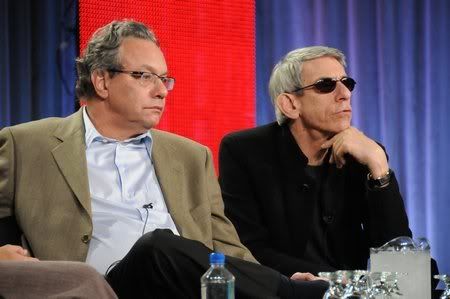
As you can imagine, it didn’t take much effort to accumulate a star-studded list of names to pay tribute to Carlin, and the PBS panel to promote “George Carlin: The Mark Twain Prize” included two of them: Richard Belzer and Lewis Black.

The first question posed was one that should’ve been expected by anyone familiar with Carlin’s work: how can PBS properly pay tribute to a man whose most famous routine involved the seven words you can’t say on television?

“I learned a long time ago that if you’re in a church, you don’t do certain things, and if you’re in someone’s home, you don’t do certain things,” said Belzer. “If the philosophy of the network is not to offend people who they think might be offended, I don’t think this hurts this show. George Carlin is so brilliant, his use of language is vast and compelling, that a few bleeps might even be enticing. I don’t think it diminishes how great George is, how important the show is, and the function that PBS serves over time. I mean, civility in manners are defined in different ways. If it were up to me, we’d have all the words you’d want, but I am not a network.”

Executive producer Peter Kaminsky followed up on Belzer’s comments, clarifying, “It goes beyond the
network. It’s the law. The Supreme Court will come down on you heavy. This case is…I mean, I think one of the legacies of George is he started something in the Supreme Court and 40 years later, or whatever, 30 years later, we’re still arguing about it. It’s very much front burner, and we hope to see that change in a new administration.”

Black, unsurprisingly, chimed in on the matter as well. “What will happen if the words were actually said?” he asked. “Children would panic? They don’t hear the words at home? I think what Richard
said is absolutely true, and I think it’s bullshit.”

For her part, Kelly Carlin McCall – George’s daughter – finds the whole matter hilarious. “My dad’s view on this was that if you actually bleep the words, they become dirtier, so it’s a beautiful irony for me,” she said. “I just find it very strange.”

She also acknowledged that her father was extremely happy when he got the news about the Twain prize, which is impressive, given that he didn’t tend to take awards very seriously. “He saw the game of it all,” she said. “It was a bunch of bullshit. But there was something about this prize that meant something to him. He did call me when he found out about it; he was very excited. I think in the last five years he really started to take in that he was the elder statesman of this genre, of these people. He took that seriously. I think he was really getting that, wow, these people really want to honor him in that way. I don’t know how he would have sat there and taken it all in. I would love to have known.”

The best series of comments from the panel…?

Continue reading »

TCA Tour, Jan. ’09: “Great Performances: King Lear”

I wouldn’t want to dismiss several generations of Shakespearean actors with a single statement, so let me see if I can phrase this just right: we’re getting to a point where it just doesn’t feel like there are as many greats as there used to be. That’s not to say that there aren’t greats, of course, but…well, surely you know what I mean. Olivier, Gielgud, Richardson…all are gone, and for all the talents that have arisen in the intervening years, few are quite as immediately associated with the Bard in the same way, where you hear their name and immediately say, “Oh, yes, of course, he’s the Shakespearean actor.”

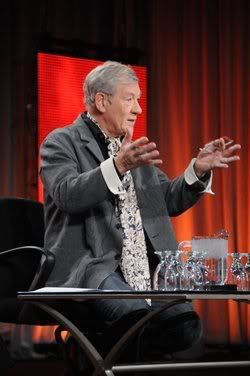
With that said, however, it’s fair to say that Sir Ian McKellen falls into the category of those who, despite roles ranging from Gandalf and Magneto to James Whale and Kurt Dussander, is still very much recognized as a Shakespearean actor. Granted, the reputation is probably significantly greater in the UK, where he’s done television productions where he’s played the title roles in “Hamlet,” “Macbeth,” and “Richard III,” as well as Iago in “Othello,” but after his unique cinematic interpretation of “Richard III,” in which he co-starred with Robert Downey, Jr., and Annette Bening, even Americans began to associate him with Shakespeare.

As such, the idea of seeing McKellen appearing as King Lear in an upcoming “Great Performances” production is one that intrigues me considerably, particularly after experiencing his enthusiasm for the play firsthand.

“King Lear” has fascinated McKellen throughout his acting career, particularly because of the wide variety of ages amongst its characters. “As a young man, I was very intrigued by the part of Edgar, which I played,” he said. “And there are a lot of young people in ‘King Lear’ that a young audience could identify with, good and bad. Then there are a lot of good middle-aged characters. But what’s perhaps special about ‘King Lear,’ as opposed to a ‘Hamlet,’ is that the central part is for an old person. And so if, like me, you’ve worked your way through Shakespeare as an actor, you know, waiting up there is ‘King Lear’ and, beyond him, a shadowy Prospero, maybe and, oh, dear, a Falstaff too.

“I’ve been in the play twice before as Edgar and as Kent. I’d seen what it cost the person — the
actors playing King Lear: Brian Cox, on one occasion, giving his all a hundred percent every night and discovering in himself depths and heights that he hasn’t necessarily had to use in any other part. And the late Robert Addison played King Lear, when I played Edgar, in his mid-60s and frail at the end of the evening because the performance had taken so much out of him. So I suppose it’s the challenge. It’s the expectation that it will complete your journey through Shakespeare.”

With that said, however, McKellen admitted that he hadn’t actually been spending his career with a burning desire to play the role of King Lear.

Continue reading »

Seven shows that just don’t get enough love

Unfortunately, I didn’t have the time to put together a list of my favorite television moments before the end of 2008, but that doesn’t mean I didn’t spend an inordinate amount of time in front of the tube. (Come to think of it, maybe my television addiction was the reason I didn’t have the free time to write about the best of 2008. Hmm.)

Anyway, here is a list of seven terrific shows that seem to be flying under the proverbial radar.

1. “True Blood” (HBO)
Alan Ball, the writer of “American Beauty” and the creator of “Six Feet Under,” brings us a series based on vampires in the Deep South. The series is based on Charlaine Harris’ Sookie Stackhouse series of books and stars Anna Paquin — whom I argued, under the moniker of Eli Cash a few years back, would have made a better Penny Lane than Kate Hudson — as a mind-reading waitress in a small town in Louisiana. The first season was excellent, though it got off to a bit of a slow start. Paquin is the key, but her best friend Tara (played by Rutina Wesley) often steals the show.

2. “Dexter” (Showtime)
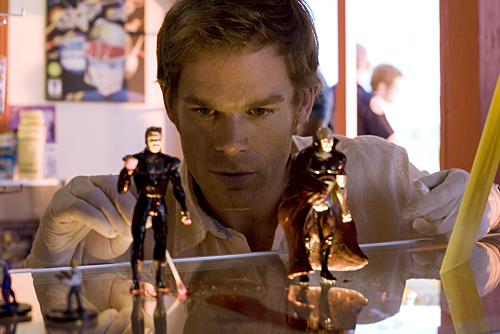
Everyone’s favorite serial killer is back for a third season. Dexter Morgan works for the Miami Police Department as a blood splatter analyst and he spends his night hunting and killing the worst criminals in South Florida. This series has been excellent from the start, and shows no signs of slowing down. This season brought in Jimmy Smits as an Assistant District Attorney with a serious dark side. After “Six Feet Under,” I thought I’d always see Michael C. Hall as the openly gay David Fisher, but now I can’t imagine him as anyone other than the dark and secretive Dexter.

3. “It’s Always Sunny in Philadelphia” (FX)
Maybe this show just too crass to be mainstream, and thinking about it, that’s probably what makes it so great. “Sunny” really hit its stride in the third season, and the fourth season was even better. The show follows a group of friends (and Danny DeVito) that own a bar in Philadelphia. Every episode has its own completely ridiculous premise, but once you accept that every single character is a selfish, narcissistic moron, it becomes that much funnier. As far as sitcoms go, for me, the excellent fourth season put it in the same tier as “The Office,” “30 Rock,” “Weeds” and “Curb Your Enthusiasm,” and that’s some good company.

4. “Summer Heights High” (HBO)
Anyone who dug the U.K. version of “The Office” should check this series out. It’s an Australian mockumentary that follows three characters — the effeminate drama teacher Mr. G, the snotty private school transfer Ja’mie and the disruptive Tongan student Jonah — which are all played by the same actor, writer/creator Chris Lilley. Watching a grown man run around in a school dress is ridiculous, but that’s part of the fun. Lilley is extremely talented; it can’t be easy to morph into three very different characters every week. The humor is outrageous and the situations (especially involving the clueless Mr. G) can be David Brent-type awkward.

5. “Supernatural” (CW)
This sci-fi/fantasy series started off in typical “freak of the week” fashion with a different monster to defeat each week, but as it got into its third season, it really developed some serious, serialized chops. Now in its fourth year, the show continues to follow two brothers who are “hunters,” i.e. they fight all manner of evil — demons, vampires, ghosts, etc. Even in its first year, the show held my attention, but with all the happenings of the last two seasons, new episodes don’t sit on my TiVo for very long. Viewers who like sci-fi/fantasy should definitely check out “Supernatural.”

6. “The Unit” (CBS)
I think a lot of people write off “The Unit” as a typical CBS show like “CSI” or “NCIS” (or some other acronym), but as the show as worn on, it’s simply gotten better and better. The subject matter is ripe with storylines; the show follows members of a Special Forces unit (led by super-badass Jonas Blane, played wonderfully by Dennis Haysbert) and their families. A quick look at the production staff reveals a couple of big names — David Mamet (“The Untouchables,” “Glengarry Glen Ross”) and Shawn Ryan (“The Shield”) — that instantly give the show some serious credibility. Early on, the series could get a little “hooah!” and focus on the wives a bit too much, but the later seasons have struck the perfect balance between the professional and the personal.

7. “Brotherhood” (Showtime)
It doesn’t have as high of a profile as “The Sopranos” and maybe it’s not as addicting, but “Brotherhood” has the same feel and the same quality of writing. It follows two brothers in Providence, Rhode Island. One is a corrupt state congressman trying to do right by his family and the other is deeply involved in organized crime. Those that miss “The Sopranos” or “The Wire” should definitely rent the first season of “Brotherhood.”

“Leverage” seems to be getting better

In the interests of full disclosure, I would have cut “Leverage” from my playlist after a ridiculous second episode (“The Homecoming Job”) if not for the insistence of my wife, who liked the first two episodes a whole heck of a lot more than I did. The premiere was solid, even if it was a little rough around the edges. It’s understandable that a show that tries really hard to be cute (a la “Ocean’s Eleven”) might struggle at the start as the relatively unknown actors get used to playing their characters and working with each other. In “Ocean’s Eleven,” audiences already knew and liked Brad Pitt and George Clooney, and had seen them acting “cute” dozens of times before, so their act went over well.

But I’m getting ahead of myself. “Leverage” is a TNT drama, which (for me) has been a little hit or miss when it comes to original scripted series. I am hooked on “The Closer,” but was never able to get into “Saving Grace” and was too annoyed by Mark-Paul Gosselaar’s distractingly long hair in the promos for “Raising the Bar” to even bother with that show. (I did enjoy the paramedic drama, “Saved,” but it was canceled after only one season.) “Leverage” is about a group of thieves that decide to go the Robin Hood route by enacting their own brand of justice on those that would take advantage of others.

At the center of the show is Timothy Hutton, whom I’ve liked since the days of “Turk 182” and “Beautiful Girls.” He plays Nathan Ford, a former insurance investigator who recently lost his son when the company he worked for wouldn’t cover his son’s experimental procedure. He enlists the help of four criminals — a con artist, a cyberthief, a cat burglar and a martial arts expert — to, and I quote, “pick up where the law leaves off.”

“Leverage” tries very hard to be witty, and it often hits the mark. There was the aforementioned second episode, however. At one point, Ford and his beautiful con artist cohort had to create a distraction at the L.A. shipping docks. So they pose as an obnoxious couple on vacation, complete with Hawaiian shirts and awful attitudes. They were even dragging their luggage around the shipping docks of L.A. — in a post-9/11 world. It was simply ridiculous.

The good parts of “Leverage” actually remind me quite a bit of “Hustle,” a British television show that was also about a group of con artists. Their intentions weren’t as noble as Ford’s, and that’s one thing that bothers me about “Leverage” — they don’t seem to want to keep any of the money. For example, in the third episode, “The Two-Horse Job,” a trainer hires them to retrieve an injured horse from his nefarious owner after the owner set fire to the trainer’s stable. The gang does its thing and manages to get the horse back and steal $12 million from the greedy owner. Do they keep any of the dough? Nope. They give it all to the trainer. This just doesn’t seem realistic to me.

I’ve always been fascinated with the dark side of society which is why I’m often drawn to anti-hero stories like “The Shield,” “Rescue Me” and “The Sopranos.” “Leverage” doesn’t get nearly as dark as those series, but it does live in that grey area between right and wrong. I’d like to see the moral ambiguity get a little thicker, as the victims of the con jobs are often caricatures of villains (with no discernable positive qualities).

So for now, I’m going to keep watching. But if I see Timothy Hutton dressed in a Hawaiian shirt traipsing through the docks of Los Angeles again, I’m going to delete my season pass and not look back.

« Older posts Newer posts »

© 2026 Premium Hollywood

Theme by Anders NorenUp ↑