Author: Bob Westal (Page 109 of 265)

Writer guy Bob Westal was literally born in Hollywood and has commented on the worlds of movies, popular culture, politics, and food ever since. His interest in cocktails is more recent, but he made up for lost time with hundreds of “Drink of the Week” blog posts for Bullz-Eye. In addition to writing and editing, Bob also talks a lot.

Movie news and stuff

Where to begin…

* Could the ultimate case of movie development hell finally be unraveling? We’re told that Ewan McGregor will star in Terry Gilliam’s “The Man Who Killed Don Quixote.”

* Lionsgate may be on the block with all kinds of possible ramifications for hardworking and often underpaid workers there. However, just in case you were worried, they’ve got $16 million set aside for five executive golden parachutes if Carl Icahn’s attempt is successful. Whew!

* Anne Thompson discusses the people who didn’t show up at Cannes.  Somehow, she overlooked my absence.

* One of the people who isn’t showing up is living cinema legend/bad boy Jean-Luc Godard, who is citing the chaos in Greece as his reason. Yeah, I have only the vaguest possible idea what he means by that myself. Meanwhile, the Playlist’s Christopher Bell reviews a new documentary about the severed friendship between Godard and Francois Truffuat, who were respectively the Rolling Stones and the Beatles of midcentury French New Wave cinema and, alas, finds it lacking.

francois-truffaut-strike

* Marina Zenovich, the woman whose documentary many credit/blame with restarting the Roman Polanski mess — and, yes, that’s the “evil profligate dwarf” himself next to Godard, Truffaut as well as Claude Lelouche and Louis Malle in the picture above — will next be doing the film version of Mark Harris’s widely acclaimed book, Pictures at a Revolution, which looks at the remarkable five best picture nominees from 1968.

* Speaking of Polanski, Oy vey, Woody. (Via FilmDrunk whose headline repeats the obvious, but still hilarious, joke here.)

* Armando Iannucci, co-writer and director of the outstanding comedy about tragedy, “In the Loop,” has a new film with a preposition and a noun in the title set up.

* Cameron Crowe, who was on an amazing run of movies like “Say Anything” and “Almost Famous” until suddenly, he wasn’t, is getting back on the horse with a fact-based tale that involves all kinds of animals, possibly including horses. It does sound like a heck of a story.

* Nikki Finke thinks James Robinson should pay up before showing his face at Cannes.

It’s late. I’m tired and I want my turkey burger and an Old Fashioned. More to come later.
Yes, yes it is.

Sam C. Mac, or at least his headline at the Playlist Nation, asks if a possible return to form for Japanese comedian turned tough-guy actor-director-painter “Beat” Takeshi Kitano is a good thing. (Apparently some, but not all critics, are responding that way to his latest film “Outrage, which is premiering at Cannes.)

In response, I’m posting the two scenes below that show Kitano doing what he does best. Creating the kind of mind-bending bad-assery that is as scary as it hypnotic, and the kind of beauty that make strong men and women cry.

First, from “Fireworks“:

From “Dolls

This movie really got to me at the AFI Film Festival some years back and if you’re wondering why the young couple is tethered together, I can’t remember. I’d look it up but I’m afraid I’d ruin my computer weeping on the keyboard. It’s that kind of a movie.

Weekend box office: “Iron Man 2” holds on in U.S., but “Robin Hood” makes out like a bandit abroad

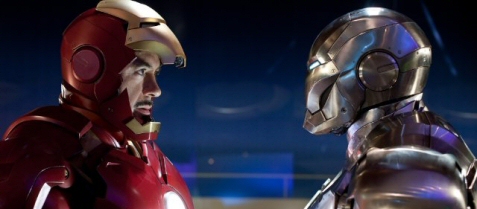
Seeing as we have two action movies in contention this week, I’ll cut to the chase. Marvel and Paramount’s “Iron Man 2,” as was universally expected back before the weekend started, easily held on to its #1 spot at the box office. Ir scored a weekend estimate of $53 million that nevertheless included a somewhat higher than average drop of over 58%, indicating that the movie, as I imagined, isn’t quite wowing filmgoers the way the first movie in the franchise did.

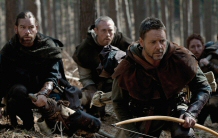
This week’s big debut, “Robin Hood” has generally received a decidedly mixed reaction from, as far as I can tell, everyone who sees. It came in slightly below expectations at an estimate of roughly $37.1 million for Universal. (Earlier, the box office gurus were talking about figures in the range of $40-50 million.) Nevertheless, though the reaction be “meh,” not all the news for brave Sir Robin is mediocre. Indeed, THR this morning trumpeted a take of $74 million from just under 6,944 screens across the globe, making it the world’s #1 movie.

Russell Crowe is, I guess, It’s been a long, long time since my stint in an International Sales wing of a smallish film company, but it appears that, then as now, the combination of a really well-known star like Russell Crowe, action, and a strong (at least in theory) storyline remains the formula for success in non-English-speaking territories. I’m sure this news is music to the ears of the suits of recently bad luck/bad decision prone Universal.

Continue reading »

“A handful of hope that became a fistful of hell”

I’d seen it before, but as my brief DVD review below kind of indicates, watching the kind of amazing new Criterion edition of Nicholas Ray’s “Bigger Than Life” was an exceptionally powerful experience for me. It’s got all the slick professionalism and entertaining wit of any studio film from the mid-fifties, but on a more subtle level it’s almost crude and points the way to film to the new style of American filmmaking to come. It was also, in a funny way, a somewhat topical film.

Bigger Than Life

Director Nicholas Ray’s bombastic follow-up to “Rebel Without a Cause” failed in 1956, but has become a cinephile favorite despite being available only at museums and on Fox Movie Channel and TCM. Now presented fully restored and in a ultra-first-rate Criterion edition, film geeks may be entranced by Ray’s outlandish use of widescreen and color, but it also stands as one of the most profoundly emotional and disturbing of classic-era Hollywood melodramas.

James Mason (who also produced) stars as Ed Avery, a kindly suburban schoolteacher struck by a rare, painful, and deadly illness. The only path to survival is a new “wonder drug,” in this case cortisone, a steroid. In time, Avery seems recovered, except that he is slowly becoming a control-obsessed tyrant and drug addict with delusions of grander prone to increasingly extreme reactionary diatribes. Of course, his loving and too dutiful wife (Barbara Rush) and devoted young son (Christopher Olson) suffer. His health-obsessed P.E. teacher best friend (Walter Matthau, terrific in one of his earliest film roles) experiences some discomfort as well, but mid-fifties people were far more naive than we are now about science-driven “miracle cures.” “Bigger than Life” could have been called “Fascist With a Chemical Cause.” (Ray was the prototypical “Hollywood liberal.”) At heart, however, it is an exploration of the potential for madness underlying all family life and quite a baroque one. “Bigger Than Life” treats the potential dissolution of a family somewhat like sci-fi horror and, in this case, it kind of is.

Click to buy “Bigger Than Life”

« Older posts Newer posts »

© 2026 Premium Hollywood

Theme by Anders NorenUp ↑