 Many film critics and commentators consider “Mulholland Drive” to be a masterpiece. Some have called it one of the greatest films of the 21st century. Roger Ebert loved it, and that’s notable as he’s not always a big fan of David Lynch’s films. He opens his review with the following: “David Lynch has been working toward ‘Mulholland Drive’ all of his career, and now that he’s arrived there I forgive him ‘Wild at Heart’ and even ‘Lost Highway.’ At last his experiment doesn’t shatter the test tubes. The movie is a surrealist dreamscape in the form of a Hollywood film noir, and the less sense it makes, the more we can’t stop watching it.”
With that context, it’s a bit of a crime that I had not yet seen the film. I’m old enough to remember watching “Twin Peaks” on television, so I’ve had ample opportunity over the years. The recent passing of Lynch gace me the motivation to go back and check out his films, so I was pleased to see that “Mulholland Drive” was streaming on Tubi.
As Ebert points out, the film doesn’t present a logical narrative. Most people watching it for the first time will be confused, and you just have to let go and follow along with the dream. But Lynch plays a clever trick on the audience, as the film opens with scenes that seem completely real . . . it’s only later that we realize this portion of the film was more of a dreamlike fantasy for one of the characters.
The film begins with a mysterious woman (Laura Harring) surviving a car crash on Mulholland Drive and suffering amnesia. She adopts the name “Rita” from a Rita Hayworth poster and hides in an apartment, where she meets Betty Elms (Naomi Watts), an optimistic aspiring actress newly arrived in Los Angeles. Betty helps Rita uncover her identity, leading them into a web of intrigue involving Hollywood auditions, shadowy figures, and bizarre subplots (like a bungled hit job or a terrifying encounter behind a diner).
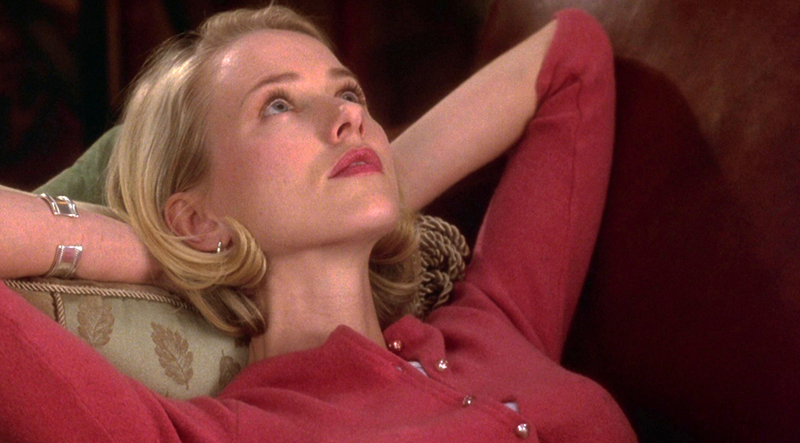
About two-thirds in, the narrative abruptly shifts: characters’ identities flip, and we follow Diane Selwyn (Watts again) and Camilla Rhodes (Harring again) in a grimier, more fragmented reality involving jealousy, betrayal, and despair.
If you knew this going in, the film would make a bit more sense, but it also would soften the experience, which is meant to disorient and confuse the audience. I’m eager to watch the film again and experience how it lands a second time through.
Watts and Harring are stunning in the film. They’re both beautiful of course, but they both contribute to layers of sensuality and eroticism that permeate the film. And they brilliantly portray their dreamlike and then reality-based characters. This manifests in many ways, not least of which is the contrast in their two love scenes.
Watts has described the film as a life-changing moment. “That’s why I will never forget what David Lynch did for me. When he cast me in Mulholland Drive, I was literally at the lowest place, and yet he managed to pull away all those masks.” – IMDb She was simply brilliant here, with the contrast between the wide-eyed Betty and the broken and bitter Diane Selwyn.
Harring was a revelation. She had that haunting beauty needed for the role, but also managed to pull off two characters as well. She credits Lynch for her performance. “Lynch told me to ‘walk like a broken doll’… ‘There’s a cloud following you wherever you go, like a dark black cloud that’s very scary.’”
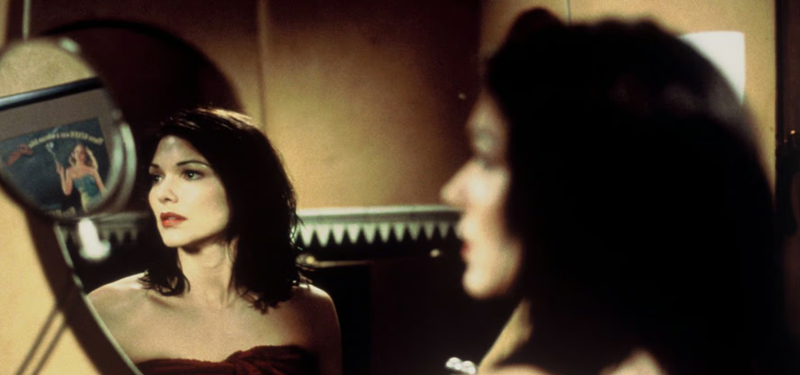
For his part, Lynch has always been famously reticent about explaining the full meaning of the film, preferring to let viewers interpret it personally. He has described it as “a love story in the city of dreams” and emphasized its emotional and intuitive origins. Lynch explained: “I always try to tune into those first ideas and let them talk to me, and follow them wherever they lead . . . I guess the initial spark for the film was the name, Mulholland Drive; the signpost in the night, partially illuminated for a couple of moments by the headlights of a car.”
In the end, the film is a brilliant depiction of Hollywood as a city of dreams that can crush the spirit of many who dream of stardom. Now on the more films by David Lynch . . .


