There’s an idea out there that documentary filmmakers require more good luck to make a successful project, and though Brent Meeske took some three and half years to complete his work after another film died aborning, he clearly made some remarkable luck for himself with “Branson.” It starts out somewhat slowly, but what emerges is a compelling chronicle of the ups-and-downs of several talented but far from famous performers trying to make a life in the small city in Missouri that could best be described as Las Vegas, but with a vastly lower budget and constructed to Ned Flanders specifications.
At times, the hugely corny but enthusiastic performances may make us feel we’re in Christopher Guest/”Waiting for Guffman” territory. The post screening discussion revealed that at least one of the performers chronicled, evangelical Christian and New York transplant Geoffrey Hastings Haberer, was more than aware of the Guffmanesque aspects of Branson performances. Still, though its connection with Jack Black might worry some, this is not a film that in any way condescends to its subjects. At the same time, I’m not sure I’d be writing so favorably about it were it not for the far more troubled, yet also incredibly talented, performer who walks away with the film, Johnny Cash impersonator Jackson Cash. His Olympian personal struggles and powerhouse performances have moved even relatives of the late legend of American music to marvel at the similarity.
As he proved in a remarkable live performance following the film, Jackson Cash is really not impersonating Johnny Cash at all in any normal sense of the world. He simply performs Cash’s material with such clarity, honesty, and with such a remarkably similar voice (the result, Cash says, of damage to his larynx delivered by an angry drug dealer), that the differences between this man in black and the earlier one dissolve.
He wowed the film festival audience at a post screening concerted, which included at least one clearly enthralled well-known director, so things may be looking up for this remarkable performer, whose personal demons (drugs, possible bipolar issues, etc.) make up a significant portion of the more dramatic material in “Branson.” I hope real success and stability are in the offing for Cash, as a brief conversation with the man indicated that he is very much as advertised: the real deal.
***
A few brief items from more or less outside the world of the L.A. Film Festival:
* Den of Geek passes along a Reuters report of director Michael Bay critiquing the marketing of the “Transformers” sequel about to hit theaters. (Hint, he apparently doesn’t think it’s a sequel at all, but an “event.”)
* Nathaniel R. has sixty ways to celebrate Meryl Streep’s birthday. (Guess how old she is.)
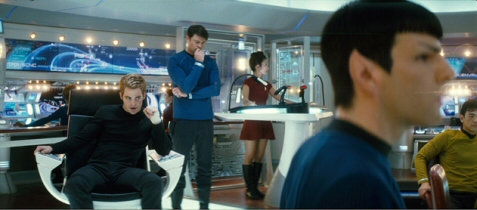
* Box Office Mojo has the “actuals” from last weekend. No big surprises, but they report that “Star Trek” is now officially the most successful “Star Trek” film of all time, adjusted for inflation. For once, I agree with the masses. I might quarrel at times with the hyperactive visual style of the film and I wouldn’t make any particular claims to greatness for it, but nor would I for “The Wrath of Khan.” All in all, it couldn’t happen to a nicer little space opera.