Tag: Los Angeles Film Festival (Page 3 of 3)

Wrapping LAFF

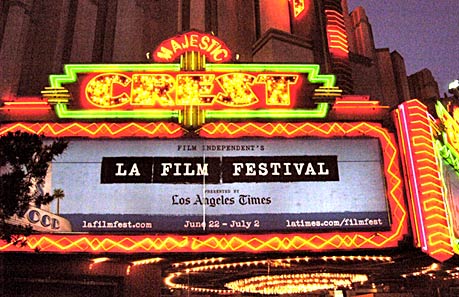
The Los Angeles Film Festival ended Sunday and I’m not sure what I want to say about it. I saw several films and wanted to see more, but circumstances, and trying to blog about most of what I did see, kept me to a one or two movie per day average on the days I attended. Most of the films were as good as their buzz at least, but most of them had already screened at Sundance.

For me, the highlights were “Black Dynamite” — which was by far the most fun screening all around despite happening within hours of Michael Jackson’s death (which happened to be a less than a mile from where I was working on my posts) — and “We Live in Public” which was simply the most interesting film with the most interesting post-screening discussion. “Branson” was a highlight of another sort for the electrifying performer/one-man-drama, Jackson Cash. The film geek/native West Angeleno in me went moderately wild for a film I haven’t written about here, Curtis Harrington’s melange of romance and dark fantasy “Night Tide,” which was shot in late fifties Santa Monica and Venice.

Los Angeles is, of course, an extremely large city with strong neighborhoods but no true urban core (which is not to say that we aren’t trying to grow one) and a place where all kinds of movies screen all the time, if you know where to find them. It’s also, of course, the place on earth with the largest concentration of people involved with actually making movies or doing things related to making them. Getting them to spend a lot of time actually watching new films probably requires enticing them to go elsewhere and break their usual, already way too busy, routine.


Continue reading »

“Branson” and the world outside LAFF

There’s an idea out there that documentary filmmakers require more good luck to make a successful project, and though Brent Meeske took some three and half years to complete his work after another film died aborning, he clearly made some remarkable luck for himself with “Branson.” It starts out somewhat slowly, but what emerges is a compelling chronicle of the ups-and-downs of several talented but far from famous performers trying to make a life in the small city in Missouri that could best be described as Las Vegas, but with a vastly lower budget and constructed to Ned Flanders specifications.

At times, the hugely corny but enthusiastic performances may make us feel we’re in Christopher Guest/”Waiting for Guffman” territory. The post screening discussion revealed that at least one of the performers chronicled, evangelical Christian and New York transplant Geoffrey Hastings Haberer, was more than aware of the Guffmanesque aspects of Branson performances. Still, though its connection with Jack Black might worry some, this is not a film that in any way condescends to its subjects. At the same time, I’m not sure I’d be writing so favorably about it were it not for the far more troubled, yet also incredibly talented, performer who walks away with the film, Johnny Cash impersonator Jackson Cash. His Olympian personal struggles and powerhouse performances have moved even relatives of the late legend of American music to marvel at the similarity.

As he proved in a remarkable live performance following the film, Jackson Cash is really not impersonating Johnny Cash at all in any normal sense of the world. He simply performs Cash’s material with such clarity, honesty, and with such a remarkably similar voice (the result, Cash says, of damage to his larynx delivered by an angry drug dealer), that the differences between this man in black and the earlier one dissolve.

He wowed the film festival audience at a post screening concerted, which included at least one clearly enthralled well-known director, so things may be looking up for this remarkable performer, whose personal demons (drugs, possible bipolar issues, etc.)  make up a significant portion of the more dramatic material in “Branson.” I hope real success and stability are in the offing for Cash, as a brief conversation with the man indicated that he is very much as advertised: the real deal.

***

A few brief items from more or less outside the world of the L.A. Film Festival:

* Den of Geek passes along a Reuters report of director Michael Bay critiquing the marketing of the “Transformers” sequel about to hit theaters. (Hint, he apparently doesn’t think it’s a sequel at all, but an “event.”)

* Nathaniel R. has sixty ways to celebrate Meryl Streep’s birthday. (Guess how old she is.)

* Box Office Mojo has the “actuals” from last weekend. No big surprises, but they report that “Star Trek” is now officially the most successful “Star Trek” film of all time, adjusted for inflation. For once, I agree with the masses. I might quarrel at times with the hyperactive visual style of the film and I wouldn’t make any particular claims to greatness for it, but nor would I for “The Wrath of Khan.” All in all, it couldn’t happen to a nicer little space opera.

Sunday box office update — “The Proposal” makes it to the altar

It’s a gorgeous and breezy afternoon as I type this from the relatively bare business center of the otherwise swanky W hotel which abides in the shadow of UCLA and, during the Los Angeles Film Festival, a small but select chunk of the film industry. That may include some of those who could be effected by the news, apparently first reported by the redoubtable Nikki Finke, that perceived poor management skills and excessively neurotic behavior have led studio chief Brad Grey to commit to a major management shakeup at Paramount. (The Hollywood Reporter has a considerably more staid version of the story up.)

I’ll finally start writing about some of what I’m seeing and hearing at the festival later tonight, but first it’s time for the numbers. Those were especially good for Ms. Sandra Bullock who, with the help of Ryan Reynolds and what Variety sees as “pent-up demand” for rom-coms, scored an estimated $34.1 million with “The Proposal.” That would be Bullock’s biggest opening ever.

Following with a really outstanding estimated $26.9 million in its third weekend, “The Hangover” dismissed it’s newer male-appeal comedy competition, “Year One,” which came in only at the #4 spot, but nevertheless managed $20.2 million in its first week. Ms. Finke described the hunter-gatherers-go-biblical film’s performance as “disappointing,” but The Hollywood Reporter deemed it “solid,” perhaps reflecting the  budget. In any case, it surely reflects that a perception of poor quality caused by bad reviews (as discussed on Thursday’s pre-weekend post) and perhaps more or less matching word-of-mouth might actually have some impact on a film’s performance.

Up” did its bit for the power of family entertainment, remaining aloft at the #3 spot for yet another week with $21.3 million, say the estimators, and is within a hair’s breadth of the $225 million mark for its entire run.

Happy Father’s Day.

News flash! Los Angeles Film Festival to eat blogger’s life

Hey folks, just a word that my posts over the next 48 hours or so might be a bit lighter and/or more fouled-up than usual as I’ll be taking the 91 to the 605 to the 105 to the 405’s Wilshire Blvd. exit and attending the Los Angeles Film Festival, starting tonight. It’ll mean commuting 40 miles, and sleeping on friends’ couches and other fun stuff like working in family stuff for Father’s Day.

The upshot is my schedule’s going to be way hectic for the just a bit, so you might (or might not) be getting more than your share of my patented “movie moments” style posts for a bit, but I’ll definitely be back Sunday night with box office and perhaps a tidbit or two about the festival, with more substantive material definitely to follow starting Monday and on through the festival’s conclusion a week from Sunday, assuming I can get into stuff.

Tonight’s film pick for me, BTW, is the latest mumblecore comedy sensation, “Humpday,” about two straight best buddies who decide to have sex for the sake of some really squirmy art porn. We’ve come a long way from Oscar and Felix.

Newer posts »

© 2023 Premium Hollywood

Theme by Anders NorenUp ↑