Tag: HBO (Page 6 of 12)

Watch “The Ricky Gervais Show”

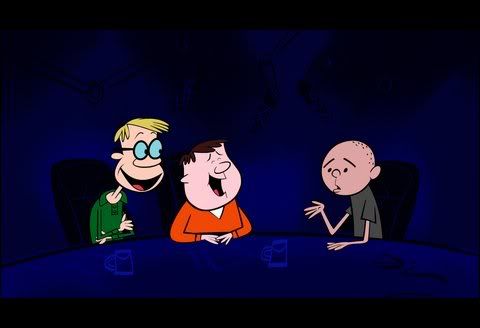
This should go without saying for fans of the original version of “The Office” or “Extras,” but Ricky Gervais is back on HBO in “The Ricky Gervais Show.” The show is based on a series of podcasts that Gervais and Stephen Merchant (co-creator of “The Office” and “Extras”) did with Karl Pilkington, a weird little man with a round head and a bunch of strange ideas.

The show premiered on Friday, and I was laughing so hard I was literally crying during the opening segment, where Karl explains his idea for how death and birth should proceed. Check out this clip from “The Late Show.”

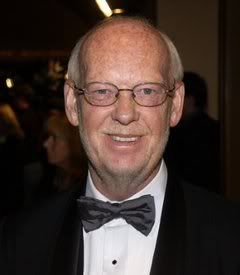
A Chat with Mick Jackson, director of “Temple Grandin”

Sunday night brings the premiere of HBO’s wonderful new film, “Temple Grandin,” and if you’ve been reading Premium Hollywood lately, then you’ve already seen my interview with its subject, Dr. Temple Grandin. After the panel for the film at the TCA tour, I also caught up director Mick Jackson for a few minutes, which was just enough time to ask him about working with Grandin, to find out why he made one of his casting choices, and for him to offer me a bit of sage directorial advice.
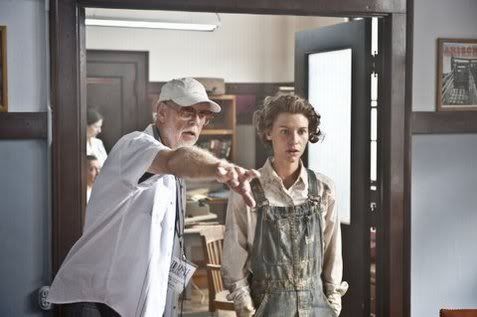
Bullz-Eye: I talked to Temple a little earlier, and she said that she really enjoyed the process of working with you on the film.

Mick Jackson: Oh, she’s wonderful. Part of the story that we tell in the movie is that she has this tremendous eye for detail and uses that to put it together into a pattern and see the whole picture, but, in fact, when you’re dealing with us as movie makers, it’s the same thing. She had the eye for the details that were right and the details that were wrong, but she also had – unusually for someone whose life you’re telling through film – a sense of what it’s like to make a movie, to put it together into a whole picture. We reconstructed what we thought her apartment as a student would be like at Arizona University, based on what she told us and where she lives now, and she visited the set and I said, “That’s supposed to be your rooms.” And she said, “Hmmm. Well, it isn’t. But it could’ve been. It could easily have been.” (Laughs) It really takes a great ability to be able to step outside your own life to be able to say that. And she understood that, when telling the story of someone’s life, you don’t tell every bit of it. Otherwise, the movie would last as long as the person’s life. So she understood that we would collapse things and create composite characters and all that stuff.

It was great. I mean, I watched the movie with her the first time she saw it, and she was in tears. And I said, “Why?” She said, “He was only Mr. Carlock,” referring to her teacher. And the screenwriter and I had decided to call him Dr. Carlock, to convey an eminence that would kind of enhance the impression he made on her. But she thought that giving him his doctorate was a way of her giving back thanks to him for everything he’d done for her. That was lovely. The other thing is that after that screening…she saw the movie once and she was very enthusiastic, and I was driving later in my car and the phone rang, and it was Temple, still enthusiastic… (Laughs) …wildly raving about the movie. And I realized that what we’d shown in the movie, which is her being able to run things in her head, was true. She was quoting me shots and edits and things from the movie that she’d seen once. So she’d obviously downloaded the movie into her head, like a DVD, and she was running it backwards and forwards! “I love that shot where she opens the door and…” (Laughs) So it was literally true…and that was very gratifying.
BE: So how familiar where you with Temple before the script for the movie landed on your desk?

MJ: Not at all. My wife had heard her on NPR, but the name meant nothing to me. So I read this thing and just got dragged into it. I thought, “This is just the most amazing story!” You can’t tell the story of every person who has autism, because it’s such a great range. Not everyone’s a visual thinker or has comfort from a squeeze machine, but…it’s like movies about the Iraq war: you don’t tell the whole war story, but you take something, like “The Messenger” or “The Hurt Locker,” you tell a specific story about one person and, in effect, you’re telling the whole story. So telling the story about Temple is like telling the whole story of autism. If you understand Temple, then you understand what autistics go through, or what being the parent of an autistic child is like.

I hope the main thing that people take away from Temple’s story, which is uniquely true for Temple but is in fact true for everybody who is a parent or a relative of an autistic child, is that you’ve got to put all that energy in there for some of it to come back. You can’t just lean back and say, “This child maybe should be looked after by doctors or go into an institution,” like they suggested with Temple. All that energy, all that pushing of Temple by her mother, her aunt, her science teacher out into the real world did it. It helped her emerge. The title of one of her books is “Emergence,” and that’s just what she did. There was this amazing mind in there that was just trapped and came out. So I think that’s the lesson we ought to take away from it: never let up your energy for a moment, and never let up that sense of constantly pushing them forward. Not really like a stage mother, but just not shielding them from life and just trusting them to find a way of dealing with life. It’s a learning experience. Everything was a learning experience for her.

BE: My wife works with autistic students, and I told her that Temple had said much the same thing, about how her mother pointedly made sure to push her toward activities in the summer and to the activities in high school. And my wife said that that’s exactly what she does every day with the student she’s working with right now.

MJ: And I’m sure she sees that the more energy she puts into it, the more she sees the change. Not immediately, because it’s over a long period of time, but…it’s the one lifeline that they have to the real world, people pushing them into it.

BE: I had one question about the casting for the film. How did Catherine O’Hara come to play Temple’s aunt?
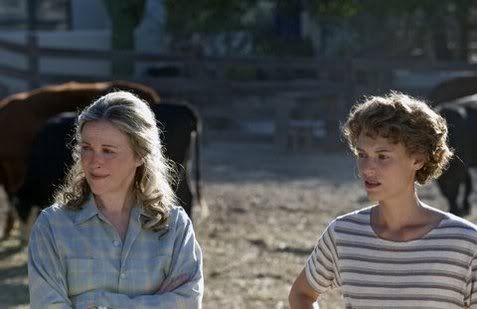
MJ: It’s my experience in casting character actors, as it were, that if you cast someone who has a great comedic career, they know a lot more about the human condition sometimes than straight dramatic actors. And I so much wanted the aunt to kind of be a way into the movie for the audience, a sympathetic, warm figure. You meet Temple with all of her kind of raw orneriness and awkwardly unsocial manic behavior, but you have this reassuring figure there in the aunt, who says, “Yes, it’s all right, dear. Come this way, Temple.” And I thought Catherine just brought all of that warmth that you get from knowing about human foibles from being a comic actress to the role. I thought she was wonderful.

BE: Of all things, my memories of “Home Alone” worked in her favor here, because that’s the movie that first made me think of her as a motherly type.

MJ: (Laughs) Yes!

BE: I know you’ve got to keep moving, but of the other projects you’ve worked on over the years, do you have one that you think didn’t get the love it deserved?

MJ: They all get a certain amount of love, which I’m grateful for. “The Memory keeper’s Daughter,” which was the thing I did before this, for Lifetime…I think it’s probably a little shorter than I would’ve had it, the movie. If I’d been allowed to expand it a little more, I think it would’ve been a more moving story, but that was quite fun to work on. I sound as if I specialize in disease-of-the-week movies: I’ve done Lou Gehrig’s Disease (“Tuesdays with Morrie”), I’ve done Down Syndrome, and now autism! (Laughs) But every one is a movie, and it’s a good movie if it happens to be about the people.

BE: Well, it’s not about a disease, but for what it’s worth, I’m very partial to “Volcano.”

MJ: That was fun, but take some advice from me: if you’re ever directing a movie, don’t get into a race with another movie on the same subject (“Dante’s Peak”). Nobody ever says, “Oh, I saw the second volcano movie!” (Laughs)

Will “Avatar” become the Octo-b.o. king?

HmmmYes, folks, at last we have a teeny-tiny bit of suspense and disagreement among the prognosticators of b.o. (that’s “box office” for those who’ve never read Variety).  Hot off the news that’s she stands to be mythologized by HBO — and make no mistake, the “no-holds-barred” fictional film blogger “Tilda” will be inspired primarily by Finke and not Sharon Waxman or especially Anne Thompson — she most definitely bars certain holds, including insulting people for sport — Nikki Finke writes that it’s just possible that “Avatar” could be knocked off its perch by a movie that few males will see except under the most extreme forms of feminine duress.

The kicker here, of course, is Superbowl Sunday, when a large majority of the male public will be obsessed with the game as well as the beer and fat-heavy snacks that go with the event. Of course, some women like football, some men lack the sports-obsession gene (that’s me), and lots of people who really don’t follow football at all will still be watching the game with friends and family. But many females will still be flocking to our nation’s cinemas, and the younger ones especially may be attracted to “Dear John.”

The wartime love story is currently at 30% on Rotten Tomatoes and directed by Lasse Hallström,who is a long way from his “My Life as a Dog” days as an arthouse favorite. La Finke notes that Sony and Relativity Media’s sentimental romance starring Amanda Seyfried and Channing Tatum was defeating the mighty Na’vi on Fandango by a margin of 20 percent. Even rival Fox execs concede re: Sony executives’ hopes for an upset: “They are not suckin’ on a crack pipe.”

Still, the more establishment voice of The Hollywood Reporter‘s jolly Carl DiOrio states fairly unequivocally that James Cameron will, in fact, reign for one more week — though that may well be it. Still, I wonder just what kind of pipe he and his editors might have been smoking that allows him to describe the violent action thriller-comedy, “From Paris with Love” as another female skewing movie — it’s certainly not a traditional romance.

From-Paris-With-Love_jpg_595x325_crop_upscale_q85

Okay, the title might skew could be misleading to some (at least those who don’t know their early James Bond), and women certainly won’t mind looking at “The Tudors” star Jonathan Rhys Meyers.  However, take one look at the trailers and clips and it’s clear this is a real testosterone-fest of an over-the-top action film, embodied by a goateed, shaven-headed John Travolta as a brutal CIA agent and Finke is probably right that it could steal some of the male thunder of “Avatar.” Well, everyone’s allowed the occasional foul-up and jolly Carl certainly is part of “everyone.”

The consensus seems to be that the film from future “Dune” director Pierre Morel will perform below the numbers for “Dear John,” especially given a male-drained Sunday. Its reviews, by the way, are about equally underwhelming. On the other hand, this highly biased critic definitely recommends you take a look at “We’ll Always Have Paris”  — a Bullz-Eye feature on Paris-based movies that I had, of course, absolutely nothing to do with.

That’s pretty much all the news that fits save for noteable Oscar-nomination driven expansions in terms of theater count of “Crazy Heart,” the very good “An Education,” and “Precious.”  Those latter two-films especially might also not be harmed by the big game.

Gabourey Sidibe in

TCA Tour: A Chat with Temple Grandin

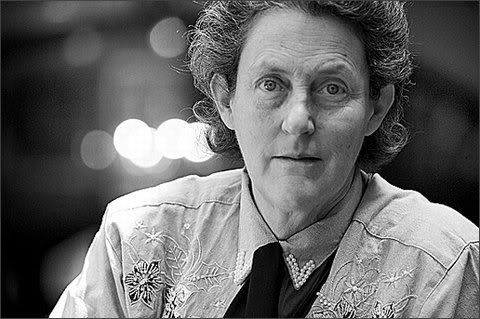
Temple Grandin is a Doctor of Animal Science at Colorado State University, a consultant to the livestock industry in animal behavior, and a best-selling author. She’s also autistic, a fact which you may have already known if you happen to have a connection to someone with autism, be it first-hand or indirectly. For instance, I came to know about her, as you’ll soon read, through my wife, who works with autistic students and is the proud owner of a copy of one of Grandin’s books, The Way I See It: A Personal Look at Autism and Asperger’s.

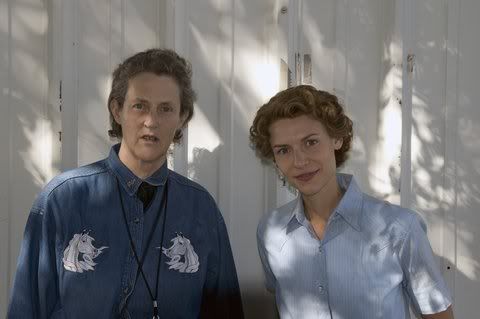
When an advance screener of the new HBO movie based on her life – entitled, appropriately enough, “Temple Grandin” – landed on our doorstep in advance of the TCA press tour, you can imagine that we popped it into the player post-haste, and I’ll tell you right now, I was blown away: Claire Danes gives a phenomenal performance as Grandin, but director Mick Jackson ties for MVP with his visual presentation of how Grandin’s mind works. I immediately went about trying to set up interviews in connection with the tour, and although Danes was unavailable, when HBO asked if I’d like to chat with Grandin herself, you’d better believe that I didn’t hesitate for a moment before saying, “You bet!”

Bullz-Eye: I just wanted to start off by telling you that my wife works with autistic children.

Temple Grandin: Oh, okay.

BE: She hadn’t actually trained in the field, but she ended up stepping into a job as a substitute teacher in a special education classroom, and she had such aptitude that the teacher gave her a gift: a copy of your book. She basically said, “Not everyone has the heart and the temperament to work with children who need a little extra effort, but I really think you do, and I think you’d get a lot out of reading this.”

TG: Which book was it?

BE: “The Way I See it.”

TG: All right.

BE: So as soon as she found out that I was going to be speaking with you, she immediately passed it on to me and said, “You’ll be wanting to read this.” (Laughs) But we also watched the movie together, and I thought it was fantastic. How did that first come about? Did someone read your book, then come to you and pitch the idea of making it into a movie?

TG: Well, that’s actually been going on for a good long time. Emily Gerson Saines started working on this about nine years ago and went to, like, two different directors and writers. Then, finally, it came together with the right people.

BE: Did you get final say about who would play you in the film?

TG: Well, that was just decided. Claire Danes did an absolutely brilliant job. Absolutely brilliant. I met with her for about six hours, and I gave her the oldest VHS tapes I could find of me, where I’d be more autistic-acting. Like, in old programs from the late ‘80s, where I was on a TV show, and some lectures from the early ‘90s. We dubbed those over onto DVDs, and she had those to practice with. I didn’t have any video older than that. Or movies. We didn’t do movies as a family, so I didn’t have that.

BE: I thought the visual aspects of the film, which try to give the viewer an understanding of how your mind works, were outstanding. I guess that was Mick’s idea…?

TG: I thought that was absolutely brilliant, the way Mick showed all of that. Wonderful. Like, the scene where it shows all of the shoes coming up…? That’s exactly how I think. Mick was absolutely brilliant with that.

Continue reading »

TCA Tour: The Ricky Gervais Show

If you’ve never listened to the podcast that Ricky Gervais does with his writing partner, Stephen Merchant, then you’ve been missing out on one of the funniest things that’s available for download. Part of it comes, obviously, because of the well-established quick wits of the aforementioned two gentlemen, but the show’s X-factor, if you will, comes from the third man in the recording studio: Karl Pilkington. Although he’s still pretty much a non-entity in the States, you can count on him achieving – at the very least – full-fledged cult status when HBO debuts their new animated series, “The Ricky Gervais Show,” which, despite its title, easily features Pilkington as heavily as Gervais.

There’s no real way to make sense of the way Pilkington’s mind works; we can but marvel at the way he perceives the world and the comments that he makes about it. Here are five moments from the panel which demonstrate what I’m talking about:

1. When asked about Pilkington’s absence from the panel, Gervais explained, “He’s on his way to Rio, I think, to do a documentary called ‘Seven Wonders,’ which we have arranged. We send him around the world to see what he thinks of the seven wonders, and he’s not impressed so far. He thinks the pyramids are overrated. I said, ‘Why?’ He said, ‘It’s a bad design. It’s a bad design.’ He said, ‘The lounge is going to be huge, but the bedroom is going to be tiny.'”

2. “Some of the things that Karl has come up with are incredible,” said Gervais. “I mean, he thought Anne Frank was just avoiding paying rent.”

3. “His serious understanding of evolution,” said Merchant, “is that…he went, ‘Yeah, I know evolution. It starts germ, fish, mermaid, man.'” Said Gervais, “I was trying to get the rudimentaries of evolution to him, and I was explaining to him that we are closer to chimps than chimps are to the gorillas. He was going, ‘No, we are not.’ I go, ‘No. We are.’ I said, ‘We are 98.6 percent genetically identical to a chimpanzee.’ I said, ‘That’s 1.4 percent difference between us and a chimp.’ And he went, ‘That’s got to be the ass.’”

4. “I call him every day, three or four times a day, just to find out what he’s doing,” revealed Gervais. “I called him the other day, and I said, ‘What are you doing?’ And he went, ‘Just walking in the park.’ I went, ‘All right.’ We went, ‘Oh.’ I said, ‘What?’ He said, ‘A worm just fell from the sky.’ And I went, ‘What do you mean?’ He went, ‘He just fell out of the sky.’ I said, ‘Well, a bird probably dropped it.’ And he went, ‘Oh, yeah, there is a bird.’”

5. “We did one podcast,” said Gervais, “I think it was in December 2006, and I said, ‘What was the highlight of the year? Looking back at this year, what will stand out for you?’” And he said, ‘Probably that time I saw a grub eating a biscuit.’ I go, ‘What do you mean?’ He went, ‘Well, I was eating a biscuit. I put the rest on the windowsill. I looked around, and there was a grub eating it.’ I went, ‘Why is that an event?’ He went, ‘I never thought I would see that that year. It made me think, ‘We couldn’t be more different, us and the grub, but we both like a biscuit.'”

Continue reading »

« Older posts Newer posts »

© 2026 Premium Hollywood

Theme by Anders NorenUp ↑