Tag: Francis Ford Coppola

Staff Pick: “What She Said: The Art of Pauline Kael”

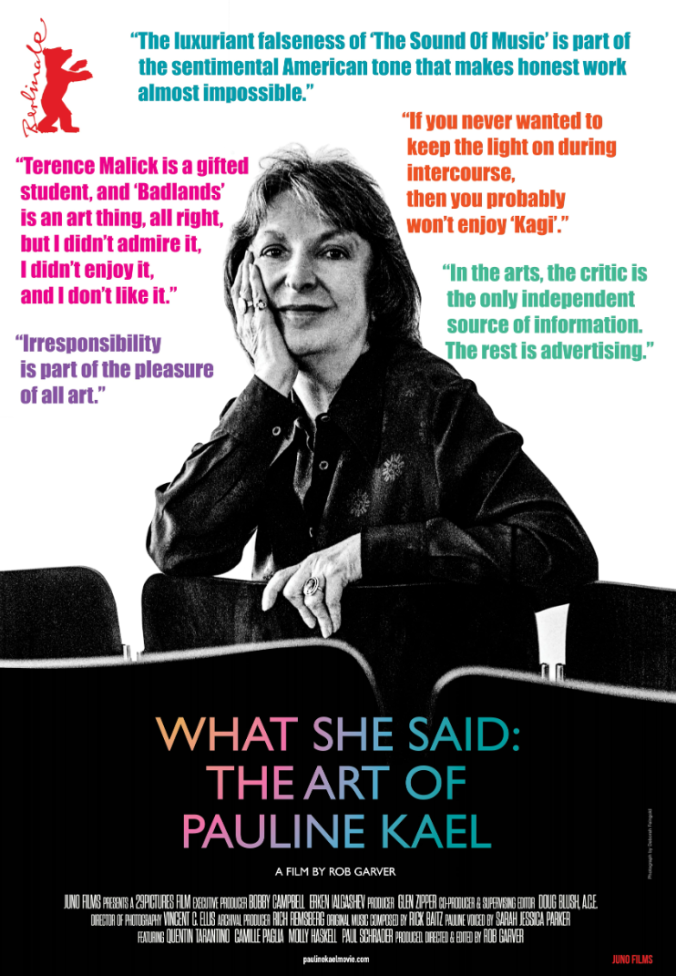
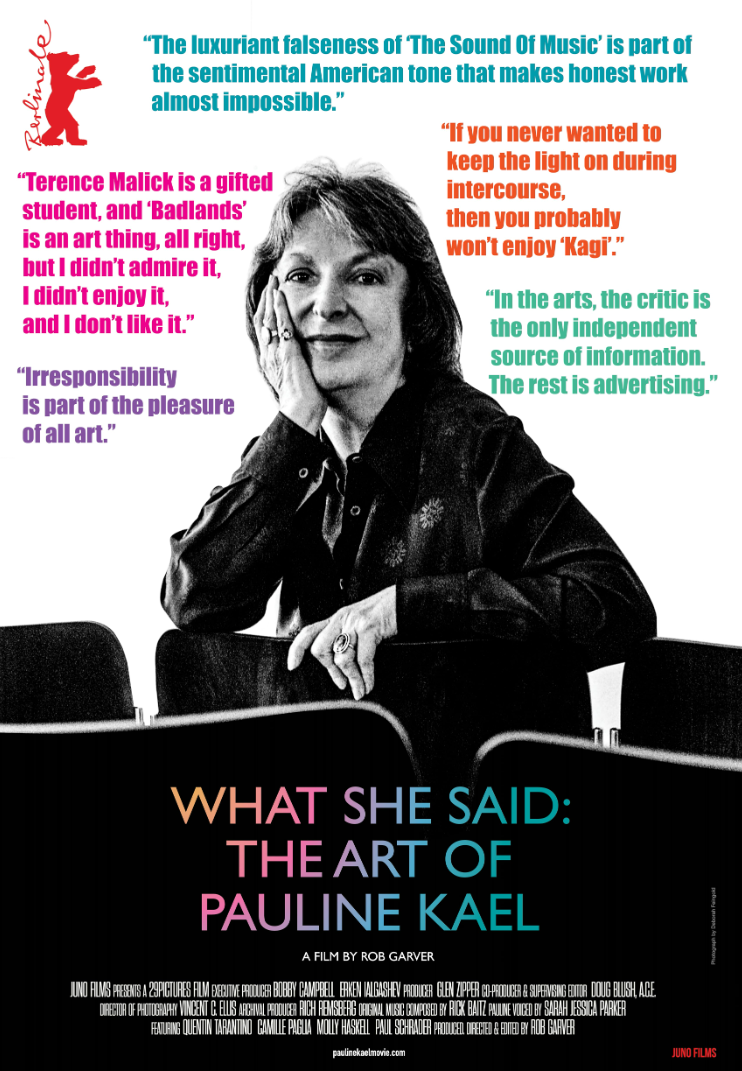
Staff Pick - What She Said: The Art of Pauline KaelPauline Kael is one of the most provocative and consequential film critics of the 20th century. I’d heard so much about her over the years and wanted to learn more, so I was quite happy when the documentary about her life — “What She Said: The Art of Pauline Kael” — appeared on Amazon Prime.

In many ways, her life story was very different from what I expected. She faced significant personal challenges, including raising her daughter alone as a single mother while navigating a male-dominated industry. She was polarizing, fiercely opinionated, and enormously talented, which led to a remarkable career highlighted by her tenure at The New Yorker from 1968 to 1991, where she penned more than 400 reviews and essays.

Her writing style was distinctive: passionate, personal, and often provocative, blending sharp analysis with visceral emotional responses to films. She championed the “New Hollywood” era of the 1960s and 1970s, praising directors like Martin Scorsese, Francis Ford Coppola, and Brian De Palma, while often taking aim at more established figures such as Stanley Kubrick. Right away, it was easy to like her as I learned more about her through this film. She was fearless, and in many ways I shared her taste in movies — especially the ones she admired.

Yet she could also be quite vicious in her criticism. While I respected that she never shied away from tearing into popular films, at times she seemed unable to appreciate genuinely great movies that simply didn’t align with her personal tastes.

Her review of “The Sound of Music” in McCall’s magazine was so scathing that it reportedly led to her firing. “The sugar-coated lie that people seem to want to eat … and this is the attitude that makes a critic feel that maybe it’s all hopeless. Why not just send the director, Robert Wise, a wire: ‘You win, I give up’?” Really? The film may not be for everyone, but as a musical, it’s undeniably brilliant.

Continue reading »

Movie Flashback: “The Conversation” (1974)

The Conversation

I’ve wanted to see “The Conversation” for years, and with the pandemic raging I was able to catch up on a number of older movies I had wanted to see. I had high expectations for this one, and frankly I came away a little disappointed.

Some movies just don’t age well, and that’s sometimes true with movies from the 70s. The decade was loaded with brilliant films, and they often live up to their reputation, even after decades have passed. But some of the films that seemed ahead of their time in that decade don’t hold up as well.

I was bored as I watched this film, even though the story throws in some interesting twists. The pacing is painfully slow, which is common from films of that era. And I can often appreciate the slower pacing of these films, particularly compared to the sensory overload we sometimes experience with many modern films. But too many of the scenes in “The Conversation” seemed unnecessarily long. I kept waiting for the story to move along, and by the time we reached the twists at the end I was just waiting for the film to end.

The story behind the film is interesting, and one comes away impressed with the direction of Francis Ford Coppola and the acting by Gene Hackman and John Cazale. Roger Ebert loved it, but the slow pace was too much too overcome to get into the story.

Ebert writes:

Coppola, who wrote and directed, considers this film his most personal project. He was working two years after the Watergate break-in, amid the ruins of the Vietnam effort, telling the story of a man who places too much reliance on high technology and has nightmares about his personal responsibility. Harry Caul is a microcosm of America at that time: not a bad man, trying to do his job, haunted by a guilty conscience, feeling tarnished by his work.

Ebert provides some excellent perspective, and as a work of art the film is brilliant. Less so, however, as a work of entertainment.

“The Conversation” was nominated for “Best Picture” in 1975, the same year that “The Godfather, Part II” took home the Academy Award. Coppola had quite a year! Yet “The Godfather, Part II” was so much more entertaining than this film.

I realize I’m in the minority in my opinion of this film. Reading the reviews on Rotten Tomatoes, with a fresh score of 97% from the critics, it seems as if each of them are trying to outdo one another in heaping praise on this film. I only found two critics that agreed with me. Fred Topel called it an “outdated techno-thriller,” which summed up my thoughts nicely. The other, John Simon from Esquire Magazine, noted, “The icy fascination soon succumbs to two forms of excess. One is Coppola’s growing infatuation with the technical aspects of his subject… The other is a mystery story that thickens into ever greater contrivance, improbability, and opacity.”

The critics who praised the film often citing the building tension and suspense. Sadly, I experience growing boredom and impatience.

I can only recommend this film to cinephiles and wannabe film critics who need to see this as an important film of the 70s. I can’t recommend it to anyone looking for an enjoyable or gripping film experience.

John Fever

I Knew It Was You: Rediscovering John Cazale

Can you name all the major actors from the “Godfather” movies? If you’re missing one, it’s probably John Cazale. He played the initially minor character of Fredo, the tragic runt of the gangster litter who figured so prominently in “The Godfather: Part II.” An accomplished stage actor, Cazale appeared in only five moves before his death from lung cancer in 1978 at age 42, but since they also included “Dog Day Afternoon,” “The Conversation” and “The Deer Hunter” — all nominated for Best Picture Oscars — it is slightly strange he isn’t better known. It’s definitely not for lack of esteem from his peers. This short HBO documentary from director Richard Shepard (“The Matador“) proves that point with testimonials from friends, colleagues and fans including Al Pacino, Robert De Niro, Francis Ford Coppola, Sidney Lumet, Gene Hackman, Olympia Dukakis, Richard Dreyfuss, Steve Buscemi, Sam Rockwell, and Meryl Streep, who was Cazale’s girlfriend at his death. It seems that, aside from his ability to submerge himself into a role and raise the game of his fellow actors, the unglamorous and good-natured Cazale also had a way with beautiful women.

Though the packaging of this DVD is first-rate if overly elaborate, it also attempts to hide the fact that “I Knew It Was You” is only 40 minutes long, not counting about an hour’s worth of special features. Nevertheless, this is a sincere, well-made, and entirely laudable labor of movie love.

Click to buy “I Knew It Was You: Redisocovering John Cazale”

3.5 / 5 Stars

An official trailer for a Thursday: Kevin Spacey is (not quite) “Casino Jack”

Not to be confused with Alex Gibney‘s documentary, “Casino Jack and the United States of Money,” also about the jailed conservative lobbyist Jack Abramoff, this new trailer for “Casino Jack” is slicker than ones I’ve seen before.

Something still feels off here to me, for all the snazzy editorial work. The only joke that’s actually funny is Kevin Spacey‘s spot-on Al Pacino impersonation, though even the choice of Spacey feels off. Perhaps I’m being too literal minded, but Abramoff was younger and more jockish and athletic when all of this was going down. On the other hand, the movie-obsession is correct. Abramoff is a movie buff who even co-produced an actual action film or two, including the Dolph Lundgren vehicle, “Red Scorpion.”

Still, I’m keeping an open mind. He hasn’t had gigantic luck with fiction features so far, but director George Hickenlooper (“The Big Brass Ring”) has been involved with probably two of the best all-time documentaries about outrageous show business figures, the Francis Ford Coppola-centric “Hearts of Darkness: A Filmmaker’s Apocalypse” and the even better “Mayor of the Sunset Strip” about DJ and ultimate scenester Rodney Bingenheimer. I’m sure there’s a bit more here than meets the eye, at least I hope so . . .

© 2026 Premium Hollywood

Theme by Anders NorenUp ↑