Category: TCA Press Tour (Page 7 of 56)

“Bones” hits the 100-episode mark

Tonight marks the 100th episode of Fox’s “Bones,” which may amaze those who originally only saw the series as something for David Boreanaz to do until Joss Whedon finally got around to making an “Angel” movie. Instead, the show has gradually found a sizable fan base who love the patter between Boreanaz and his co-star, Emily Deschanel, as FBI Agent Seely Booth and forensic anthropologist Dr. Temperance “Bones” Brennan.
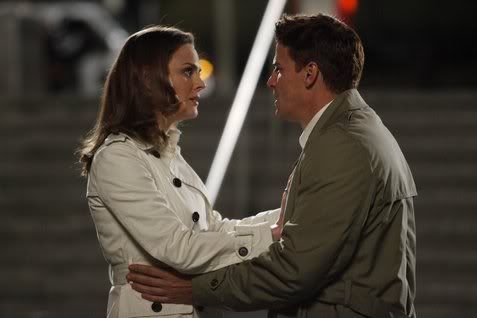
Sorry, did I say “patter”? Obviously, I meant “sexual tension.”

This evening’s episode is a flashback to the very first case worked together by Booth and Brennan, one which took place a year prior to the events seen in the show’s pilot. In addition to the fact that it provides an opportunity for the actors to revisit the way they played their characters five years ago (or, in the case of Eric Millegan, an opportunity to play Dr. Zach Addy again period), there’s a concluding moment which has the potential to completely change one of the fans’ favorite parts of the show…or, at the very least, shake it up a bit. My wife, who has seen every episode of the series since its premiere, got a bit emotional at the concluding scene. I’ll be interested to find out if you react the same way.

I was fortunate enough to attend a “Bones” breakfast during Fox’s day of the Winter 2010 TCA Press Tour, and both David Boreanaz and Emily Deschanel were in attendance. Unfortunately, however, my conversation with David was precisely two questions long, thanks to a strange moment where I asked him about working with Diedrich Bader – he plays FBI Agent Andrew Hacker – and got a blank stare and an assurance that he had absolutely no idea who that was.
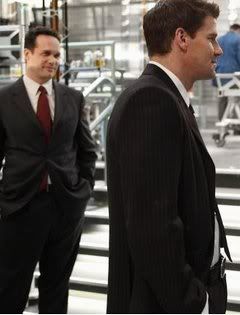
At the time, I was concerned that I’d gotten bad information, but, no, he definitely had worked with Bader. Weird. Fortunately, before that confusion caused the chat to come to a complete and total standstill, leading someone else to pick up the reigns of the conversation and run with them, I’d asked him how he felt about his series making it to the vaunted 100-episode mark.

“It’s kind of hard to believe that you’re there,” Boreanaz admitted, “especially when it’s hard enough to get a pilot made, let alone picked up. I’ve always maintained that whatever you’re working on, you should work just really in the moment and not think about the next episode. You should just maintain a real strong sense of your work and your ethics and being honest with yourself and just continue to work hard and see where that takes you, whether you do 12 episodes, 20 episodes, or whether you just do a pilot. You’re just fortunate to be working.”

Thankfully, I made no such faux pas while talking to Emily, who was glad to answer my question about how she thinks the character of Brennan has changed over the course of 100 episodes.
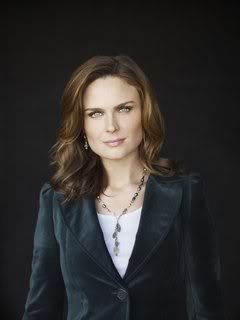
“You know, I recently just watched the pilot again, because I’ve been thinking about doing this 100th episode and doing a flashback, so I’ve been thinking about that a lot,” she said. “I think she’s become less guarded, more open…she’s trying to learn socially how to interact with people. Watching the pilot, I was, like, ‘She’s very wild, in a way.’ She’s just determined to do her thing and just does it and doesn’t care what anybody else thinks…and I just love that about her! That’s definitely still true. In one sense, she’s become more polished…and I say that in a lot of ways! But she’s just growing up and kind of thinking about something before she does it. And she’s also trying to understand social interaction and people’s emotions and feelings…and her own! Trying to understand other people’s through exploration of her own. She’s not as quick to just kick someone’s ass! She’s kind of learning to take a breather before she…it’s, like, Fox had this whole campaign of ‘Take a Moment,’ and Brennan had to take a moment before she acted on things. Before, she just acted. That’s not to say that she doesn’t still just act sometimes, but I think that’s a way she’s changed over the years.”
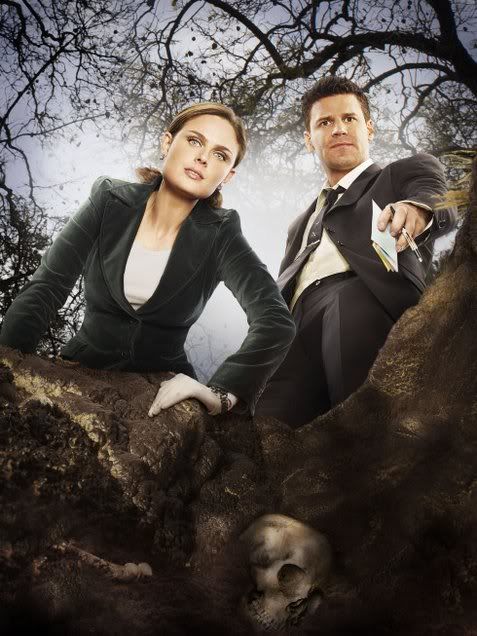
At the time we chatted, they hadn’t yet begun filming the 100th episodes, but they had been having meetings about what it was going to look like.

“Visually, with the hair and make-up and wardrobe, it was fun trying on the wardrobe that was Brennan back in the day,” said Deschanel. “Cynthia Somers, the costume designer, did a great job. She was not there at the beginning, but she did a great job of pulling these things that were very Brennan-esque from the beginning. It’s been great to go and to start thinking about Brennan in that time and what she was. It’s been fun.”


A Chat with John Walsh (“America’s Most Wanted”)

And, now, for today’s “this’ll make you feel old” moment: on Saturday night, “America’s Most Wanted” will be celebrating the airing of its 1,000th episode. The series has been on the air for an astonishing 23 years, and when you consider the number of criminals that host John Walsh has – with the assistance of the show’s viewers – helped put behind bars in that amount of time, you have to hope that it will continue to run for at least as many more. I had the chance to chat with Mr. Walsh when he made an appearance at the January TCA Press Tour, and I quizzed him about the show’s origins, its longevity, and its ties to the TV movie based on his own real-life events (“Adam”), but given the heavy topics at hand, it seemed appropriate to ease into things with a slightly lighter topic.

Bullz-Eye: I wanted to start off by asking you about a couple of your pop-culture appearances outside of “America’s Most Wanted,” the first being your turn as a character in DC Comics’ “The Outsiders.”

John Walsh: It was a real honor. It actually was a real honor, and when I talked to the guys who draw and write “The Outsiders,” they went, “You know, we’d like to incorporate you into this, because you are the real-life Batman.” And I went, “What a compliment!” And they said, “Well, you were a successful businessman, and you’re kind of not a vigilante. You really want to try and change things.” I considered that a real compliment. I have a 15-year-old son who’s a terrific artist and a big fan of comic books. I had had the distinct pleasure of being the only guy ever written into the “Dick Tracy” comic strip, too, so I’d experienced it years before, but “The Outsiders” is kind of a cool comic book, and for an old guy like me… (Laughs) You know, it’s so funny, but of all the things…I mean, I’ve been honored in the White House Rose Garden by four different presidents, and that’s something that really touches your heart, but my son said to me, “Dad, you’ve been on ‘South Park’ and now you’re on the cover of ‘The Outsiders.’ Now you’re cool.”

BE: Did you manage to score any of the original artwork from your “Outsiders” appearance?

JW: I did! And I treasure it, because they really did it with some dignity. The segments were about the exploitation of runaways, of how bad guys use teenage runaways that may be running away from a terrible abusive home or sexual abuse, and they hit the streets and get exploited. And, you know, a lot of the Outsiders are kids who’ve been through Hell themselves and are trying to make a difference. So, yes, I have some of the original artwork, and I treasure it. It’s really kind of a gratifying thing.

BE: So how about that “South Park” appearance? (Laughs)

JW: “South Park” I loved. I loved the “South Park” guys, was a fan of the show, and didn’t know I was going to be on… (Laughs) …and was on the road somewhere and….I have another son who’d just graduated from college, and he said, “Dad, everybody at my college is talking about you being on ‘South Park.’ It’s all over school.” I thought it was funny. It’s really an irreverent look at society, and it was very cool. I’m a fan of that show.

BE: Did you send them a thank-you note?

JW: Oh, gosh. You know, I should. I actually should, because it was very funny. Very satirical, but very funny.

BE: Have you turned up anywhere else that’s really stuck out for you?

JW: You know, someone told me the other day that there’s a punk rock band called John Walsh, and that they’re not kind of the alternative punk. Their music is pretty edgy, and they’re kind of on the side of the right. Their punk music says, “Hey, there are heroes out there, and there are guys who are making a difference, but you can still be an alternative type of person and a punk rocker.” I never cease to be amazed by the younger culture in this country.

BE: How thrilled are you that the show has continued to thrive for as long as it has?

JW: I’m amazed, because we…now I’ve been told that we’re the 3rd longest running show in prime time history, behind “60 Minutes” and “48 Hours.” That’s a real compliment to the fans. And we’re still #1 in the most important demographics. I mean, I don’t kind myself: you’ve still got to be #1 in the 18-49 demo. It’s such a rewarding experience, because we’ve caught over 1,000 guys, and last week we caught the guy who murdered a 6-year-old girl and shot three other people on Thanksgiving. He’d been out there 5 weeks. I went down to south Florida to do the show, and he got caught 10 minutes after the show aired. It was fantastic. I’ve walked in those people’s shoes. I’m the father of a murdered child. I’m amazed that we’ve been able to stay on this long and that we’re so popular, but I thank the public. Now we’re worldwide, we’ve caught people in 35 countries, our website is huge and usually the second most popular TV website next to “American Idol”…usually, depending on the week. (Laughs) It’s such a gratifying experience, and I think it’s the public saying, “We don’t want to be vigilantes. We watch the show because we want to make a difference. Maybe we’ll see one of those creeps, or we’ll learn something, or we can help society.” Last year, we caught someone in China, we caught someone in India. Both countries extradited those creeps immediately. We’ve kind of been woven into the global culture now, and it’s a pretty gratifying thing, it really is. Especially for the father of a murdered child.

BE: That actually leads me to a question I’ve been curious about. When they made the movie “Adam,” about your son, were you very involved, or was it just something that came about because they were aware of your experience and wanted to bring it to the public consciousness?

JW: It was a wonderful woman named Linda Otto, who is now deceased, who brought the idea. She was an award-winning documentary film producer, and she’s the one who brought it to NBC. At that time, Grant Tinker was the president of NBC, and they were the #1 network. I’ve been told it was the most-watched TV movie of all time. It aired three times. She said to Grant Tinker, “We’re going to do it with dignity and integrity, and I’m going to involve the Walshes. I want to try and stay as close to what happened with the Walshes as possible.” And I thought they did a really good job, but the most incredible thing is that, with those three airings of “Adam,” it was the first TV show ever to show pictures of missing children…and they found sixty kids from those three airings! Most of them were non-custodial parental abductions, but they were kids that were missing for years, so I sort of learned the power of television from watching and being part of the movie “Adam.” I think NBC did a very dignified job of doing it, and Linda Otto sort of changed the way this country looks at missing children with a TV movie.

BE: To bring it full circle, was it “Adam” that led you – either directly or indirectly – to “America’s Most Wanted”?

JW: No, you know, it really was people internally at Fox. Rupert Murdoch had seen “Crimewatch UK” in England, which is done by the BBC and has been on for 40 years. When they approached me in 1987, I said “no” for six months. I didn’t know what Fox was… (Laughs) …and I didn’t know who Rupert Murdoch was, and I didn’t know who Barry Diller was. I didn’t want to be on television. I was trying to change laws, trying to recover from Adam’s terrible abduction, and…I was a businessman. I built deluxe hotels before Adam was murdered. So when they approached me…it wasn’t my idea…they said, “You know, you’ve spent so long trying to change laws and change the way this country looks at missing and exploited children. How would you like to host the first reality television program?” My first question – other than “who’s Rupert Murdoch?” and “what’s Fox?” – was, “What’s reality television?” Because America didn’t have reality television. So we were Fox’s first show. I did it because the first guy was a child killer that escaped from prison. He was our first capture. Three days after the show had aired, he was caught in Staten Island, New York. Guess what he was doing? He was running a shelter for the homeless. An escaped killer and rapist. (Shakes head) It’s been an incredible experience…but it was really Fox’s idea. They pursued me, and it’s been a wonderful partnership for 23 years.

A Chat with Adrian Hodges (“Survivors,” “Primeval”)

Adrian Hodges has been beloved by fans of BBC America’s ever-growing sci-fi lineup ever since presenting them with “Primeval,” which he created along with Tim Haines, but they’ll soon have a new reason to give him a hug when they seem him on the street. Americans may not be familiar with the 1970s British TV series known as “Survivors,” but, hey, that’s okay: it just means that they’ll be able to dig into Hodges’ new take on the series – which premieres this Saturday night on BBC America – without any preconceptions. Plus, as you’ll soon read in my chat with Mr. Hodges, which took place a few hours after the TCA panel for “Survivors,” he’s taken great pains to make sure even those who are familiar with the original series will, by the end of the first episode of this new version, realize that he’s got plenty of surprises in store for them, too. Oh, and listen up, “Primeval” fans: you’d well to read beyond the bits about “Survivors,” as we chatted about the status of the third series of “Primeval” as well as the oft-discussed feature film based on the show. There’s also some stuff about other items on Hodges’ C.V., and…well, you’d just better go ahead and read it for yourself, hadn’t you?

Adrian Hodges: Wow, look at your recorder. I used to do a bit of journalism when I first started out, but my tape recorder was… (Holds his hands several inches apart, then laughs) That’s technology for you!

Bullz-Eye: Hey, mine’s shrunk by two or three times in size just in the past few years! (Laughs) Well, first off, I just want to say that I’m a big “Primeval” fan.

AH: Thank you! Cool!

BE: I was not familiar with the original 1970s version of “Survivors,” but I take it that you were at least somewhat of a fan of it.

AH: Yeah, I was, in that kind of general way we are when we’re kids and we watch TV. I was maybe 15 or 16, something like that, and I remember very clearly the impact of the first episode. If I’m honest, I’m hazy about some of the other, later episodes, but I do remember the extraordinary shock of the imagery of a husband dying, of things that were stand-out images in my head, and you carry that through the years. It was something I remembered very well, so it was really kind of great to be asked to have another look at it, you know?

BE: So they pitched it to you, then?

AH: They did. What happened was that I’d done “Primeval,” as you know, and I was very actively looking for a genre show that I could do in a slightly…well, in Britain, it’s in a later timeslot. Something that was a bit more…I don’t want to say more adult, because I think that “Primeval” is adult, but not a family show in the same way. However you define “family.” (Laughs) So “Survivors” was perfect. BBC had had this great success with reviving “Doctor Who,” so they were looking at some of their old shows and saying, “Well, that one wouldn’t work, but maybe this one would.” And “Survivors” was one they thought might work again, so they basically came to me and said, “What do you think?” And I thought it was great, not so much because of the set-up, not just because of the post-apocalyptic thing, which is fascinating, but it’s kind of not the point. The point is what happens afterwards, and that’s the fun of it for me as a writer, ‘cause you don’t often get a chance to write about people in the most extreme situation. So that’s why I wanted to do it.

BE: What was the profile of the original show? Was it semi-high? I ask because I’m a kind of an Anglophile, so I was surprised that I hadn’t heard of it.

AH: I don’t think it was, really. In terms of being a success at the time, it was, but it wasn’t, like, a thing like with “Doctor Who,” where you carry that memory with you, and so that when it was revived, there was this huge desire to like it. It was one of those shows where…people didn’t want to not like “Doctor Who.” They wanted to like it. It was a nice thing to happen, and it doesn’t often happen. There aren’t many shows that people are so fond of that they can go with that attitude to them. Usually, as you know, when you remake or re-imagine a show, you get the opposite reaction, which is that people don’t really want you to do it, because they liked it the first time. And, now, there’s been such an acceleration of remaking of formats. It’s a very dangerous area. I thought “Survivors” was a good one because it was a success at the time, which proved that it was a strong idea, but it wasn’t so well known that it would be something that everybody would be saying, “Oh, but you didn’t do that scene, you didn’t do it like this, you didn’t do that.” The truth is, it was the best part of 40 years ago, and it’s not a classic. It’s a very good show. The first episode of the original is a model of brilliant series set-up writing, and, indeed, much of the rest of it. But it is fundamentally a show which was well-liked but probably not as well-remembered as some. Not everything can be a classic, you know. That’s the way it is. I couldn’t believe that “Edge of Darkness” was being remade. It’s amazing, after all these years, to suddenly see it. So stuff comes around.

BE: So did you revisit that first episode of “Survivors” before you made this new version, or did you just kind of go from memory and dive into the new version?

AH: I watched the whole of the first series before I started writing, and I don’t usually do that with things where there’s existing material. I mean, in a completely different genre, I’ve just done a new version of a film called “The Go Between.” I’ve adapted the L.P. Hartley novel, and I didn’t look at the film of that, because I deliberately didn’t want to be influenced by it. I’ve only looked at it relatively recently, and it’s interesting to see what they did and what I did, and that’s fine. But with “Survivors,” I thought that it was…well, because I was basing some of my material on that original material, it seemed respectful and sensible to look at the way they’d done it, and also to remind myself what they’d done well and maybe what they hadn’t done quite so well, just to see how it would go. I always knew I was going to move away from that version quite quickly, but I wanted to make sure that whatever was good…I mean, I’m not crazy: if it’s good, I’m going to do it again. (Laughs)

BE: How did you go about selecting your cast? Was it a case of finding folks you’d worked with in the past, or was it more of a standard audition process?

AH: There’s a little bit of that. I mean, because of the way television works, as you know, there’s a certain pressure to use a certain profile of actor in certain roles. We knew we needed a leading lady that meant something to the British audience, and that’s, in truth, not that big a pool of people. It’s tough to find exactly the right person, particularly a woman who’s grown up, a woman with children who’s believable as an ordinary woman. So Julie (Graham) was actually pretty straightforward, because she was one of only one or two who really fit the bill…and, luckily, she wanted to do it! So at that point, we closed that. That was done. The other guys…it’s an interest process. Paterson (Joseph), funnily enough, was a very early choice, and then we went ‘round the houses looking at other people and then came all the way back to Paterson. And that sometimes happens, ‘cause it’s a bit like when you get something right first time, and you think, “Have I really got it right?” And you go and try prove it sixteen other different ways, but you still come back to the right answer, so that was Paterson. The others…it’s just a question of trying to find the right faces for the roles, the right talent and the right look, and that’s hopefully what we did.

(SPOILER ALERT: If you haven’t watched the first episode of “Survivors” yet, then you’ll want to head off for a bit and pop back ‘round after you’ve had a chance to see it.)

Continue reading »

TCA Tour: A Chat with Temple Grandin

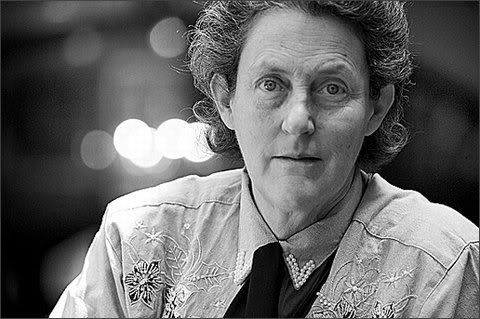
Temple Grandin is a Doctor of Animal Science at Colorado State University, a consultant to the livestock industry in animal behavior, and a best-selling author. She’s also autistic, a fact which you may have already known if you happen to have a connection to someone with autism, be it first-hand or indirectly. For instance, I came to know about her, as you’ll soon read, through my wife, who works with autistic students and is the proud owner of a copy of one of Grandin’s books, The Way I See It: A Personal Look at Autism and Asperger’s.

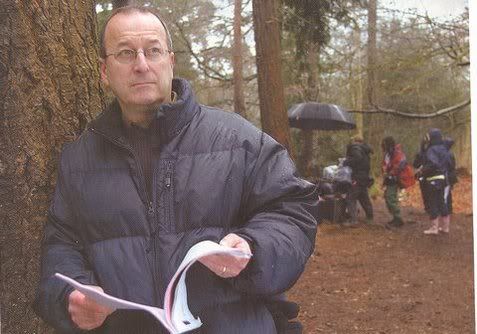
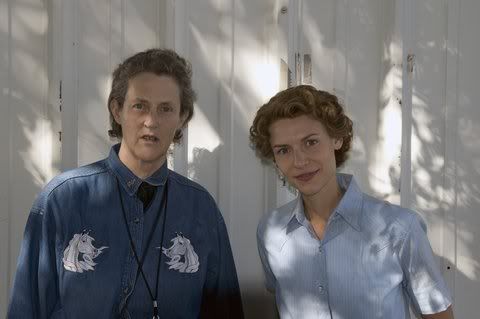
When an advance screener of the new HBO movie based on her life – entitled, appropriately enough, “Temple Grandin” – landed on our doorstep in advance of the TCA press tour, you can imagine that we popped it into the player post-haste, and I’ll tell you right now, I was blown away: Claire Danes gives a phenomenal performance as Grandin, but director Mick Jackson ties for MVP with his visual presentation of how Grandin’s mind works. I immediately went about trying to set up interviews in connection with the tour, and although Danes was unavailable, when HBO asked if I’d like to chat with Grandin herself, you’d better believe that I didn’t hesitate for a moment before saying, “You bet!”

Bullz-Eye: I just wanted to start off by telling you that my wife works with autistic children.

Temple Grandin: Oh, okay.

BE: She hadn’t actually trained in the field, but she ended up stepping into a job as a substitute teacher in a special education classroom, and she had such aptitude that the teacher gave her a gift: a copy of your book. She basically said, “Not everyone has the heart and the temperament to work with children who need a little extra effort, but I really think you do, and I think you’d get a lot out of reading this.”

TG: Which book was it?

BE: “The Way I See it.”

TG: All right.

BE: So as soon as she found out that I was going to be speaking with you, she immediately passed it on to me and said, “You’ll be wanting to read this.” (Laughs) But we also watched the movie together, and I thought it was fantastic. How did that first come about? Did someone read your book, then come to you and pitch the idea of making it into a movie?

TG: Well, that’s actually been going on for a good long time. Emily Gerson Saines started working on this about nine years ago and went to, like, two different directors and writers. Then, finally, it came together with the right people.

BE: Did you get final say about who would play you in the film?

TG: Well, that was just decided. Claire Danes did an absolutely brilliant job. Absolutely brilliant. I met with her for about six hours, and I gave her the oldest VHS tapes I could find of me, where I’d be more autistic-acting. Like, in old programs from the late ‘80s, where I was on a TV show, and some lectures from the early ‘90s. We dubbed those over onto DVDs, and she had those to practice with. I didn’t have any video older than that. Or movies. We didn’t do movies as a family, so I didn’t have that.

BE: I thought the visual aspects of the film, which try to give the viewer an understanding of how your mind works, were outstanding. I guess that was Mick’s idea…?

TG: I thought that was absolutely brilliant, the way Mick showed all of that. Wonderful. Like, the scene where it shows all of the shoes coming up…? That’s exactly how I think. Mick was absolutely brilliant with that.

Continue reading »

Bullz-Eye’s TCA 2010 Winter Press Tour Wrap-Up: Simon Signs, Conan Conquers, and Patrick Stewart Just Plain Rules

The 2010 winter press tour of the Television Critics Association took place at the Langham Huntington Hotel and Spa from January 8th – 18th, which you probably already know from the various postings which were done during and have continued since my attendance at the event. It’s a regular tradition, however, that I do a wrap-up piece which summarizes my experiences during the tour, and since I invariably seem to get a positive response from those pieces, I always try to make it as entertaining a read as possible. Here’s hoping I’ve succeeded as well this time as I have in the past…but if I haven’t, I feel certain you’ll let me know.

Most enjoyable panel by a broadcast network: “Great Performances: Macbeth,” PBS.

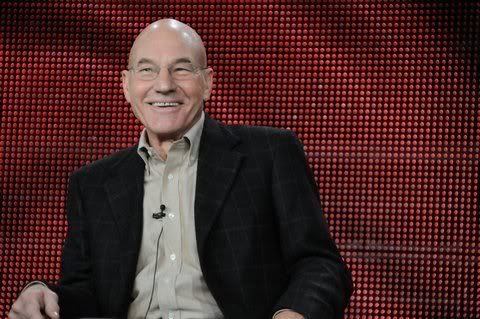
I’ll freely admit that I was predisposed to enjoy the panel due to the fact that it featured the newly-knighted Sir Patrick Stewart, but I spoke to others afterwards who declared it to have been the best panel of the tour up to that point. Partial credit for the success goes to the critics in the audience, who consistently offered up intelligent questions about the subject matter at hand…and let me assure you that this is not always the case. Even on an occasion when an attempt at going in a unique direction fell flat, such as when one writer asked Stewart if he was familiar with FX’s “Sons of Anarchy” (it’s been called a Shakespearean saga on motorcycles), it led to the revelation that Ron Perlman has played an interesting place in Stewart’s life. “I was having dinner with Ron Perlman the day that I was offered Jean-Luc Picard in ‘Star Trek: The Next Generation,’” he said, ‘so I have always looked on Ron as being a lucky omen. So you mentioning his name today, I hope, means that the rest of the day is going to be brighter than it begin.” At the very least, Sir Patrick’s remarks during the panel brightened mine.

Most interactive panel by a cable network: “The Choir,” BBC America.

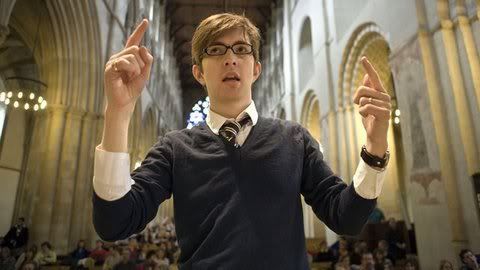
Gareth Malone is a man on a mission to bring music to those who may not think that they have an interest in it, creating choirs in various schools in England and helping the youth of today raise their voices in song. We soon discovered that this extended to television critics as well. “In England, everyone knows that when I enter a room, everyone’s going to sing,” Malone began ominously, “so I would like to invite you to leave your Apples and come up onto stage, and we’re going to have a little singsong.” The immediate reaction was less than enthusiastic, with at least one person piping up, “It’s against the bylaws!” Malone would not be denied, however. “It will be very brief,” he assured us. “I’ll be very, very, kind. I promise not to do opera. Honestly, it’s going to be very, very gentle. I promise. Risk it. There won’t be very much. Typists, abandon your typing!” In the end, he managed to get a couple of dozen of us up there…yes, I was among the huddled masses…to perform a not-as-bad-as-it-could’ve-been chorus of “Barbara Ann.” As there is neither an audio recording nor a YouTube clip to prove otherwise, you may feel free to believe that I personally sounded fantastic.

Best intro to a panel from a cable network: “Dance Your Ass Off,” Oxygen.

All I know about this show is what I’ve learned from watching clips on “The Soup,” but when a panel starts off by having its panelists literally dancing their way down the aisles and onto the stage, at the very least, it gets your attention.

Continue reading »

« Older posts Newer posts »

© 2026 Premium Hollywood

Theme by Anders NorenUp ↑