Category: TV Dramas (Page 46 of 235)

A Chat with Mick Jackson, director of “Temple Grandin”

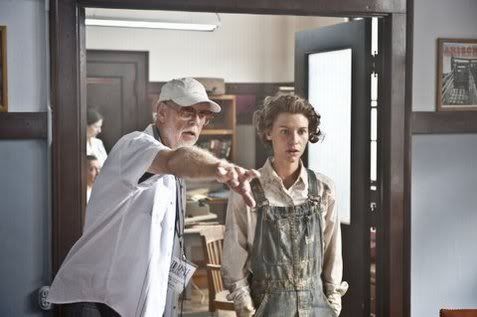
Sunday night brings the premiere of HBO’s wonderful new film, “Temple Grandin,” and if you’ve been reading Premium Hollywood lately, then you’ve already seen my interview with its subject, Dr. Temple Grandin. After the panel for the film at the TCA tour, I also caught up director Mick Jackson for a few minutes, which was just enough time to ask him about working with Grandin, to find out why he made one of his casting choices, and for him to offer me a bit of sage directorial advice.
Bullz-Eye: I talked to Temple a little earlier, and she said that she really enjoyed the process of working with you on the film.

Mick Jackson: Oh, she’s wonderful. Part of the story that we tell in the movie is that she has this tremendous eye for detail and uses that to put it together into a pattern and see the whole picture, but, in fact, when you’re dealing with us as movie makers, it’s the same thing. She had the eye for the details that were right and the details that were wrong, but she also had – unusually for someone whose life you’re telling through film – a sense of what it’s like to make a movie, to put it together into a whole picture. We reconstructed what we thought her apartment as a student would be like at Arizona University, based on what she told us and where she lives now, and she visited the set and I said, “That’s supposed to be your rooms.” And she said, “Hmmm. Well, it isn’t. But it could’ve been. It could easily have been.” (Laughs) It really takes a great ability to be able to step outside your own life to be able to say that. And she understood that, when telling the story of someone’s life, you don’t tell every bit of it. Otherwise, the movie would last as long as the person’s life. So she understood that we would collapse things and create composite characters and all that stuff.

It was great. I mean, I watched the movie with her the first time she saw it, and she was in tears. And I said, “Why?” She said, “He was only Mr. Carlock,” referring to her teacher. And the screenwriter and I had decided to call him Dr. Carlock, to convey an eminence that would kind of enhance the impression he made on her. But she thought that giving him his doctorate was a way of her giving back thanks to him for everything he’d done for her. That was lovely. The other thing is that after that screening…she saw the movie once and she was very enthusiastic, and I was driving later in my car and the phone rang, and it was Temple, still enthusiastic… (Laughs) …wildly raving about the movie. And I realized that what we’d shown in the movie, which is her being able to run things in her head, was true. She was quoting me shots and edits and things from the movie that she’d seen once. So she’d obviously downloaded the movie into her head, like a DVD, and she was running it backwards and forwards! “I love that shot where she opens the door and…” (Laughs) So it was literally true…and that was very gratifying.
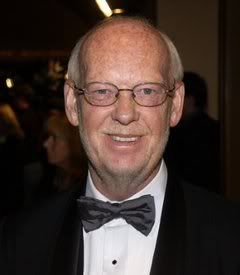
BE: So how familiar where you with Temple before the script for the movie landed on your desk?

MJ: Not at all. My wife had heard her on NPR, but the name meant nothing to me. So I read this thing and just got dragged into it. I thought, “This is just the most amazing story!” You can’t tell the story of every person who has autism, because it’s such a great range. Not everyone’s a visual thinker or has comfort from a squeeze machine, but…it’s like movies about the Iraq war: you don’t tell the whole war story, but you take something, like “The Messenger” or “The Hurt Locker,” you tell a specific story about one person and, in effect, you’re telling the whole story. So telling the story about Temple is like telling the whole story of autism. If you understand Temple, then you understand what autistics go through, or what being the parent of an autistic child is like.

I hope the main thing that people take away from Temple’s story, which is uniquely true for Temple but is in fact true for everybody who is a parent or a relative of an autistic child, is that you’ve got to put all that energy in there for some of it to come back. You can’t just lean back and say, “This child maybe should be looked after by doctors or go into an institution,” like they suggested with Temple. All that energy, all that pushing of Temple by her mother, her aunt, her science teacher out into the real world did it. It helped her emerge. The title of one of her books is “Emergence,” and that’s just what she did. There was this amazing mind in there that was just trapped and came out. So I think that’s the lesson we ought to take away from it: never let up your energy for a moment, and never let up that sense of constantly pushing them forward. Not really like a stage mother, but just not shielding them from life and just trusting them to find a way of dealing with life. It’s a learning experience. Everything was a learning experience for her.

BE: My wife works with autistic students, and I told her that Temple had said much the same thing, about how her mother pointedly made sure to push her toward activities in the summer and to the activities in high school. And my wife said that that’s exactly what she does every day with the student she’s working with right now.

MJ: And I’m sure she sees that the more energy she puts into it, the more she sees the change. Not immediately, because it’s over a long period of time, but…it’s the one lifeline that they have to the real world, people pushing them into it.

BE: I had one question about the casting for the film. How did Catherine O’Hara come to play Temple’s aunt?
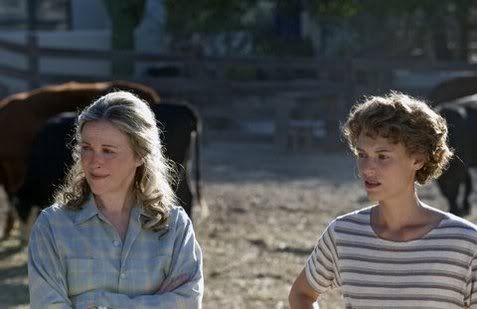
MJ: It’s my experience in casting character actors, as it were, that if you cast someone who has a great comedic career, they know a lot more about the human condition sometimes than straight dramatic actors. And I so much wanted the aunt to kind of be a way into the movie for the audience, a sympathetic, warm figure. You meet Temple with all of her kind of raw orneriness and awkwardly unsocial manic behavior, but you have this reassuring figure there in the aunt, who says, “Yes, it’s all right, dear. Come this way, Temple.” And I thought Catherine just brought all of that warmth that you get from knowing about human foibles from being a comic actress to the role. I thought she was wonderful.

BE: Of all things, my memories of “Home Alone” worked in her favor here, because that’s the movie that first made me think of her as a motherly type.

MJ: (Laughs) Yes!

BE: I know you’ve got to keep moving, but of the other projects you’ve worked on over the years, do you have one that you think didn’t get the love it deserved?

MJ: They all get a certain amount of love, which I’m grateful for. “The Memory keeper’s Daughter,” which was the thing I did before this, for Lifetime…I think it’s probably a little shorter than I would’ve had it, the movie. If I’d been allowed to expand it a little more, I think it would’ve been a more moving story, but that was quite fun to work on. I sound as if I specialize in disease-of-the-week movies: I’ve done Lou Gehrig’s Disease (“Tuesdays with Morrie”), I’ve done Down Syndrome, and now autism! (Laughs) But every one is a movie, and it’s a good movie if it happens to be about the people.

BE: Well, it’s not about a disease, but for what it’s worth, I’m very partial to “Volcano.”

MJ: That was fun, but take some advice from me: if you’re ever directing a movie, don’t get into a race with another movie on the same subject (“Dante’s Peak”). Nobody ever says, “Oh, I saw the second volcano movie!” (Laughs)
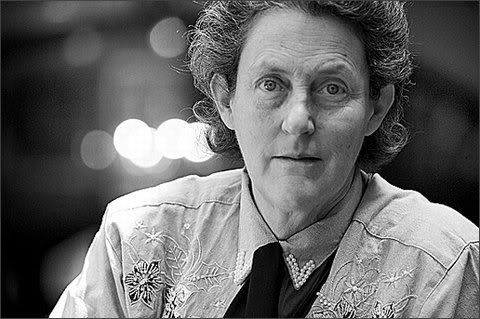
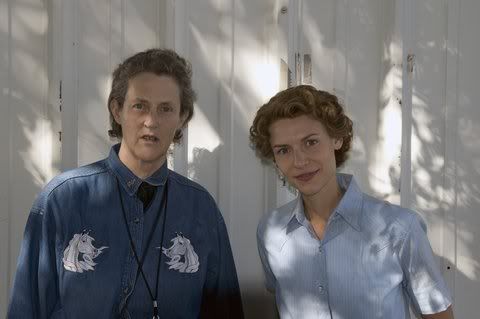
TCA Tour: A Chat with Temple Grandin

Temple Grandin is a Doctor of Animal Science at Colorado State University, a consultant to the livestock industry in animal behavior, and a best-selling author. She’s also autistic, a fact which you may have already known if you happen to have a connection to someone with autism, be it first-hand or indirectly. For instance, I came to know about her, as you’ll soon read, through my wife, who works with autistic students and is the proud owner of a copy of one of Grandin’s books, The Way I See It: A Personal Look at Autism and Asperger’s.

When an advance screener of the new HBO movie based on her life – entitled, appropriately enough, “Temple Grandin” – landed on our doorstep in advance of the TCA press tour, you can imagine that we popped it into the player post-haste, and I’ll tell you right now, I was blown away: Claire Danes gives a phenomenal performance as Grandin, but director Mick Jackson ties for MVP with his visual presentation of how Grandin’s mind works. I immediately went about trying to set up interviews in connection with the tour, and although Danes was unavailable, when HBO asked if I’d like to chat with Grandin herself, you’d better believe that I didn’t hesitate for a moment before saying, “You bet!”

Bullz-Eye: I just wanted to start off by telling you that my wife works with autistic children.

Temple Grandin: Oh, okay.

BE: She hadn’t actually trained in the field, but she ended up stepping into a job as a substitute teacher in a special education classroom, and she had such aptitude that the teacher gave her a gift: a copy of your book. She basically said, “Not everyone has the heart and the temperament to work with children who need a little extra effort, but I really think you do, and I think you’d get a lot out of reading this.”

TG: Which book was it?

BE: “The Way I See it.”

TG: All right.

BE: So as soon as she found out that I was going to be speaking with you, she immediately passed it on to me and said, “You’ll be wanting to read this.” (Laughs) But we also watched the movie together, and I thought it was fantastic. How did that first come about? Did someone read your book, then come to you and pitch the idea of making it into a movie?

TG: Well, that’s actually been going on for a good long time. Emily Gerson Saines started working on this about nine years ago and went to, like, two different directors and writers. Then, finally, it came together with the right people.

BE: Did you get final say about who would play you in the film?

TG: Well, that was just decided. Claire Danes did an absolutely brilliant job. Absolutely brilliant. I met with her for about six hours, and I gave her the oldest VHS tapes I could find of me, where I’d be more autistic-acting. Like, in old programs from the late ‘80s, where I was on a TV show, and some lectures from the early ‘90s. We dubbed those over onto DVDs, and she had those to practice with. I didn’t have any video older than that. Or movies. We didn’t do movies as a family, so I didn’t have that.

BE: I thought the visual aspects of the film, which try to give the viewer an understanding of how your mind works, were outstanding. I guess that was Mick’s idea…?

TG: I thought that was absolutely brilliant, the way Mick showed all of that. Wonderful. Like, the scene where it shows all of the shoes coming up…? That’s exactly how I think. Mick was absolutely brilliant with that.

Continue reading »

Bullz-Eye meets Bryan Cranston on the “Breaking Bad” set

When you’re an easily-amused TV critic, every day is filled with wonderful surprises which range from the arrival of an advance screener of an episode of one of your favorite shows to the opportunity to interview one of your favorite actors. Once in awhile, though, something arrives via E-mail which blows your mind completely…and, in this case, it was a personal letter from Bryan Cranston, who plays Walter White on AMC’s “Breaking Bad.”

Bryan Cranston - Breaking Bad

Dig this: Mr. Cranston kindly invited me – and when I say “me,” I actually mean all of the members of the Television Critics Association – to visit the set of “Breaking Bad.” Obviously, it was an offer that I could not refuse, nor could Bullz-Eye’s editor-in-chief, Jamey Codding, who was far too big a fan of the show to allow me to go alone if he could possibly get away with attending as well.

I’ve offered up a summary of our quick trip to Albuqerque over at the Bullz-Eye blog, so be sure to head over to check it out…and, of course, be sure to tune into AMC on March 21st when “Breaking Bad” kicks off its 3rd season. And read our weekly blog after each episode. And, for that matter, keep your eyes open for our review of the Season 2 set when it hits DVD on March 16th. (Spoiler: it’s probably going to be a rave.)

Yeah, that’s right: we love “Breaking Bad.” You got a problem with that?

Lost 6.1/6.2 – LA X

The final season of “Lost” has been one of the most hyped events of the year, so it was always bound to be a little disappointing, right? Let’s get any criticisms out of the way first, because while the two-hour premiere definitely offered plenty in the way of WTF moments, I couldn’t help but feel a little underwhelmed by it all. Most of that had to do with the alternate reality Jack and Co. have seemingly created by detonating the hydrogen bomb. They don’t know it just yet, but from the few hints that appeared throughout the course of the episode (the shot of the four-toed statue underwater, Jack’s vague memory of Desmond, and Juliet’s beyond the grave message to Sawyer that “it worked”), I don’t think there’s any other explanation. Which makes me wonder, if the plane didn’t crash like it was supposed to, did all the flashbacks that we saw in previous seasons still take place? Because if they did, why wouldn’t Desmond remember Jack?

I’m sure we’ll learn more as the season progresses, with the alternate reality portions (what Carlton Cuse and Damon Lindelof refer to as flash-sideways) delivering the survivors’ stories as they might have occurred had Oceanic 815 never crashed. Most details have remained the same (Jack’s still transporting his father’s body, Kate is still a fugitive, Hurley is still crazy rich, Locke is still handicapped, Jin’s still an insufferable prick, and Charlie is still an addict), but there were a few differences, like Boone’s failure to convince Shannon to come home with him, or the fact that Desmond is now on the flight. It wasn’t until the plane safely landed when the story really began to get interesting, and though Kate’s escape from the U.S. Marshall was totally expected, I didn’t think we’d see Claire in the backseat of the taxi cab she took hostage. Jin’s run-in with customs was also a nice surprise, particularly because I think Sun is telling the truth about not speaking English. After all, if the Desmond/Jack meeting from Season Two never happened, then maybe Sun never planned on leaving Jin either.

lost_6-1

Of everything that went down on the plane and in the airport, however, the meeting between Jack and Locke in the luggage claim office was easily my favorite moment of the night. It’s so fun to watch Terry O’Quinn jump back and forth between playing pure evil (more on that later) and crunching his face into a big ‘ol smile, and along with Michael Emerson, O’Quinn’s best scenes tend to be opposite Matthew Fox. I’m also curious to see where they go with the whole missing body subplot (Christian Shephard’s an integral part of the island storyline, so why wouldn’t he play a part in this one as well?), and more importantly, if Locke decides to pursue Jack’s offer to perform surgery on his spine. The idea that these characters still go on the same journey even though they’re not on the island makes for a fairly cool premise, and one that would be especially fun to explore if the two timelines actually begin to affect one another.

A mirror reality may have been created, but that doesn’t mean the original one still doesn’t exist. That’s surely something not even Faraday could have anticipated, because despite the fact that Juliet detonated the bomb, they’re still stuck on the island… only now they’ve been pushed into the present. Unfortunately, Juliet’s dead (crushed under the wreckage of the Swan) and Sayid is bleeding out from a gunshot wound to the gut. It’s a good thing Hurley can see dead people, then, because Jacob (who really did bite the dust) tells him to go to the temple in order to save Sayid. When they arrive, they meet a new group of Others including a Japanese man (Hiroyuki Sanada) who appears to be their leader, and his translator (“Deadwood” alum John Hawkes), though he doesn’t really need one.

Continue reading »

Awards news: Director’s Guild and Sundance

There’s some sadness hanging over the American film world this morning due to the tragic and disturbing death of highly respected 39 year-old editor Karen Schmeer, best known for her work on Errol Morris projects as “Fast, Cheap, and Out of Control,” “Mr. Death,” and “The Fog of War.” (Shawn Levy of The Oregonian has much about piece her shockingly random death in a crime-related automotive accident, her work, and her early start in the documentary film business.)

Nevertheless, the awards beat goes on and today, as Nikki Finke points out, we can chalk up a big victory for female directors as Kathryn Bigelow of “The Hurt Locker” defeated a boys club of directors that included such ultimate mega-males as Quentin Tarantino and her one-time husband, James Cameron.  Bigelow, of course, has been a noted director since her early features, 1982’s “The Loveless,” which introduced Willem Dafoe, and 1987’s ahead-of-its-time vampire drama, “Near Dark” attracted the attention of genre friendly critics. Her best known film, ironically enough, is probably the silly action flick, “Point Break,” which has emerged as a culty guilty pleasure after its 1991 release.

kathryn-bigelow1

“The Hurt Locker” is the first time Bigelow has been associated a project to get this kind of near-universal acclaim. It’s a major departure stylistically from her often slick and superficial past work, looking at an unexploded bomb team with the same kind of dispassionate intensity as “The French Connection” examined police work. This award definitely makes Bigelow the apparent favorite for the Best Director Oscar. It also doesn’t hurt it’s chances at the Best Picture award either.

“Hurt Locker” also swept the Producers Guild award earlier this week. Similar to the DGA, that award is widely seen as a harbinger for the “Best Picture” category, in which the producer is the one who actually receives the award. Still, as Dave Karger reminds us, the DGA doesn’t make the award inevitable. Also with the nominees this year doubled to ten and a more complex voting system for “Best Picture” that category, at least, remains open to any of the four or five most frequently nominated films in my opinion.

In other awards, “The Cove” got a boost in the nevertheless very hard-to-predict documentary Oscar category with an award for its director, Louie Psihoyos. I usually don’t cover TV, but it is worth a mention that the winner of the award for direction in a TV drama series was also won by a woman. Lesli Linka Glatter was awarded for her work on the action-packed “Guy Walks Into An Advertising Agency” episode of “Mad Men.” Not a bad choice.

Meanwhile, over in Park City, Utah, the Sundance Film Festival presented its awards, which offer a fairly significant peak into what are likely to be some of the most acclaimed and potentially award-winning films of the next year or so. Young people with family ties to crime seemed to be a winning theme in the dramatic categories: “Winter’s Bone,” about a young girl in search of her crystal meth manufacturing father, won the U.S. Prize; the Australian crime drama “Animal Kingdom,” about a teen boy born into a crime family in 1980s Melbourne, took the international award.

The documentary award went to one of the festival’s most high profile entries, “Restrepo.” From two-first first-time directors, journalist/author Sebastian Junger (the book, The Perfect Storm) and documentary cinematographer Tim Hetherington. The film is follows a U.S. Army platoon in Afghanistan for a year. As the offical Sundance description has it, it depicts a “surreal combination of back breaking labor, deadly firefights, and camaraderie….”  Indiewire’s Eugene Hernandez has a complete rundown.

Battle Company

« Older posts Newer posts »

© 2026 Premium Hollywood

Theme by Anders NorenUp ↑