Category: Movies (Page 314 of 498)

More remakes

* The word has arrived of Steven Spielberg‘s new project, it’s a remake of a particular favorite of mine, Mary Chase’s terrific play “Harvey,” best known for the solid 1950 film version starring Jimmy Stewart in one of his best roles. (He reprised the part for TV in 1972.) Nikki Finke mentions Tom Hanks‘ name for the plum lead role of Elwood P. Dowd, a grown man who believes his best buddy and constant companion is an invisible 6’6″ rabbit. I’ve also seen Will Smith‘s name floated for it (he’s maybe a bit young for the part, still), but any number of actors could take this one on in fine fashion. It’s also possible Hanks might be a bit leery about stepping into a role so closely associated with the actor he’s most often compared to, but therein may lie the challenge, too. Jeffrey Wells inveighs against the project, in the usual terms. I think it’s fine, as long as Spielberg and writer Jonathon Tropper bring something new and worthwhile of their own to this version.

One interesting aspect here is the way that our present age is in some respects more puritanical than America in 1950, particularly as it relates to drinking. Most modern viewers would likely regard Elwood Dowd as an alcoholic today. (In the old days, I remember that TV Guide referred to him as a “gentle tippler.”) Will Spielberg and Tropper try to send Elwood to rehab? I say, no, no, no. Also, I sure hope Wells is wrong about the CGI Harvey. That would pretty much eliminate the whole point of the tale. This is not “Roger Rabbit.”

* I’m a bit late on this, but the planned remake of the Michael Curtiz-directed Errol Flynn swashbuckler — or, to be more kind, the new adaptation of the 1922 Rafael Sabatini novel of derring-do on the high seas — should really be called “Captain Blood in Outer Space” now. By the way, the 1935 “Captain Blood” was actually the second version of the tale to be made in Hollywood. Damn remakes.

* One way to avoid the whole “remakes bad” thing is to use a movie that hardly anyone in your target audience has seen. The French spy thriller, “Anthony Zimmer,” may be available through Netflix, but it there are only three reviews posted of the 2005 film on Rotten Tomatoes, which means it likely only showed in the U.S. at festivals and the like. When the new version, renamed “The Tourist,” comes out with Charlize Theron and Sam Worthington, will anyone remember “Zimmer”?

* Anne Thompson has some thoughts on the general timidity of Hollywood. She’s not wrong, particularly when it comes to the endless recycling of once-hot properties, but — at the risk of repeating myself — I really do think that most of the complaining is off-base to the extent that there’s really nothing new under the sun and that even “Hamlet” and “Romeo and Juliet” were essentially remakes the very first time they ever appeared on an Elizabethan stage. When remakes are good (say, “3:10 to Yuma“) no one complains, though too many forget the original. When remakes are bad (“The Wicker Man“, which was worse than bad, actually), well, the fault is not in the idea of remakes but in what the filmmaker decided to do with the material.

TCA Tour, Day 2: “Occupation”

I knew less about “Occupation” than any of the four series that were being spotlighted during the course of BBC America’s time at the TCA tour, but I certainly recognized the actor who was in attendance to promote the show. James Nesbitt’s been working steadily since he turned up at the 2007 TCA tour to sing us a song or two and tell us about “Jekyll,” having played both a tabloid journalist (“Midnight Man”) and Pontius Pilate (“The Passion”), but this time he’s part of the ensemble of “Occupation,” a series which takes a look into the lives of three soldiers who all return to Iraq for the wrong reasons: one for love, one for money, and one for duty.

We do see at least one American within the context of “Occupation,” but for the most part, we’re offered the British perspective of the war in Iraq. It’s a side of the story that we haven’t really gotten to see before, but creator Peter Bowker (“Viva Blackpool”) believes that the themes of his series are fairly universal.

“I think it’s about love, about what it is to be a man, and it’s about doing the right things for the wrong reasons and the wrong things for the right reasons,” said Bowker.

He is not, however, going to hazard a guess as to how Americans will respond to the series. “I think fairly typical things happen in any wars that are engaged in,” he said, “and I think that in this particular war, although it took awhile longer in Basra for the local population to become alienated from the Brits, I think it did happen. I think maybe the surprise will be that it’s not a war drama in that the whole thing isn’t set actually in the war. One of the starting points for this for me was ‘The Deer Hunter’ and noticing in ‘The Deer Hunter’ how little screen time, relatively speaking, is spent in Vietnam. As a writer, ultimately, for me what happens afterward is a far more interesting dramatic field than actually what happens during wartime.”

In order to acclimate himself to the material of “Occupation” as much as possible, Bowker worked with the charity Combat Stress, which counsels traumatized ex-servicemen.

“What the counselors said there was that the mind-set of soldiers who were seeking help was very similar to the mind-set of soldiers coming back from Northern Ireland, in that it didn’t seem entirely clear what the aims of the war were, and going in to ostensibly help a civilian population, which then became hostile…and with good reason, in lots of cases,” said Bowker. “That seemed to be the mind-set. The thing they said that was most significant was the speed with which ex-servicemen were seeking help from the Iraq war. They had never seen that before. They thought of a new intensity, but they said that was partly because young soldiers were no longer seeking solace in alcohol, they were seeking solace in drugs…and we do touch on that in the piece.”

If you’ve never been a situation such as this, then it may strike you as a bit unlikely that a soldier would make a concerted effort to return to the country where he once fought a war. Nesbitt has a theory about that.

“In the arena of war there is, sort of bizarrely, a sense of security for soldiers, because they’re more comfortable in their uniforms, I think, than they are in their civis,” he said. “I think the rhythm that war gives them with the camaraderie, which we discovered, was so important to them – that they can confide in each other, that they are completely together – is in stark contrast to them coming away from that situation losing the uniform, going back into a family life where they feel terribly displaced because of what they’ve seen and what they’ve gone through. They can’t really share that with their partners and their families. I was struck very much by how they’ve lost the rhythm of how to behave physically and emotionally at home. In our piece quite early on, you see when my character comes home he just doesn’t know how to be with his family. They don’t know who turns the kettle on. They don’t know how to react. It was something about the human element of the impact of war that it has on the families that struck me as something that I think is and will hopefully be universal.”

“Occupation” premieres on BBC America in October.

“You’re fired!” Another televisionary movie moment

A little cynicism for a Sunday night in line with Will Harris’s ongoing coverage of the TCA confab and pow-wow. Written by Paddy Chayefsky and directed by Sidney Lumet, “Network” is one of the movies that really started me thinking seriously about movies and other media when I first saw as a person who was maybe a little young to be seeing it. I may show you one of the better known scenes from this now-classic film a bit later (“I’m mad as hell…”…”You are meddling with the primal forces of nature”…, etc.), but right now I’m going with this equally crucial scene because it gets to the heart of the real-life media trend Chayefsky was attacking.

As the MPAA likes to say, this scene includes “language,” so it’s NSFW for anywhere F-munitions are unappreciated. On the other hand, if you work at a television network, it probably won’t be noticed.

Is the “Funny People” box office take half full or half empty?

Like so many things in life, the meaning of the weekend gross for the Judd Apatow/Adam Sandler “serious comedy,” “Funny People,” is a matter of perspective. On the more cheerful side, we have the trades, which typically enough are accentuating the positive, noting that the somewhat risky project, at least by modern mainstream film standards, was actually #1 at the box office, even if the amount it took the lead by was less than mega-spectacular.

The Hollywood Reporter (actually the AP as carried by THR) thinks that Judd Apatow is living in the best of all possible box office worlds:

Movie audiences have taken a liking to Adam Sandler’s more serious side…[“Funny People”] grabbed the top spot at the weekend boxoffice with a $23.4 million debut.

Variety takes a more measured, but still somewhat upbeat, tone:

Adam Sandler’s “Funny People” has topped a moderate weekend box office with $23.4 million at 3,008 playdates.

Nikki Finke, however, has a different way of seeing things. Here’s her headline:

‘Funny People’ No Laughing Matter; Opens To Lousy $8.6M Fri And Worse $7.4M Sat For Disappointing $23.4M Weekend

La Finke goes on to point out that Universal has been lowering expectations from Sandler’s usual $30-$40 million openers to a more modest $25 million, and fell a bit short of that.

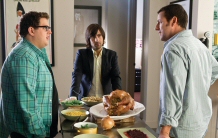
Jonah Hill, Jason Schwartzman, and Adam Sandler kvetch over turkey It really does come down to your frame of reference. In my weekend preview post, I mentioned the Sally Field/Tom Hanks starring “Punchline,” which I think is a better point of comparison than any particular Apatow or Adam Sandler film, including 2002’s “Punch-Drunk Love,” simply because of the subject matter, the more-serious-than-you-might-expect approach, and the level of star power. That movie got similarly mixed reviews but was one of 1988’s lowest grossing films, despite the presence of two bankable stars. Two small differences: one had laughs, the other doesn’t, and Sally Field was not ever thought of as a great comedian, “The Flying Nun” notwithstanding.

Continue reading »

Movie Moments: Chita Rivera

Unlike the other arts recipient of the Presidential Medal of Freedom, Sidney Poitier, Broadway legend Chita Rivera hasn’t had an extensive career in movies. In 1960, she originated the role of Rosie in the first Broadway production of “Bye Bye Birdie.” When the time came to do the film version, however, Hollywood blew its shot at having a positive portrayal of a Latina actually be played by a Latina. Instead of using Ms. Rivera, a great dancer and singer, the part went to Janet Leigh, a “name” whose considerable talents were mainly in acting.

Still, a few years later, the great director-choreographer Bob Fosse choose to include Ms. Rivera in his first film, “Sweet Charity.” Unfortunately, 1969 was exactly the wrong year to release a more or less traditional musical. “Charity” bombed, forcing Fosse to completely rethink the musical form for the movies and Rivera to keep plugging away in New York. Fortunately, that means we have a couple of great movie-moments from this semi-forgotten classic featuring Chita Rivera as Nickie, a tough-talking taxi dancer. Here, along with friends Helene (Paula Kelley) and Charity Hope Valentine (Shirley MacLaine), she reconsiders her career choice.

Continue reading »

« Older posts Newer posts »

© 2026 Premium Hollywood

Theme by Anders NorenUp ↑