Category: External TV (Page 106 of 419)

TV of the 2000s: 5 British Series That Didn’t Translate Nearly As Well As “The Office”

In “Star Trek II: The Wrath of Khan,” Spock casually observed, “As a matter of cosmic history, it has always been easier to destroy than create.” As such, it should come as no surprise that, when the networks have the opportunity to avoid creating something new in favor of destroying something old, they damned well take it. As we continue our look back at the TV of the 2000s, we decided to revisit several of the networks’ attempts to adapt popular British series to match American sensibilities. As “The Office” has proven, they can sometimes make it work, but as these five shows remind us, they very often can’t.

5. Eleventh Hour (CBS): In 2006, ITV broadcast a four-part series entitled “Eleventh Hour,” starring Patrick Stewart as Professor Ian Hood, a special advisor of the British government’s Joint Science Committee who investigated threats related to various scientific developments and experiments. Each episode was 90 minutes in length, and it was received well enough in the UK that CBS immediately set forth on a quest to develop the concept into a weekly series in the States. Stewart was switched out for another talented Brit – Rufus Sewell – and even though he dropped his accent in favor of going “American” with his character (now renamed Jacob Hood), we were still optimistic about the series. Alas, despite an intriguing premise, the adaptation suffered from a couple of major problems.

First off, critics perceived the show as “troubled” before its premiere because of the delay in releasing the first episode for review, but, fair enough, many series have managed to survive that particular issue. The bigger problem came from CBS’s steadfast determination to make “Eleventh Hour” fit into the same procedural mold utilized by all of its other series. As such, the predominant thrust tended to be about the crime of the week, leaving not nearly enough focus on Dr. Hood, whose considerable knowledge on scientific matters makes him an enigma. Viewers should’ve been left wondering, “Who is this guy? What’s his story?” But just as we were starting to learn about Hood’s past and getting the impression that he might actually be able to find romance for the first time since the death of his wife, the series steered back into a let’s-stick-to-the-case mindset, making its cancellation after only 18 episodes less disappointing than it might otherwise have been.

4. Worst Week (CBS): The original series – which bore the slightly longer title of “The Worst Week of My Life” – had three incarnations. The first focused on the week leading up to the marriage of its two lead characters, the second shone the spotlight on the week before the birth of their first child, and the whole thing culminated in a three-part holiday special entitled “The Worst Christmas of My Life.” Anyone who enjoys a good bit of slapstick would see the merit in trying to adapt the series for an American audience, but after watching the pilot, I wrote, “Despite the first episode being thoroughly hilarious, it’s hard to imagine how they’re going to keep up that kind of momentum on a weekly basis.” What I didn’t write – but what I did indeed wonder – was why, given how much testing goes into television nowadays, they didn’t change the title. I mean, c’mon, if you watched the show, then don’t tell me you didn’t find yourself wondering from Episode #1 just how long they were planning to drag things out. In the end, “Worst Week” ran for 16 episodes, and given that its final episode* was entitled “The Epidural,” it’s clear that the series never had a chance to expand much beyond its source material. Not that they could’ve managed it much faster: getting from premiere to bringing the pregnancy to fruition within five months is certainly nothing to sneeze at. Still, with all British-adapted series, the rule of thumb is that you should create your own identity as quickly as possible…and they didn’t.

* As far as the show’s chronology is concerned, anyway. The actual final episode was entitled “The Party,” and it should’ve actually been the fifth episode. Instead, it was held back from the initial run and was later (and somewhat inexplicably) thrown into the network’s Saturday night schedule some four months after “The Epidiural” aired.
Continue reading »

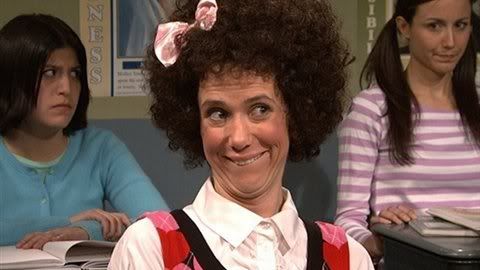
NBC continues the dumbing-down of America in earnest with…”A Very Gilly Christmas”

First, David Medsker sent a public memo to “Saturday Night Live,” pleading with them to stop Kristen Wiig from playing the most annoying characters imaginable, and although the show’s producers ignored him, the posting has received 76 comments to date, many of them completely behind Mr. Medsker’s position, so it clearly struck a nerve with readers. Then, two months later, John Paulsen got specific and called out Wiig’s then-new character, Gilly, as the unfunniest returning character ever. No word from the Wiig camp yet, but 65 readers have responded to it thus far, and while many of them are in full-on defense mode, it takes no more than a cursory glance at the comments to see that Mr. Paulsen is onto something with his premise.

* “Gilly should be put in juvenile detention.”
* “OMG, I want to break the TV when I see that stupid skit!”
* “Gilly keeps coming back for more and more and more and more and more. And it gets worse every time.”
* “The Gilly skits – and indeed, pretty much all the characters that Wiig does – are appealing to those lowbrow people who find catch-phrases funny.”
* “I know ‘to each his own’ and everybody’s taste is different, but I’m shocked that people are defending this really, really bad, really, really unfunny recurring character.”

And, of course, there’s my personal favorite:

“Like a fool, I kept watching, hoping the sketch could redeem itself somehow, that a punchline or a line delivery would come in making it somewhat funny. I mean, this is a comedy show, right? Right? But, alas, it was just painful. I have no idea what the audience was laughing at or why. Maybe SNL installed a live laugh track, or maybe they do pump in laughing gas. But what I saw no one could honestly find funny. NO ONE. Stock footage of starving children has equal comedic value as the Gilly sketch.”

To these discerning individuals, NBC is offering up the comedic equivalent of a lump of coal in their stocking on December 17th from 8 – 10 PM EST, when “Saturday Night Live” presents…wait for it…“A Very Gilly Christmas”!

The good news is that the two-hour special will include brand-new material with Alec Baldwin and Steve Martin, along with favorite holiday-themed sketches from the 35-year history of “SNL,” including “NPR’s Delicious Dish and the Schweddy Balls,” Martin’ famous “Holiday Wish,” and Justin Timberlake and Andy Samberg’s “D**k in a Box.”

The bad news: it will also include new Gilly material.

TV of the 2000s: The Top 10 “Doctor Who” Stories of the Decade

There has been no better decade to be a fan of “Doctor Who” than the ‘00s. The show, once considered a punchline for jokes made by Trekkies, has risen from the ashes of the ‘80s and been reborn as a serious sci-fi/fantasy force with which to be reckoned. It’s managed to generate two spinoffs in the form of “Torchwood” and “The Sarah Jane Adventures,” as well as open up the entire 26 previous seasons to a whole new generation of fans. Yeah, it’s a good time to be a “Doctor Who” fan, because more than ever, people are less than likely to look at you “that” way when you tell them it’s your favorite series. With that in mind, here’s an entirely subjective list of its crowning achievements since the new series started in 2005; it’s just a shame I’ve not yet seen David Tennant’s two-part finale, “The End of Time,” so it could warrant possible inclusion. In any case, here’s to, at the very least, another full decade of time and space travels inside the TARDIS.

10. “School Reunion” – There are other stories that from a plot standpoint are much better written than this one, and thus more deserving of being in this Top 10, but I’ve an enormous fondness for this outing simply because it not only brought Lis Sladen’s Sarah Jane Smith back into my life, but it did it in such a way that left me a sobbing mess. If, like me, you grew up watching Doctor #4 (Tom Baker) and Sarah Jane battle the evil Morbius on Karn, defeat the diabolical Sutekh on Mars, and kill the giant Krynoid at the estate of Harrison Chase, then seeing her character – as well as her relationship with the Doctor – hit a poignant and dramatic high note of finality was most definitely a strong cup of tea. It’s a bit of a shame Sarah Jane has her own series now, because everything about her that’s come since has somewhat eroded what was beautiful about this story in the first place.

9. “The Waters of Mars” – It’s entirely possible I’m riding a “Who” high at the moment, and that in time “Mars” won’t seem quite as perfect as it does at present. Further, since it won’t play on BBC America until Dec. 19th, it would be wrong to discuss it in any great detail. Nevertheless, it’s got an intricate premise from Russell T. Davies and Phil Ford, deft direction from Graeme Harper, creepy monsters, outstanding set design, and one helluva complex performance from David Tennant, that’s clearly aimed at setting up “The End of Time.” The last 20 minutes are frenzied and game-changing; this is Davies pulling the rug out from under the Time Lord and redefining everything we thought we learned about him over the past four seasons. It’s fucking glorious, and even if the big finish doesn’t quite live up to the buildup, I’ll know they made a damn good go of it.

8. “The Impossible Planet/The Satan Pit” – Here’s another story that might leave a reader or two scratching their heads, but it’s a tale that holds an immense amount of nostalgia for me. See, my kid was 13 at the time it premiered, as were his friends. For the second season of new “Who,” the fates conspired so that he and his buds gathered at the house nearly every weekend to watch the latest episode with me, and the otherworldly goings-on at Sanctuary Base in particular had all of us riveted. “Don’t Turn Around!” became the catchphrase for a good long while around my casa, and further, this was the story where Tennant “became” the Doctor for me. The scene where he was being lowered into the Satan Pit, talking of how the specifics of the creature didn’t fit his “rules” was the defining moment. If I’d had even a vague vibe that he might not be precisely the right actor for the role before this, any such thoughts were dashed immediately after viewing that scene. Beside, the Doctor meets Satan? Hot diggity damn! This two-parter also unleashed the Ood, who have clearly become one of the defining alien races of the new series; they returned for the aptly named “Planet of the Ood” in Season Four, and will be returning again for Tennant’s finale.

Continue reading »

Welcome to Japan, Mr. Tarantino

A number of bloggers have been running Mr. Tarantino’s Japanese TV appearances and commercials. No reason PH readers should miss out on the fun.

Most of what you see below is in Japanese, but no need to fear if you understand the international language of otaku (geek) chic.

More after the flip, including a cooking show, or something, with Brad Pitt.

Continue reading »

TV of the 2000s: 15 Sci-Fi Series That Deserved A Longer Run

It’s always been a rough go on network television for series which require viewers to think and suspend their disbelief at the same time, but despite this, many brave producers and writers have tried to capture the imaginations of couch potatoes. Sometimes it works, as evidenced by the long runs of such shows as “Battlestar Galactica,” “Lost,” “Smallville,” and “Supernatural,” but more often than not, it doesn’t, which is why IMDb is littered with listings for sci-fi series that lasted for only a single season. Looking back at the decade (which, if you hadn’t noticed, is what we’re doing with all of these TV of the 2000s features), you can also find way too many shows which survived into the second season, proved that their first season wasn’t a fluke, sometimes even improving on it, and then got canceled…and, man, does that hurt. Heck, I even included three- and four-season wonders in this list, one because it had scored such a huge upswing in quality, the other mostly because it seemed like such a gyp when it got the axe. But, then, you could say that about all of these shows, really…

WARNING! LIST CAVEAT! – To be included within this list, the show cannot have started at any point prior to Jan. 1, 2000. Without that caveat, you can bet that “Angel” would’ve been included…and, yes, probably “Farscape,” too. But definitely “Angel.”

15. Masters of Science Fiction (ABC): As an anthology series in the 2000s, it’s not like it ever had a chance in Hell of surviving, anyway, which is why it comes in at the bottom of the list. Still, it deserves mention here, partially because it was really good, but mostly because it got an even bigger shaft from ABC than “New Amsterdam” got from Fox.

Masters of Science Fiction

Get this: during ABC’s executive panel during the TCA Press tour of summer 2007, someone asked Stephen McPherson, the network’s president of entertainment about the origins of the series, and he responded, “It was a low-cost initiative that we tried. We did this series of movies to see if there was a way to spark something different at a really low cost point. You know, I think there is some good work done there, but it’s very unseen. So it’s just been…it’s been a little bit problematic.” Okay, now, to be fair, he’s acknowledging that there’s “good work” inherent somewhere in the series, but to put these comments in a better perspective, they were made before the show had even premiered. And how did he decide to remedy this problem of the series being “unseen”? By premiering it at 10 PM on Saturday night. Hey, way to get behind your programming, Steve!

In fairness, I’m sure no one, not even the series creators, ever expected “Masters of Science Fiction” to be anything other than a short-lived midseason entry, but it’s not like it had to be. The series harked back to classic dramatic anthologies like “The Twilight Zone,” “The Outer Limits,” and the like, and while its budget might not be through the roof, the performances – including turns from Malcolm McDowell, Anne Heche, Sam Waterston, Judy Davis, Terry O’Quinn, Elizabeth Rohm, Brian Dennehy, and John Hurt – were top-notch. But, then, that’s what happens when you bring in directors like Mark Rydell (”On Golden Pond”), Michael Tolkin (”The Player”), and Jonathan Frakes (”Star Trek: First Contact”) to helm adaptations of stories by Robert Heinlein (”Starship Troopers”), Howard Fast (”Spartacus”), and legendary sci-fi writer Harlan Ellison, who actually adapted his own story, collaborating with Josh Olson (”A History of Violence”). If any of this sounds like it might be up your alley, you can at least take comfort in the knowledge that the entire series is available on DVD, including two episodes that ABC couldn’t be bothered to air.

14. Dark Angel (Fox): Nowadays, it’s best remembered for the fact that it introduced the world at large to the assets of Jessica Alba (which, by the way, look damned good in black leather), but when “Dark Angel” premiered, its high profile came from the fact that it was the first thing that it was produced by James Cameron. What not nearly as many people remember, however, is that the show also starred Michael Weatherly, who would get a much longer running gig a few years later when he took on the role of Anthony DiNozzo in “NCIS,” and Jensen Ackles, now better known as Dean Winchester on “Supernatural.”

Dark Angel

But I digress. The slightly-futuristic (it took place in 2019) “Dark Angel” was predominantly about Alba’s character, Max Guevara, a genetically enhanced super-soldier who has escaped from the government that created her and is using her job as a motorcycle courier to cover for the fact that she spends most of her time searching for her brethren, i.e. the other 11 super-soldiers who escaped with her. She does this with the help of Logan Kale (Weatherly), a.k.a. cyber-journalist “Eyes Only,” whose unparalleled computer skills go a long way toward making up for the fact that he’s paralyzed from the waist down. The series looked great, and having John Savage serve as one of its primary villains (Colonel Donald Michael Lydecker) was inspired, but trying to get the general public to embrace the cyberpunk movement – even the highly diluted version of it that “Dark Angel” offered – was a lost cause. Truth be told, we’re probably lucky that we got as much of the show as we did. If Cameron’s name hadn’t been on it, it probably would’ve been over at the end of Season 1.

13. Kyle XY (ABC Family): Ironically, I’m writing this mere moments after getting word that a copy “Kyle XY: The Final Season” has just been sent my way. Even if you aren’t familiar with the series, you’ll nonetheless have deduced from the appearance of the word “final” in the set’s subtitle that this isn’t a show that came and went within the span of a single season. Yes, “Kyle XY” actually lasted for three seasons, but it was still going strong creatively when ABC Family decided that it just didn’t match up well enough with their other content, like “Greek” or “The Secret Life of the American Teenager.” Now, look, I dig those shows as much as the next thirtysomething who wants to vicariously relive his youth through semi-realistic TV characters, but is that any reason to kill off a great sci-fi melodrama like “Kyle”? No, sir, it is not.

Continue reading »

« Older posts Newer posts »

© 2026 Premium Hollywood

Theme by Anders NorenUp ↑