Category: External Movies (Page 268 of 336)

First impressions of “Caprica”

The two-hour pilot of “Caprica” debuted on DVD and digital download late last month and I finally found the time to watch it. Regular readers might be wondering why a huge “Battlestar Galactica” fan like myself would wait so long. Well, I’m not really sure. Maybe the “BG” finale was still a little to raw in my mind. Maybe there was too much other good television grabbing my attention. Or maybe I just couldn’t find the right time to watch it.

While I’m certainly excited about Ronald D. Moore’s next project, I can’t help but be a little leery of a prequel. “Caprica” has the same challenge that the “Star Wars” prequels had: Everyone knows how it turns out. The question is whether or not the history is compelling enough to outweigh the certainty of the story’s outcome. In the world of “Star Wars,” fans were clamoring for a better understanding of how Anakin Skywalker actually became Darth Vader. The transition was mentioned several times over the course of Episodes Four, Five and Six, and it became almost inevitable that there would eventually be a series of prequels to explain just how Anakin turned to the dark side.

Were there any “Battlestar Galactica” fans clamoring for a prequel? I’m sure there were a few, but I hadn’t even considered the prospect until I heard that “Caprica” was already in development. How interested are we in seeing how Cylons were developed? Personally, I’d rather get a glimpse into the behind-the-scenes scheming that led up to the Cylon invasion.

That said, there’s no doubt that “Caprica” is two strong hours of television.

Continue reading »

5 non-“Khan” alternatives for the “Star Trek” sequel (and 5 to avoid)

That J.J. Abrams’ reboot of the “Star Trek” franchise did $76.5 million in its opening weekend should come as no surprise to anyone who’s been reading the reviews of the film and seeing the near-universal praise it’s been receiving. Also no shock: a sequel is already in the works…though, quite frankly, it received the green light several weeks prior to the debut of “Trek.” (That’s how much confidence Paramount had in the film.) It would be all too easy, however, to offer up a new “Star Trek II” and have the villain be the genetically engineered superman known as Khan Noonian Singh. That, and it would also be tempting fate. After all, Abrams just succeeded in the impossible by making a “Trek” film that pleased both the masses and the Trekkies. Why alienate them so quickly by attempting to reconceive the most iconic baddie in all of Trek-dom? Instead, here are a few alternative ideas for the sequel that can be found within the original “Star Trek” television series, as well as a few non-Khan concepts to steer clear of.

1. Trelane (“The Squire of Gothos”). A brash and impetuous being in possession of incredible power…like, on the level where he can pop onto an uninhabitable planet and create not only a bubble of breathable atmosphere but his very own mansion. So, y’know, he’s basically a proto-Q for the original Enterprise crew. After toying with Kirk and company and using them to play his own spin on “The Most Dangerous Game,” it’s revealed that, amongst his race of beings, he’s but a child, and his parents swing by to chastise their kid for acting out of turn.

This would actually be the perfect opportunity to tie in the original universe of “Star Trek: The Next Generation,” since it’s long been suggested amongst the various aspects of “Trek” fiction – most notably in Peter David’s novel, “Q-Squared,” that Trelane was actually a member of the Q Continuum. Given how much fun John de Lancie always seemed to have when he was playing Q, it’s hard to imagine that he wouldn’t want to join in the fun and play in Abrams’ new universe, especially since the character’s powers are so limitless that he could still be the same Q, thereby allowing him suggest that he’s just checking out this new parallel universe while still making reference to Picard and company.

Continue reading »

Star Trek: The Motion Pictures – The Cinematic Voyages of the Starship Enterprise

The new “Star Trek” movie is almost here, my friends, and the excitement is palpable. What has J.J. Abrams done to Kirk and company, and will his efforts live up to the high expectations of the notoriously-picky “Trek” fans? We’ll all know the answer on May 8th, but in the meantime, the anticipation has led many to take a step back and revisit the previous films in the franchise…which, as it happens, is exactly what yours truly has done. In addition to the motion pictures, your trusty Bullz-Eye contributor has also gone back and re-read the novelizations for each film, and you might be surprised to find just how much good stuff never actually made it past the printed page…even if it probably should have.

Check out the piece by clicking right here…or, of course, you could click on the big ol’ graphic directly below.
Just in case you’re still on the fence about clicking over, here’s an excerpt from the feature to give you an idea what to expect…

Star Trek: The Motion Picture (1979)
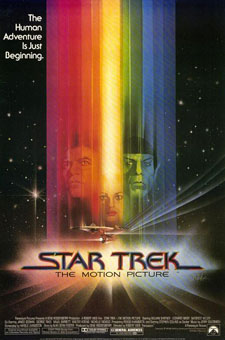
Storyline: When an alien force of inconceivable power sets its sights on Earth, Admiral James T. Kirk emerges from retirement, swipes the refurbished U.S.S. Enterprise from its new commander, Willard Decker, and sets off to save the planet. Spock, who had left Starfleet in favor of purging his emotions on his home planet of Vulcan, decides that the answers to his spiritual quest may be found with this alien and rejoins his former crewmates. Oh, and there’s also this bald chick…
Villain: V’ger. That’s short for Voyager 6, a space probe launched from Earth way back yonder in the 20th century. The probe was found by an alien race of living machines that interpreted its programming as instructions to learn all that can be learned, and return that information to its creator. Unfortunately, it can’t imagine that its creator can possibly be a “carbon unit,” a skepticism which proves highly problematic for the human race.
What’s good: At the time of its release, the best part was simply seeing the cast together again for the first time since the series’ cancellation, and having a noticeably bigger budget to work with. Nowadays, however, the film is driven by the interaction between the eternal trifecta of Kirk, Spock, and McCoy, whether it’s Spock’s pure logic battling against McCoy’s emotions or Kirk’s inability to accept that Decker might actually know something that he doesn’t.
What’s bad: ven Robert Wise’s Director’s Cut of the film still contains some seriously interminable shots, most notably as Admiral Kirk sees the refurbished Enterprise for the first time. There’s a reason my friend Donnie found it more interesting to count the tiles on the movie theater ceiling than watch the film…but, then, he always was more of a “Star Wars” guy. “Trek” fans, meanwhile, have long groused – and rightfully so – that the first big-screen adventure for Kirk and company was, at its heart, little more than an expanded version of an original episode, “The Changeling.”
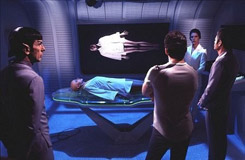
Most surprising cast member: Stephen Collins as Commander Willard Decker. Collins went on to starring roles in “Tales of the Gold Monkey” and “Tattinger’s,” then followed it up with a recurring role on “Sisters,” but his most memorable role is almost certainly that of Rev. Eric Camden, the patriarch on “7th Heaven.”
“Yeah, but the book was better.” – The novelization of “Star Trek: The Motion Picture” was actually written by “Trek” creator Gene Roddenberry, and it provides several details which, though they aren’t actually in the movie itself, have nonetheless become accepted as fact throughout the “Trek” universe. Most notable is that the character of Willard Decker is actually the son of the late Captain Matt Decker, from “The Doomsday Machine,” an episode of the original series. One that hasn’t taken off, however, is the suggestion that Kirk had a significant romantic relationship with a woman named Lori Ciani during the so-called “lost years” between the series and the movie. Oh, and you really need to read the book’s footnotes. Roddenberry treats the novel like it’s a historical record, and when Spock refers to Kirk as his “t’hy’la,” a Vulcan word which apparently can mean either “brother” or “lover,” it results in a response from Kirk that has spawned one hell of a website.

Now are you tempted? C’mon, just click right here. Go on, you know you want to…
TV Roundup: Shorter seasons for “Heroes,” ABC shows in limbo and more

– NBC wants shorter seasons from “Heroes,” according to AdAge.com. The network is looking for 18 to 20 episodes instead of the usual 25, with fewer in-season breaks. I’m all for shorter seasons, as shorter usually equals better.

– ABC has renewed “Lost,” “Grey’s Anatomy,” — no surprises there — “Brothers & Sisters,” “Desperate Housewives,” “Ugly Betty” and “Private Practice,” but “Cupid,” “Better Off Ted,” “Castle,” “Scrubs,” “Samantha Who?” and “The Unusuals” are still in limbo. TV.com thinks that “Castle” has the best chance of surviving.

Television Without Pity lists 10 series that deserve a movie before “CSI.”

Yahoo TV highlights 16 season finales that are coming up over the next five weeks.

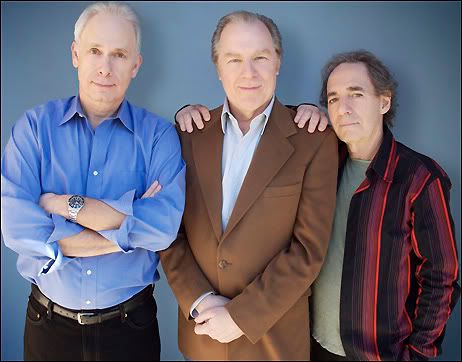
Christopher Guest, Michael McKean, and Harry Shearer Hope You’ll Enjoy Their New Direction

When “This is Spinal Tap” premiered twenty-five years ago, the now classic mock-documentary…or “mockumentary,” if you will…about lightly-brained, heavily sedated British metal stars on the skids received good reviews but unexciting box office. Considering that most people who saw it – and understood that it wasn’t a real documentary — thought it was one of the funniest movies they’d ever seen, it wasn’t too big a surprise that it soon became a very significant cult hit via home video. What was a bit harder to predict was that a film featuring three only moderately well known comedian/satirists and directed by then first-timer Rob Reiner would become one of the most influential comedies of its era. It certainly wasn’t clear that lines such as “this goes to eleven” or “it’s such a fine line between stupid and clever” would enter the general musical and cultural lexicon, and that, decades on, “mock docs” would remain among the most popular of low-budget movie subgenres — and not only for comedy.

Still the biggest surprise of all was that, as musicians, improv geniuses Christopher Guest, Michael McKean, and Harry Shearer, turned out to be better at music as a sideline than most of those who do it fulltime. Not only could the trio play rockers like “Big Bottom” and “Sex Farm” live with brio and dexterity, “unplugged” versions of such vintage Tap classics as “Listen to the Flower People” and “Give Me Some Money” were among the highlights of their early live shows. Of course, the shows were funny, but the big surprise was how well played the music actually was, wowing both metalheads and metal-haters (that would be me) alike.

It didn’t end there. With Christopher Guest emerging as the most reliable comedy-mockumentary director of his time with such irony fests as “Waiting for Guffman” and “Best in Show,” Guest, McKean, and Shearer became the Limelighters/Kingston Trio-like Folksmen. The group figured prominently in Guest’s affectionate 2003 poke at the folk music scene, “A Mighty Wind,” leading to the inevitable gigs where the geeky but oddly talented folk music threesome would open for the bombastic boy-men of Spinal Tap.

Six years later, however, Guest, McKean and Shearer would, in preparation for an upcoming Spinal Tap reunion, take the ultimate step of acoustically performing a collection of Tap and Folksmen classics as well as new material not as any of their off-kilter comedy personas, but as themselves for this spring’s 30-city “Unwigged and Unplugged” tour, which is now officially underway.

Continue reading »

« Older posts Newer posts »

© 2026 Premium Hollywood

Theme by Anders NorenUp ↑