Category: Actors (Page 110 of 343)

“I ain’t much of a lover boy.”

Vice-obsessed film writer Peter Biskind, best known for the book Easy Riders, Raging Bulls: How the Sex-Drugs-And Rock ‘N Roll Generation Saved Hollywood, has a new biography coming out of Warren Beatty.  The most interesting thing to me about Beatty is how an actor who could have easily done just fine on his good looks,  charisma, and acting ability also became one of the most important filmmakers of the later 20th century. But that’s me and I’m weird.

True to form for Biskind, he has grabbed headlines with an estimate that Beatty, who in his prime was definitely noted for being one of the world’s most avid heterosexuals, might have slept with as many as 12,775 women, a number inflated to “almost 13,000” by caption writers. This was all presumably between losing his virginity at 20 in 1957 (kind of late for a future mega-multi-stud, even in the fifties) and settling down with Annette Bening to start a family in the early nineties.

Now, if we simply multiply 365 days by 33 years, the number we get is 12,045. That means that Beatty would have had to sleep with at least an average of a different woman every day, plus add in a good number of various menages or multi-partner days while also managing to help redefine Hollywood movies during the sixties, seventies, and eighties. Not impossible, I suppose but a guy’s gotta sleep and work and eat and stuff.

Naturally, the Beatty camp has shot back and everyone has clarified that, while  Beatty allowed himself to be interviewed by Biskind, the book it is in no way an authorized biography, as some outlets had wrongly stated.

Anne Thompson writes that “Beatty works in mysterious ways.” Absolutely. Anyone who’s seen one of his Barbara Walters interviews can see that the extremely intelligent Beatty is a remarkably cagey fellow in dealing with the gossip-loving press and, based on his reputation, it’s easy to assume that Beatty did sleep with a number of women most of us would regard as enormous, even if this particularly number seems a bit absurd. This, my friends, is not news. Absent moral qualms and given the ability to easily bed innumerable beauties, so, perhaps, would most of us males.

But, what’s really interesting to me is that Beatty’s career-defining role which presumably upped his already massive sexual stock into the stratosphere, was playing a guy who loved exactly one woman and couldn’t even make love to her — not physically, anyhow.  That’s how it works sometimes.

“The Hurt Locker” sweeps the National Society of Film Critics Awards

The National Society of Film Critics has bestowed another big awards win on the Iraq war thriller, “The Hurt Locker,” which won’t hurt its Oscar possibilities.  As with the two other most prestigious critics groups — the Los Angeles and New York film critics — the highly praised tale about a bomb disposal unit during the chaotic early days of the U.S. invasion won the group’s best picture award scroll.

The Hurt Locker

Ironically, according to Peter Knegt of Indiewire, the last time a single film swept the best picture prize from all three groups was when Curtis Hanson’s outstanding “L.A. Confidential” managed the coup in 1997. It lost the Oscar to James Cameron‘s sentimental and spectacular romantic melodrama, “Titanic” — one of the most widely disagreed with Best Picture winners in recent history. With “Avatar” becoming a wide popular favorite and a gigantic hit, a repeat of this scenario is not outside the realm of possibility.

“The Hurt Locker” also won major prizes for director Kathryn Bigelow and star Jeremy Renner, who edged out Jeff Bridges, currently a favorite the win the Best Actor Oscar for “Crazy Heart,” as well as Nicolas Cage for “Bad Lieutenant: Port of Call New Orleans.” For Best Supporting Actor, once again “Inglourious Basterds” break out bad guy Christoph Waltz took the top prize, with another former unknown, Christian McKay, getting the second largest number of votes from critics for “Me and Orson Welles.”  The best screenplay nod went to the Coen Brothers’ ultra-dark black comedy, “A Serious Man.”

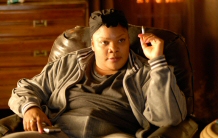
Mo'Nique in In something of an upset that, I’m guessing, might not be repeated at the Oscars, Yolande Moreau, of the French language biopic “Seraphine,” beat Meryl Streep in “Julie and Julia” by one vote for Best Actress. Once again, however, talk show host and comedian Mo’Nique added to a truly impressive number of wins with her work in “Precious,” taking yet another Best Supporting Actress prize.

You can see the complete list of winners at bottom of the Indiewire article I linked to above.

Warner Brothers movie moments #3

I’m still in the middle of my holiday weekend salute to the early years of the most fiscally successful movie studio for the last two years running, back when Warners was known for films which explored the grimy underside of society in highly entertaining ways. First, a pre-code muckraking classic directed by Mervyn LeRoy, produced by Hal Wallis, and starring Paul Muni — the first method actor to become a real superstar and therefore the creative descendant of Marlon Brando and Montgomery Clift who together set the mold for probably most of the film stars of the last forty or fifty years or so, to some extent or another.

And here’s is maybe my favorite gangster movie of all time not involving the Corleone clan. Raoul Walsh’s hugely enjoyable “The Roaring Twenties” from 1939. The hype about that year isn’t so far wrong.

Warner Brothers Movie Moments #2

Of course, early Warner Brothers wasn’t all gritty depression gangster dramas like the movie I featured in the post below this one, “The Public Enemy.”  They also made actually rather gritty depression early musicals that featured the work of ingenious lunatic choreographer and sometime director Busby Berkeley. And sometimes, Berkeley could get downright weird — usually in a good way.

Check out “Sitting on a Backyard Fence” from “Footlight Parade.” Cagney was actually a great song and dance man as well as being an A-1 leading man, but neither he nor costars Joan Blondell or Dick Powell are in this number which, as you’ll see, maybe be just as well for their dignity. It’s definitely different.

Insert Andrew Lloyd Weber joke here.

Warner Brothers movie moments #1

Happy New Year.

Now that we’ve got that out of the way, since Warner Brothers has ruled the domestic box office for two years straight while setting new records both at home and abroad, I thought it might be fun to take a look at movie moments which epitomize the Warner Brothers style when it was grittiest and most cost conscious of the major classic era film studios.

Few sequences encapsulate the WB style better than this scene from 1931’s “The Public Enemy,” directed by William “Wild Bill” Wellman, one of just a few films which set the pattern for the gangster movie for years to come. It’s all here, the crackling, cynical, fast-paced dialogue, the borderline fatalistic pessimism years before the “film noir” genre would be born, and a great star to deliver the goods in Jimmy Cagney.

And as a brief bonus, we have one of the most famous scenes of cozy marital relations every filmed featuring Cagney and Mae Clarke as the gangster’s unhappy wife. According to Wikipedia this scene — easily one of the most frequently excerpted moments ever made from any film — may have begun as a practical joke on the crew.

« Older posts Newer posts »

© 2026 Premium Hollywood

Theme by Anders NorenUp ↑