Author: Ross Ruediger (Page 5 of 16)

TV in the 2000s: The Shows that Defined the Decade

A recent issue of Time magazine has the phrase “The Decade from Hell” emblazoned across its front cover. It’s referring to everything America has gone through in the past ten years, and it’s difficult to argue such an assertion: it’s been a shitty decade on a national level. During such times of stress, people inevitably turn to entertainment as a form of release, and although the methods in which we’ve distracted ourselves over the last ten years have unquestionably diversified, television remains the most easily accessible outlet for most Americans.

Within the format itself, the whole concept of reality TV must surely have been the biggest revolution of the decade. It’s really easy to bag on reality TV – mostly because the bulk of it is so damned unreal – but anybody who spends any time in front of the tube has surely had at least a couple of reality series they consider appointment TV. The two concepts that paved the way for everything else are undoubtedly “Survivor” and “American Idol.” The former, of course, opened the floodgates for the genre, and while it’s seen a considerable dip in the ratings department over the years, 12 million viewers isn’t a viewing figure to sneeze at. The latter, despite all the bitching and moaning and cries of “it’s not as good as it used to be” that accompany each new season, remains one of the most watched shows on the tube, likely due to the fact that it’s strictly a talent competition.

On “American Idol,” the only backstabbers are the judges, and since they aren’t part of the competition, their amusing duplicity is championed. The contestants, on the other hand, are innocents, and once the competition is underway, we’re given no peek into any possible backstage drama, which is a good thing, because by the time the audition rounds are over, we’ve had enough drama to last the whole season. Everything that comes after is all about who can best transfix us for three minutes a week via one pop ditty. It actually says something positive about the U.S. that “American Idol” remains our #1 form of reality entertainment, even if the actual reality is that the vast majority of Americans couldn’t care less about buying the winner’s album six months after they’re crowned.

You might think reality TV is a bunch of crap, and in most cases you’d be right, but the whole idea of it, to my mind, led to an important revolution, and that is serialized nighttime television (the classic “soap” formula notwithstanding). Reality shows taught viewers how to become invested in characters, how to be concerned for their eventual fate, and, most importantly, how to pay attention to an ongoing storyline, and the need to tune in every week. It didn’t take long for the networks to figure out that there was an audience for shows that didn’t continually hit the reset button. “24” must have been the first successful show of the decade to embrace the serial formula, and it embraced it whole hog. It required you to tune in for every episode, because each installment was another hour of a single day in the life of Kiefer Sutherland’s Jack Bauer. That “24” premiered less than two months after the terrorist attacks on 9/11 was pure happenstance. That it became enormously popular with viewers? Probably not so much. America needed some fictitious reassurance that there were folks on the job who could get shit done, and “24” filled the prescription.

Strangely, “24” didn’t open the network floodgates for more such programming right away. It took a few years, and then “Lost” made its mark. The number of “Lost” episodes I’ve seen could be counted on two hands, but that’s not because I didn’t like it, but because real life got in the way of it being appointment TV. Yet I viewed the pilot for “Lost” several months before its 2004 premiere, and when it ended I was convinced that I’d seen the second best TV pilot ever made. (“Twin Peaks” stills sits at #1.) The fact that a show as intricate as “Lost” still has a hardcore, central audience is perhaps a testament to that pilot. “24” started a new story with each new season; “Lost” required that you tune in for every episode of every season.

Another sci-fi series that did just that was “Battlestar Galactica,” a show that, due it being on a niche network (Syfy), never amassed a huge audience yet snagged boatloads of publicity and awareness nonetheless. It was no small feat to take an utterly laughable short-lived series from the late ‘70s and re-envision it for modern audiences, but Ron Moore and company did just that…and they did it far more successfully that anyone ever guessed possible. Most amazingly, the show taught us a lot about ourselves, by thoroughly defining what it means to be human, and as the damaged ‘00s dragged on, there may not have been a more important lesson to be learned.

On the same day I saw the “Lost” pilot, I saw another pilot for a completely different kind of series. While I didn’t rank it as one of the greats, there was one thing I was sure of: it would be a massive hit…and it was. “Desperate Housewives” was precisely the sort of vapid, soapy fare that had been absent for far too long on American TV. It clued into the seemingly bland suburban construct which surrounds so many Americans, via the Lynchian notion that “all is not what it seems.” Most anyone who lives a suburban life can no doubt relate to that idea, because wherever there are groups of people, there are bound to be some of them that are fucked up. “Housewives” is littered with fucked up suburbanites of all shapes, sizes and types, but they’re kooky and funny and there’s always some twinkly music playing in the background that in the end makes everything OK. It is not great television, but over the years it has, for the most part, been immensely watchable in the most disposable sort of way.

Around the same time period as “Housewives,” “Grey’s Anatomy,” made some major waves. It’s a series I have never watched and never plan to, but I’d be foolish to omit it from discussion since it brought two annoyingly obnoxious terms to the TV table: McDreamy and McSteamy. I haven’t heard either in a few years, but there was a time when they seemed to define everything that was wrong with television. I assume “Grey’s” fans have grown out of it…or maybe the show killed one of those guys off? I’ve no idea and can’t be motivated to investigate. Presently, there’s a brand new version of it going around, through cinema, via Camp Edward and Camp Nimrod. People can be so easily distracted it makes you wonder why some shows actually try harder.

Continue reading »

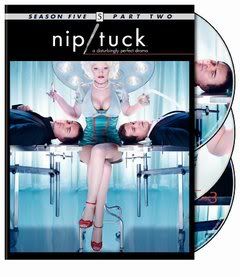
Nip/Tuck: Season Five, Pt. 2

The press release for this set finishes up with two sentences: “And Liz says ‘I do’ to the last person you’d imagine. Time to stretch your imagination, fans.” When even the marketing department can no longer take a show seriously, it must be “Nip/Tuck.” As a fan since day one, I’m past resenting the show for failing to be as good as it once was, and have moved on to embracing “Nip/Tuck” for the freakshow it’s become. How freaky you ask? Well, in one episode, when Dr. Troy (Julian McMahon) refuses to give a woman an unnecessary mastectomy, she performs the surgery on herself – in the lobby of McNamara/Troy – with an electric carving knife.

Never a show to be too far behind the times, another installment features a pair of lovers who’ve taken their vampiric bloodlust a bit too far. You’ve seen these folks at goth clubs, I’m sure, but have secretly hoped it was all an act. “Nip/Tuck” is here to show you that the freakshow never ends, and that people do indeed partake in mutual bloodsucking. Surely the most outrageous display of hedonistic debasement comes in the form of the guy who likes to fuck furniture. If I hadn’t been laughing so hard, I might have turned away. What’s most noteworthy about this block of episodes, is that there isn’t a villain in the traditional “Nip/Tuck” sense – no Carver, or Escobar – although Eden (AnnaLynne McCord) does show up a couple times to fan a few flames.

In other news, Kimber (Kelly Carlson) wants to inject collagen into her baby daughter’s lips so she can get a head start on a successful modeling career. Sean (Dylan Walsh) is babied by a girl when he pretends to be an invalid. Later on in the half season, he dates Dr. Teddy Rowe (Katee Sackhoff), and they experiment with hallucinogens in the desert when they aren’t having sex in strange houses. Julia (Joely Richardson) heads back to New York after a tragedy, and Matt (John Hensley) does a huge favor for a McNamara/Troy intern (Adhir Kalyan), after the boy is asked to perform his father’s penis lengthening surgery. In another episode, a patient asks that his member be decreased, as he can’t stop fellating himself; Bradley Cooper’s Aidan returns for this installment, pitching Sean a movie based on his life. And in the biggest news of all, Christian dates Liz (Roma Maffia) in a storyline that by no means should work, and yet miraculously does.

You’ll hate the final moments of the season, and accuse the show of selling out, but hey, haven’t we been making this accusation for several years now? “Nip/Tuck” hasn’t sold out as much as it’s bought into its own trashy hype. It’s ambling toward the finish line of 100 episodes for syndication purposes, and the writers are having a field day unleashing an enormous amount of tasteless depravity along the way. It’s become very much of a drug in that respect. When it’s good, it’s really, really good; when it’s bad, it’s still there for the doing, and I, for one, choose to continue jabbing the needle deep into my arm.

Click to buy Nip/Tuck: Season Five, Pt. 2

Wuthering Heights

Here’s a long forgotten relic from the past. It’s a BBC adaptation from 1967 of the Emily Brontë classic, and there’s really only one reason it’s out on DVD at all: It stars Ian McShane (“Deadwood”) as Heathcliff. I’m a slave to all things “Wuthering Heights,” and not just because Kate Bush put her stamp on it, either. I’ll watch any adaptation of the book that comes out, and my wife tells me this makes me a very strange man, since to her mind, it’s not a story that many guys dig. What’s not to like? A guy is jilted by his one true love and proceeds to makes life for her (and everyone she knows) a living hell. I get it; I see where ol’ Heathcliff is coming from. He probably takes it a bit too far, though, especially in the second half of the story, when Cathy’s been dead for years and he’s still pissed off and inflicting all manner of pain and degradation on the next generation. Dude – you’ve got to learn to let it go! I say this through every version, and of course he never gets it right. But those misty moors keep calling me back for further helpings, and I can’t get enough “Wuthering Heights.”

Unfortunately, this isn’t one of the better adaptations, especially given how many strong versions have been produced in recent years. With a running time of just over 3 hours, it pretty much covers the entire story, which is certainly a plus. However, the DVD artwork is somewhat misleading. The full color shot of McShane and Angela Scoular (who plays Cathy) might lead you to believe this is considerably more sumptuous than it actually is. It is in fact in black and white, and the video quality is mediocre at best. The entire thing feels like a stage play on film, and perhaps worst of all, it has no musical score whatsoever. It’s pretty creaky, vintage British TV that’s ultimately saved by McShane, who, even at the age of 25, plays an utter bastard (literally) better than most. Even with the problematic production values, he’s a force with which to be reckoned. The same can’t be said for Scoular, who’s one of the brattiest and most unlikable Cathys ever filmed. Ultimately, this version is only going to have two audiences: “Heights” completists like myself, and female McShane fans with a masochistic streak.

Penn & Teller Get Killed

Most people have never heard of “Penn & Teller Get Killed,” let alone seen it. Whether or not it ever even had any sort of theatrical run I’m unsure, but it’s managed to amass a minor cult following on home video over the years, which makes it an ideal title for the Warner Brothers Archive series. Playing fictitious versions of themselves, it kicks off with Penn & Teller appearing on a late-night talk show, where Penn announces that he wishes someone were trying to kill him, as it would bring some meaning to his life. Before long, it appears that someone may be taking him up on the request, yet the pair has been playing an escalating series of practical jokes on one another. Is the death threat against Penn one of Teller’s elaborate ruses, or is it the real deal?

There isn’t much more to the plot than what’s written above, and the screenplay, which was penned (ahem…) by the duo, is mostly a showcase for their oddball talents and dark personalities. It elicits at least a handful of genuine chuckles, and in the final reel, delivers an unusual, quirky sense of dread as it lives up to its title. It’s difficult to recommend to anyone who isn’t a fan, as this isn’t going to turn you into one, and yet it’s a noteworthy minor pop culture history lesson: the Penn & Teller of the movie are far removed from the Penn & Teller of today. Yes, there actually was a time when these guys were all about having a good time and entertaining the audience, as opposed to the bloated Libertarian windbags they are today.

Click here to buy “Penn & Teller Get Killed”

« Older posts Newer posts »

© 2026 Premium Hollywood

Theme by Anders NorenUp ↑