Author: Ross Ruediger (Page 4 of 16)

“Doctor Who” 5.1 – The Eleventh Hour

It feels like it’s been forever since Steven Moffat was announced as the new showrunner and Matt Smith as the new Doctor. It hasn’t been, of course, but well over a year in both cases is nothing to sneeze at. For some fans, the anticipation has been damn near excruciating. Another very vocal minority had little interest in the continuing adventures of the Time Lord without David Tennant steering the TARDIS. And yet another group – perhaps the most important, due simply to the fact that they comprise a huge segment of the viewing audience – were understandably nervous that a new Doctor alongside a new head honcho might lead to a series that was somehow lesser than what had been seen over the past five years.

I’d like to believe that everybody was as utterly intoxicated by “The Eleventh Hour” as I was, but that’s probably wishing for too much. On the other hand, I can’t really see that it offered up anything that would possibly alienate audiences – not even in the form of the new Doctor, who’s not such a drastic departure from the antics of Tennant so as to drive viewers away. Indeed, the differences between Eccleston and Tennant are far more tangible than the divide between Tennant and Smith. All that said, Smith definitely has something of his own going on, and whatever that “something” is will most certainly grow as the season progresses. Both Eccleston and Tennant each took about a half season to find their Time Lord groove; Smith found it by the end of his first episode. I was wholly won over by him upon his delivery of “I am definitely a mad man with a box,” which was followed by an uneasy cackle that seems to imply this Doctor is not quite as right in the head as his recent predecessors.
But I’ve clearly jumped to the end of the episode far too quickly. The pre-credits sequence with the Doctor hanging onto the TARDIS as it flies over London is utter nonsense – derivative of the worst aspects of the Davies era, and completely different from the tone of the rest of the episode. Maybe that was the point? To reassure viewers right off the bat that they’re still watching the same show? I don’t know, but let’s hope there’s less of that and more of all that follows as the weeks move on.
Of course the sequence is followed by a brand new set of opening titles and a rearrangement of the theme tune. I haven’t done an immense amount of reading reactions to this episode, but even with what little I have read, there appeared to be an immediate backlash to these changes. Every time these basic alterations are made to the series, people complain, which is understandable, because why fix what isn’t broken? But “Doctor Who” thrives on change, and this is just another aspect of it. Eventually they get over it and move on, realizing that it probably isn’t quite the disaster their fanboy gut had told them on first viewing. Having seen the sequence numerous times now, I’m already digging it. Unlike the previous credits, the lightning bolts and cloud tunnel seem to indicate the TARDIS is travelling through some sort of space as opposed to time, and the rearrangement has grown on me with each subsequent viewing.
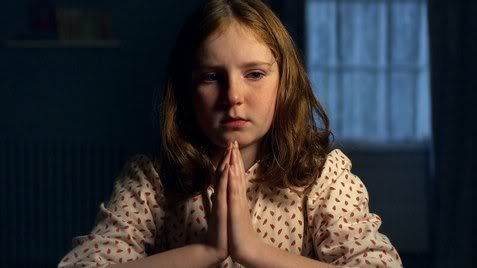
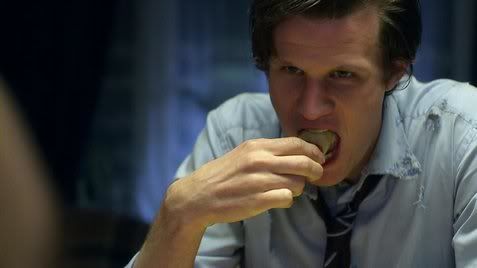
The next 15 minutes, which detail the first meeting of the Eleventh Doctor and the 7-year old Amelia Pond (Caitlin Blackwood) are deliriously charming, and it kicks off with the girl praying to Santa on Easter, and it’s nice to see Moffat’s keeping things on a vaguely secular level. Using children as a big part of the narrative has been a Moffat hallmark (“The Empty Child,” “The Girl in the Fireplace,” “The Silence on the Library”), and here it once again works as a wonderful means to cement the Doctor/companion relationship (although you may not find me as supportive of this gimmick in the coming weeks). No doubt the highpoint of this section is the search for food, which is something that’s never been done before during the post-regenerative state. If every cell in the body of a Time Lord rearranges itself during regeneration, then it’s perfectly reasonable to assume the tastes buds have changed, too. The Doctor thinks he knows what he likes, but it turns out he finds most of it disgusting. In the end, he finds a thoroughly revolting dish – fish fingers and custard – the most tasty and appetizing, which is a gas (or surely will be once it passes through his digestive tract).
Continue reading »

Doctor Who: The End of Time Part Two

Last week, when writing about the first part of the Tennant/Davies swansong, I talked about not making any predictions, as well as the possibility of expectations not being met. On the predictions front, I’m glad I didn’t bother (although one of the few that I did make may actually be true – more on that in a bit), because there’s really no way I could have predicted the bizarre manner in which this tale concluded. The narrative meat of this episode – the stuff involving the Time Lords, Gallifrey and the Master – was quite frankly difficult to wade through on the first viewing; a second viewing alleviated some of that, and yet I’m still not convinced it all makes perfect sense. Perhaps I’m looking at it too deeply, and wanting more than there is?

I’d also be lying if I said I went into this episode without any expectations – I mean, how can you not? Many, if not most of them weren’t met, although there were plenty of other treats on display that made up for that. Indeed, this episode was hell bent on subverting expectations. “The End of Time” as a whole, which is how it should be judged, is a landmark slice of “Doctor Who,” even though the writing isn’t as tight as the intricate standard set by “The Waters of Mars.” Oh well – based on previous finales, I didn’t really expect it to be, and on that level it can’t be called a letdown. It’s so steeped in the mythology of Davies’ vision of “Who,” that it’s difficult to imagine it could possibly work as a piece of standalone drama for anyone unfamiliar with the past five years of the series. But that also can’t be a criticism, since what it really is is a jagged love letter to everyone who’s been paying attention during that time. Davies really backed himself into a corner with this one, because “Journey’s End” very much felt like the end of the era, only it wasn’t. So this proper ending, which feels more like a coda or an afterward, had to be a horse of a different color, and it most certainly was.

Continue reading »

Doctor Who: The End of Time Part One

Before moving on to the actual write-up, let’s take a moment to offer some high praise to BBC America for showing this episode a day after it first screened in the U.K. A day! For the first time on American TV, we aren’t seeing the premiere of a “Doctor Who” Christmas special when it’s warm outside, and the Christmas-themed portions of the story don’t seem hopelessly out of place. Back when I wrote up “Journey’s End,” I pleaded with Syfy to show the various David Tennant specials in a timely manner, so that audiences wouldn’t be forced to go elsewhere to get their “Who” fix or, even worse, get bored and forget about the show altogether. Good thing Syfy no longer has first-run rights here in the States, because I highly doubt they would’ve made the same programming move that BBC America made. Further, BBC America is committed (at least for the time being) to showing the episodes uncut, which is just as if not more important. Keep it up BBCA, and you’ll keep building a devoted audience. Heck, even a week or two after the U.K. premieres would be more than acceptable in my book.

It’s always difficult to write about the first half of a two-part finale, and never more so than in this case. This episode is all over the place in tone, and yet hangs together quite nicely, although it took me two viewings to realize the latter. Yet whatever one might think about “The End of Time Part One,” there’s no denying that the bigger picture has yet to be seen, and what Russell T. Davies unveiled in this hour is only a setup for the real finale. About the first 15 minutes of this thing just zoom by, setting up one aspect of the story after another. In fact, there are so many elements that are set up throughout the hour that one wonders how they can all be addressed in the finale proper.

Continue reading »

Doctor Who: The Waters of Mars

When it was first announced that “Doctor Who” was taking a break from normal seasons in 2009, I thought, “I can handle that – not a big deal.” After all, aside from the Fox TV movie with Paul McGann in 1996, I’d lived without new televised “Who” for 16 years before the show came back in ’05. Each new season since then has been like a little gift. Surely one year with “only” four specials would be a breeze? As 2009 droned on, however, it seemed an interminably long wait for new outings of the series, and it didn’t help matters that the one outing we did get – “Planet of the Dead” – was a subpar piece of storytelling at best. The other three specials are all finally being unveiled on BBC America in the last weeks of the year (actually, the big finale will play on the second day of 2010!). Anyway, this was my roundabout way of illustrating how much I’ve come to take the new series for granted, and thankfully “The Waters of Mars” is as strong a slice of “Who” as just about anything the series has done up to this point. It is, in fact, everything “Planet of the Dead” wasn’t, which may very well have been the point.

The Doctor (David Tennant), still traveling alone, lands on Mars in the year 2059. He trudges across the desolate, red landscape and bumps into a robot, called Gadget, that takes him to its leader on Bowie Base One, which is a clever enough joke – although one that’s a bit old hat for anyone who’s basked in the wonder that is “Life on Mars,” which coincidentally (or not) starred John Simm, who we’ll be seeing more of next week. Inside the base, the Time Lord meets the crew, led by Captain Adelaide Brooke (Lindsay Duncan), and quickly realizes who they are, and is as awestruck as any fanboy we’ve ever seen. Bowie Base One holds humanity’s first group of colonists on Mars, only the Doctor knows they all mysteriously died on the 21st of November, 2059. Guess what the date is? He quickly realizes that he should go, as this is an instance where he shouldn’t meddle with time. He sees it as a fixed point in the universe, and, as he explains later in the episode, “What happens here must always happen.” But events conspire to prevent his exit, and before long the crew begins succumbing to what ends up being a virus – it transforms them into hideous, zombie-type creatures, with cracked faces and the ability to use water as a deadly weapon. Only “Doctor Who” can find an inventive, frightening way to use water as a killer, and its ideas such as this that make the show the unique concept it is.

Continue reading »

TV of the 2000s: The Top 10 “Doctor Who” Stories of the Decade

There has been no better decade to be a fan of “Doctor Who” than the ‘00s. The show, once considered a punchline for jokes made by Trekkies, has risen from the ashes of the ‘80s and been reborn as a serious sci-fi/fantasy force with which to be reckoned. It’s managed to generate two spinoffs in the form of “Torchwood” and “The Sarah Jane Adventures,” as well as open up the entire 26 previous seasons to a whole new generation of fans. Yeah, it’s a good time to be a “Doctor Who” fan, because more than ever, people are less than likely to look at you “that” way when you tell them it’s your favorite series. With that in mind, here’s an entirely subjective list of its crowning achievements since the new series started in 2005; it’s just a shame I’ve not yet seen David Tennant’s two-part finale, “The End of Time,” so it could warrant possible inclusion. In any case, here’s to, at the very least, another full decade of time and space travels inside the TARDIS.

10. “School Reunion” – There are other stories that from a plot standpoint are much better written than this one, and thus more deserving of being in this Top 10, but I’ve an enormous fondness for this outing simply because it not only brought Lis Sladen’s Sarah Jane Smith back into my life, but it did it in such a way that left me a sobbing mess. If, like me, you grew up watching Doctor #4 (Tom Baker) and Sarah Jane battle the evil Morbius on Karn, defeat the diabolical Sutekh on Mars, and kill the giant Krynoid at the estate of Harrison Chase, then seeing her character – as well as her relationship with the Doctor – hit a poignant and dramatic high note of finality was most definitely a strong cup of tea. It’s a bit of a shame Sarah Jane has her own series now, because everything about her that’s come since has somewhat eroded what was beautiful about this story in the first place.

9. “The Waters of Mars” – It’s entirely possible I’m riding a “Who” high at the moment, and that in time “Mars” won’t seem quite as perfect as it does at present. Further, since it won’t play on BBC America until Dec. 19th, it would be wrong to discuss it in any great detail. Nevertheless, it’s got an intricate premise from Russell T. Davies and Phil Ford, deft direction from Graeme Harper, creepy monsters, outstanding set design, and one helluva complex performance from David Tennant, that’s clearly aimed at setting up “The End of Time.” The last 20 minutes are frenzied and game-changing; this is Davies pulling the rug out from under the Time Lord and redefining everything we thought we learned about him over the past four seasons. It’s fucking glorious, and even if the big finish doesn’t quite live up to the buildup, I’ll know they made a damn good go of it.

8. “The Impossible Planet/The Satan Pit” – Here’s another story that might leave a reader or two scratching their heads, but it’s a tale that holds an immense amount of nostalgia for me. See, my kid was 13 at the time it premiered, as were his friends. For the second season of new “Who,” the fates conspired so that he and his buds gathered at the house nearly every weekend to watch the latest episode with me, and the otherworldly goings-on at Sanctuary Base in particular had all of us riveted. “Don’t Turn Around!” became the catchphrase for a good long while around my casa, and further, this was the story where Tennant “became” the Doctor for me. The scene where he was being lowered into the Satan Pit, talking of how the specifics of the creature didn’t fit his “rules” was the defining moment. If I’d had even a vague vibe that he might not be precisely the right actor for the role before this, any such thoughts were dashed immediately after viewing that scene. Beside, the Doctor meets Satan? Hot diggity damn! This two-parter also unleashed the Ood, who have clearly become one of the defining alien races of the new series; they returned for the aptly named “Planet of the Ood” in Season Four, and will be returning again for Tennant’s finale.

Continue reading »

« Older posts Newer posts »

© 2026 Premium Hollywood

Theme by Anders NorenUp ↑