
Terry Gilliam is 70. We celebrate with the best part of “Monty Python’s The Meaning of Life,” “The Crimson Permanent Assurance.”
Author: Bob Westal (Page 37 of 265)
Way back in May of ’09, I wrote about a geek-storm caused by a possible movie reboot/remake of the “Buffy, the Vampire Slayer” franchise not involving the creator of the original TV series and writer of the original film of that name, Joss Whedon. The response from Whedon fans at the time — a group that includes myself and, to a great or lesser extent most of the other writers here at Premium Hollywood/Bullz-Eye land — was pretty much catcalls.
It seemed such an obvious and hamfisted attempt to cash-in on the success of “Twilight,” “True Blood,” etc., even though it was actually the “Buffy” TV series that milked the concept of vampire-human interspecies romance and the rights holders behind it didn’t have the rights to anything from the television show, just the original, likably mediocre, movie.

As the press day began for director Nigel Cole and writer William Ivory’s amiable historical comedy, we assembled entertainment writers believed we’d be doing separate roundtable interviews with the film’s best known actresses. When Sally Hawkins and Miranda Richardson entered the room together to promote “Made in Dagenham,” about a 1968 strike by female workers at a Ford plant located in a grimy London suburb, however, it was easy to be a little overwhelmed. Either one of them is worthy of a Russian novel’s worth of questions and our time would be limited.

Like so many first-class English actors of her generation, Miranda Richardson is known for her ability to play all ends of the dramatic spectrum. In England, and certain geekier quarters of the U.S., she’s still extremely well known known for her work alongside Rowan Atkinson and Stephen Fry as “Queenie” (i.e. Queen Elizabeth I) and assorted other characters on Richard Curtis and Ben Elton’s historical cult-com, “Black Adder.” Younger geeks, however, might know her better as magical tabloid journalist Rita Skeeter in the Harry Potter films. On the more realistic end of the spectrum, she has also done magnificent work playing a ruthless IRA operative in “The Crying Game,” a maltreated housewife in an Oscar-nominated role in Louis Malle’s “Damage,” a widely praised turn in the Oscar-winning “The Hours,” and a widow investigating her husband’s death on AMC’s recently canceled suspense drama, “Rubicon.” On the other hand, she’s also portrayed the character of Mrs. Santa Claus opposite Paul Giamatti‘s Santa in “Fred Claus.” Despite some resemblance, both physically and in terms of talent, she is not part of the famed Redgrave acting dynasty and no relation to the late Natasha Richardson. She is, in fact, the only actor in her family, which perhaps makes her all the more impressive.
Although Sally Hawkins has appeared in some 34 movie and TV productions since 1999, she broke into the consciousness of most of her fans with her Golden Globe winning performance in Mike Leigh’s 2008 “Happy-Go-Lucky,” in which she dominated the film as a relentlessly happy and, strangely enough, rather bright, elementary school teacher. It was probably an ideal role for a woman who really does come across as cheerful in person, with an approachable demeanor that certainly seems to fit the child of two children’s books authors. Currently starring on Broadway in a new production of George Bernard Shaw’s “Mrs. Warren’s Profession,” Hawkins has continued to mix starring roles with a number of smaller supporting appearances, including a turn in Cary Fukunaga’s highly-anticipated new version of “Jane Eyre.” Her next leading role is as Irish radical politician and activist Bernadette Devlin in “The Roaring Girl” — assuming the real Devlin is not successful in her efforts to prevent the film from being made.

So, folks, here’s your key to box office success: fund the kind of European-styled welfare state that would drive Tea Party activists into a state of complete hysterics, if they weren’t already there. With impoverished moms actually having a modest amount of free time to themselves because they don’t have to worry about their children starving or being unable to go the doctor and your society as a whole benefiting from improved physical and mental health, wait for one of those moms with a literary bent to come up with a once-in-a-century sensation of a book series. Hopefully, it will be aimed at a young audience with time to watch each movie several times. Then, film it — competently, will suffice, no particular need for brilliance — making sure, as Anthony D’Alessandro reminds us, to avoid the need for a momentum-killing reboot by recruiting strong and likable leads you can continue with for the entire length of the franchise. Repeat.
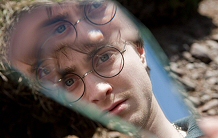 That’s pretty much the formula for the massive success of the Harry Potter film franchise. So, as stated Thursday eve, the question for the first weekend of “Harry Potter and the Deathly Hallows: Part One” was always whether it would have a great opening or the greatest opening of all time. Well, it did have the greatest opening of all time…for a Harry Potter film. To be specific, according to Box Office Mojo, it earned an estimated $125 million, still well shy of the current opening weekend record holder, “The Dark Knight,” which grossed over $158 million on its mega-huge opening weekend.
On the other hand, that is a series best, significantly well north of the $102 million and change earned by “Harry Potter and the Goblet of Fire” five years back. Also, as the saying goes, $125 million here and $125 million there, and pretty soon you’re talking real money. The emotionally rather dark-hued installment (I haven’t seen it, but I’ve read the book, and I can only imagine) also earned the highest per-screen average this week, a rather unusual achievement for a super-wide release like this, earning a whopping $30,332 average in over 4,100 theaters. That’s a nice infusion into our failing economy, as well, even if we have to share it with billionaire ex-welfare mom J.K. Rowling and a bunch of other Brits because of that whole welfare state thing I propagandized for up top. Well, don’t worry because “austerity” might mean that there won’t be any more new English Rowlings for a while, either. Still, she’s got another even bigger pay day ahead of her with the upcoming 3D series finale.
Meanwhile, last week’s trinity of top moneymakers held on decently with drops somewhere not too far above the 40% region. #2 “Megamind” amassed an estimate of $16.175 for its world domination war chest; runaway train thriller #3 “Unstoppable” was not stopped and earned an estimated $13.1 million; #4 “Due Date” avoided lateness penalties in its third weekend for a star-driven $9.15 million.
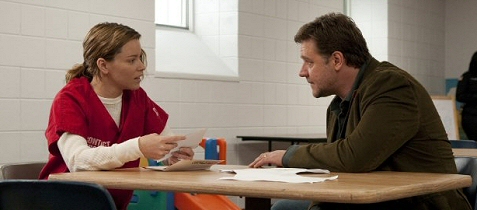
Meanwhile, the wide theatrical run for Russell Crowe‘s latest may not be all that much longer than, you guessed it, “The Next Three Days.” Paul Haggis’s underwhelmingly reviewed thriller costarring Elizabeth Banks debuted in the deadly #5 spot with only $6.75 million. The budget on the film, which could well be very modest if you subtract Crowe’s paycheck, is unknown at this point, but Nikki Finke is quick to remind that marketing costs for a film like this pretty much start at $30 million.

This is not the first time I’ve posted about the great thriller Michael Powell made with writer and famed WWII cryptographer Leo Marks. Released the very same year as “Psycho,” “Peeping Tom” was also about a serial killer, but was much more stylized and shot in eye-filling Eastmancolor. It featured, I believe, not a single drop of onscreen blood. Yet, it more or less permanently disabled the career of one of the greatest directors of all time.
Below the often thoughtful but highly tendentious BBC film critic, Mark Kermode, is on his absolute best behavior as he provides terrific interviews with Powell’s widow, famed film editor Thelma Schoonmaker, and her boss/colleague and #1 Powell fan and friend, Martin Scorsese, as they try to explain just what made, and makes, “Peeping Tom” so powerful and relevant today.
The irony of the completely opposite post-serial-killer movie fates of Alfred Hitchcock and Powell, who were of roughly the same generation and peers in the English film industry at one point, never fails to stun me. I’m also endlessly impressed by the fact that there was a time and a place where movie critics could not only destroy a film, they could end a career. I wonder how “Peeping Tom” would have been received if it came out in North America first.
You can see the even more excellent complete 22 minute interview with Martin Scorsese over at The Guardian which, among other topics includes some discussion of the upcoming “The Invention of Hugo Cabret” and Scorsese’s thoughts on shooting the film in 3D. As for, “Peeping Tom,” let’s hope, that restoration hits the States before too long.
FOLLOW US!


CATEGORIES
© 2024 Premium Hollywood
Theme by Anders Noren — Up ↑