Month: June 2010 (Page 14 of 17)

Breaking Bad 3.12 – No More Half-Measures, Walter

I’m going to go out on a limb and say that, no matter what happens in the season finale, this week’s installment of “Breaking Bad” will still go down as the best episode of Season 3. With that said, we’ve got plenty to discuss, but let’s start things off with a song, shall we?

I don’t know about you, but, personally, I’m never going to be able to hear The Association’s “Windy” in the same way again. Here we go with another example of what I referenced last week, paying off longtime viewers by revisiting a long-dormant storyline. We haven’t seen Wendy since the early days of Season 2, but she’s back and, as we (and Jesse) can clearly see, business is still booming for this industrious young lady.
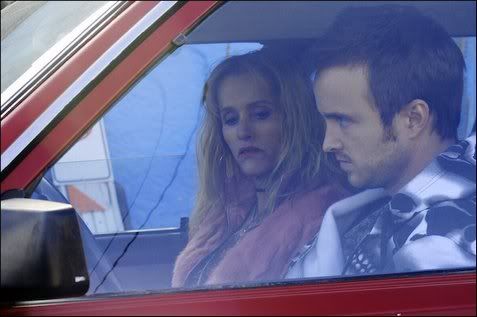
Despite Jesse’s assurances to Walt that Wendy had the necessary emotional stamina to help him with his plan, I knew she was acting way too hesitant about assisting him for things to go smoothly. Frankly, given the ominous green light in her room and the way she was gazing longingly at the blue meth, I figured we were looking at the very real possibility of an O.D. before her part in the proceedings ever came to pass. That’s not what happened, of course…but, then, given the way she shambled off after her dismissal, who knows what her eventual fate will be?

(Actually, it’s probably kinda like Lucy Lawless’s comment on “The Simpsons,” where, whenever you notice a continuity error on “Xena: Warrior Princess,” the explanation is that a wizard did it…except that anytime a character on “Breaking Bad” vanishes and is never seen again, you can presume that they either O.D.’ed on meth or were killed by a dealer. I mean, c’mon, if you do the stats, the law of averages speaks for itself on this matter.)

It was nice that Walt, Jr. got a chance behind the wheel, and it was even nicer that they kept it real and directly addressed how his medical condition would affect his driving. While Walt and son were bonding, however, Skyler was online, doing her research on money laundering so that she’d be properly prepared to pounce on Walt the second he arrived. That was a great scene, with the back-and-forth between them, each certain that the next words out of their mouths would give them the upper hand in the discussion, and even though Walt seemed to be bowing to her superior position, he ended triumphantly. (“…and THAT is how we’ll sell your little fiction!”)
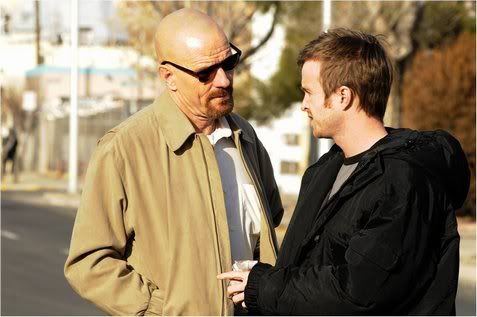
There were a lot of intense discussions this week, with the one between Walt and Skyler quickly followed by one between Walt and Jesse. This one, however, took place over the course of a couple of cold ones. (“No, seriously, get a beer with me.”) Looks like my concerns were correct: the dealers were some of Gus’s boys. Not that Jesse gives a rat’s ass about the possible end result of taking them out, since he’s angry about the situation on at least two levels, but Walt tries to talk some sense into him, anyway. (“Murder is not part of your 12-step program!”) Walt was making some pretty harsh statements, most notably underlining the fact that if Jesse had really been interested in revenge, he would’ve done something about the dealers weeks ago instead of just getting doped up, but surely he knew that his arguments were falling on deaf ears.

Jesse’s record for making rational decisions isn’t exactly unblemished, however, so not only was there never any way he was going to change his mind, but, frankly, I can’t believe Walt ever really expected Jesse to show up for the meeting at Saul’s office, either. Not that I’m really complaining: any scene with Saul is a good scene, and this one was no exception, thanks to his clarification to Walt about wearing orange jumpsuits and picking up trash along the highway (“That’s jail”) and his musing on the chancy bathrooms at Springer. What I found most enjoyable about the scene, though, was the way Bryan Cranston so effectively captured the feeling that Walt was just kinda spitballing ideas, with no real idea what to do about the situation.
Continue reading »

Rock and roll gender wars

More in my series of clips featuring fake bands from the movies inspired more or less by Aldous Snow and Infant Sorrow, the band in “Get Him to the Greek.”

As Roger Ebert notes in the DVD commentary to Russ Meyer’s “Beyond the Valley of the Dolls,” it was kind of progressive to make a movie about an all-female rock band in 1970. They were certainly rare as hens-teeth in real life until  several years later the Runaways, the Go-Gos, and finaly the Bangles broke the rock and roll gender barrier. I’m not sure how inspired any of them were were by the Carrie Nations, the fictional band in the film directed by Meyer and written by Roger Ebert, but this opening sure shows Meyer’s remarkable filmmaking approach and a hint of what kind of dialogue you can expect when you let a movie critic write a movie. (A later scene features the immortal words spoken by a Phil Spector-esque impressario: ‘This is my happening and it’s freaking me out.” That’s Ebert, baby.)

By 2001, of course, women in both real and cinematic rock bands were hardly unusual. On the other hand, there weren’t too many rock and roll band transsexuals, and there was just one victim of a botched sex change operation. Below, Hedwig and the Angry Inch explain the meaning of their name. It’s not necessarily an experience for the faint of heart, but it sure is rock and roll.

“Shrek Forever Ever” threepeats, “Get Him to the Greek” wins silver amid box office malaise

Shrek Forever AfterThe numbers are out early this morning via Box Office Mojo and the Numbers, so I’m going to rush out the weekend box office news whilst I have time. Basically, it’s been a fairly slow couple of weekends with disappointing performances for movies like “Shrek Forever After,”  and, to a greater extent, “Prince of Persia: The Sands of Time” and “Sex and the City 2” — though I think most any sensible person could have told the studios these movies, suffering from overused or tired or just kind of lame concepts, never had much mega-blockbuster potential. Let’s see how things go when “Inception,” “Toy Story 3,” and, maybe, “Scott Pilgrim vs. the World” come out.

Anyhow, the news wasn’t all bad. The final “Shrek” production continues to capitalize on the fact that it’s been better received than the prior film in the hyper-extended series. It’s showing reasonable legs, earning an estimated $25.3 million for Dreamworks/Paramount in its third week and dropping a lower-than-average 41.6%.

Some seem to think it’s a disappointment, but “Get Him to the Greek” sure looks like a moderate success to me. It broke out from a pack of four new releases, two of which were supposed to earn more money than it, and earned a couple million more than some of the gurus were predicting on Thursday, an estimated $17.4 million. I guess the fact that some critics mentioned “The Hangover” in their reviews kind of ginned up expectations, but sleeper successes like that have their own surprising logic and always come out of left field. Universal needs a lot more than this to really break it’s losing streak, but it’s not a horrid start.

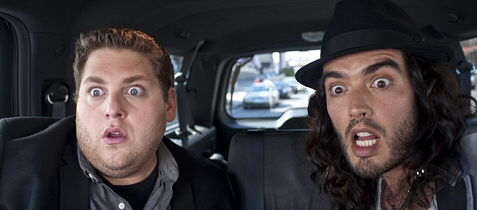
Russell Brand and Jonah Hill in

Nikki Finke, for some reason, expected “Greek” to make more than the movie it’s spun off from, “Forgetting Sarah Marshall.” However, the fact of the matter is that that film had more of an almost classical screwball romantic comedy premise that appeals to a wider audience of both men and women when done well, with more traditionally appealing leads — Jason Segal’s  unpretty but brilliant nude scenes notwithstanding. Even if Russell Brand and Jonah Hill were in the earlier film in scene-stealing supporting roles, the Mutt and Jeff twosome is still not all that widely known and a fairly unusual pairing for a mass audience movie in our time. Moreover, the $40 million budget is modest these days, making the very home-video friendly, Judd Apatow-produced, “Greek” a very probable nice earner over the long haul.

Moving on, things get worse. “Killers,” starring my least favorite male actor in the universe and Kathryn Heigl, came in third with an estimate of $16.1 million. With a budget of $75 million, this is obviously the opposite of a  homerun for Lionsgate. Despite being a family film, the CGI-aided talking dog movie, “Marmaduke”, had at least a certain degree of failure pretty much written all over it, coming in at sixth place with an opening weekend estimate of $11.3 million for Fox. Not quite in the basement, but with a $50 million budget and no reason to expect any kind of legs, this one looks (I cannot resist) like a bit of a dog.

Kim Cattrall in As for last week’s aforementioned debuts, it wasn’t pretty. Both Disney’s “Prince of Persia: The Sands of Time” and, more so, Fox’s widely reviled “Sex and the City 2” showed no legs this week, dropping by worse than average 54% and 59% respectively, and coming in fourth and fifth with $13.9 and $12.65 million respectively.

Though Nikki Finke and others are trumpeting the tale of how it even got a theatrical release at all, the creepy science-fiction thriller “Splice” pretty much died with $7.45 million estimated for Warners, which is keeping the project at arms length. It apparently did badly on Cinemascore, which I guess reflects my hunch that the modern blood-and-gore-thirsty, trauma-loving, horror audience was the wrong group to pitch the movie too, especially given its potentially misleading R-rating (as much for sexuality and language as “sci-fi violence”).  It should have been sold as more of an adult science fiction thriller and probably started out with more of a limited release. Instead, they promised the audience a chili-bacon cheeseburger and gave them Fettuccine Alfredo. Well, it only cost $30 million, it has its fans, and there’s always DVD/Blu-Ray.

Doctor Who 5.7 – Amy’s Choice

Here we are, more or less mid-season, and as someone who’s recapping this block of episodes week in and out, as well as someone who’s been deconstructing this series for years now, I’m frankly a bit flummoxed by Steven Moffat’s inaugural year. It’s starting to feel as if the season is only going to make total sense once it’s over and done with. Some time ago, long before the season began, Moffat was saying that he wanted the season to be referred to as Season One, rather than Season Five, and that’s starting to make a whole lot more sense. Aside from the occasional references to the past, everything about this year feels as if some kind of reset button has been hit, and yet it remains difficult to watch without bringing the baggage of the last five years into the equation, even though I’m fairly certain Moffat would prefer that we didn’t. I mean, it’s hard to picture a character like Mickey Smith, for instance, fitting into any part of this narrative in any kind of believable manner, and yet you almost want somebody like him to turn up in a scene just to remind you that you’re still watching the same show.

I continue to want to compare this material to stuff from seasons’ past, and yet this nagging feeling keeps telling me that’s just an unfair thing to do. I wonder if Moffat’s even got some kind of grand master plan that extends beyond this block of 13 episodes? None of this means I’m not enjoying the season, just that it’s a much different kind of enjoyment than what I’ve become accustomed to during the Davies years, which began feeling predictable about three years in. Say what you will about this season, but, at least at this stage, it is most certainly not predictable. In some ways watching this season is as disorienting as the predicament in which our heroes find themselves in this week’s episode. As viewers, we’re experiencing a new reality of the series, while we keep thinking back on what we came to know prior to this season’s start. Which is the real “Doctor Who?” The Davies or the Moffat era? Both, or maybe neither? I’ll likely elaborate on all of this further during the final recap of the season.

Continue reading »

« Older posts Newer posts »

© 2026 Premium Hollywood

Theme by Anders NorenUp ↑