Category: TCA Press Tour (Page 31 of 56)

Patrick Swayze checks into the hospital

I don’t generally get to be present for breaking news, but this time I was. I turned up for A&E’s panel about Patrick Swayze’s new series, “The Beast,” only to be apologetically informed that Swayze was not in attendance, having checked himself into the hospital for observation after having contracted pneumonia. It’s the price of chemotherapy, of course, to find one’s self in a weakened state and prone to becoming further ill as a result, but Swayze personally requested that the panel go out without him, so that we could speak with the creative team as well as his co-star, Travis Fimmel.

I won’t lie to you: I’m both disappointed by Swayze’s absence and totally sympathetic for his situation. Here’s hoping he’s able to get back on his feet.

TCA Tour, Jan. 2009: “Make ‘Em Laugh: The Funny Business of America”

Dying is easy, and comedy is hard, but if you really want hard, try putting together a six-hour documentary about comedy in motion pictures and on television without having someone complain about what’s been left out. Can’t be done…and hasn’t been done, if I’m to be perfectly honest. There’s just too much comedy out there. But with that said, PBS’s effort, “Make ‘Em Laugh: The Funny Business of Comedy,” is a damned good attempt at accomplishing the feat, and more importantly, the show’s executive producer, Michael Kantor, is fully willing to concede the impossibility of covering everything.

“Max Welk, who was one of our consultants, is maybe 90 years old, kept saying the two funniest people he ever saw were Jack Benny, who could walk on stage and say nothing and an audience would laugh, and Wheeler and Woosley,” said Kantor. “Jeff Abraham lobbied for the Ritz Brothers. So it was very difficult. Rather than tell the kind of…not standard story, but natural story of, okay, here were the different studios that sprang up and we’ll march chronologically through the silent film era, we decided that a comedy series needs to be surprising and the audience, the viewer, would enjoy it more if they were a little taken aback by the next story, perhaps Paul Lynde following Redd Foxx. It’s surprising, ‘Well, where are we going?’ So we tried to hue to the framework that way rather than comparing, you know, Charley Chase with Harold Lloyd with Buster Keaton. I almost interviewed Rudy Ray Moore, who lived — just died, actually — lived in Vegas. He created Dolemite. And I kept thinking, ‘God, this is an amazing story. It deserves its own AMERICAN MASTER special.’ But it kind of didn’t fit into the six different episodes we created.”

As for the narrator of “Make ‘Em Laugh,” Amy Sedaris made a point of noting that Buddy Hackett didn’t end up making the final cut, either. (There is, however, a quick cut to a shot of Jerri Blank, from “Strangers with Candy,” which made her happy.) Kantor seemed apologetic about the omission, but he explained, “The goal was, once, with a team of consultants, we’d figured out that these six categories or archetypes or – call them what you want — genres that reflected different aspects of American culture were the ones we were sticking with, we wanted to tell the best story we could. And that’s why poor Buddy Hackett didn’t make it.”

Kantor said it was also an issue when it came to trying to figure out what classic clips would fit into the proceedings without feeling shoehorned in.

“There were a couple of sitcoms that we really wanted to include, but we just didn’t have time for,” he said. “One was ‘The Odd Couple.’ We reference it in passing. You see someone talk about it and yet it seemed to so clearly speak to a moment in time where divorces were happening in America and yet we couldn’t give it as much weight, as maybe if we had 72 minutes in an hour, we would have wanted. And Richard Pryor had the ill-fated ‘Richard Pryor Show,’ he only did four of five episodes, and he does this great speech where he’s a black President,” said Kantor. “And it felt like, ‘Boy, wouldn’t that be interesting to sneak in?’ Robin Williams is standing in the back. But that wasn’t for cost or any other reason. It was just the arc of the Richard Pryor story; it didn’t hold. My job as a documentary filmmaker is how to tell the best overall story. Maybe like a baseball manager: you might have a great hitter, but he doesn’t fit in perfectly, so you’ve got to trade him.”

Despite Buddy’s omission, Sedaris enjoyed working on the special and acknowledged that it proved to be an educational experience for her.

“I was never a big Charlie Chaplin fan – I liked Buster Keaton – and it made me appreciate him a little bit more,” she said. “Phyllis Diller, I loved. She made her own clothes, dragged her kids along with her. She really magnified the fact she was unattractive, and I love that. And Mae West. I was never a big fan of Mae West, but I didn’t realize she wrote all that stuff, and I didn’t know about all the problems that she had. And that made me appreciate her. And Jonathan Winters, I love that whole section because he…it seemed like he had a mental disorder and yet embraced it, because his humor came from his characters, and that’s what I always find funny: the characters.”

“Make ‘Em Laugh: The Funny Business of America” begins airing on January 14th and continues on Jan. 21 and 28.
TCA Tour, Jan. 2009: “George Carlin: The Mark Twain Prize”

There were an obscene number of celebrity deaths in 2008, but very few of them hit quite as hard as the loss of George Carlin. He’s one of those guys who I just kind of figured would be around forever, secretly suspecting that he couldn’t die until he had nothing left to grouse about. So much for that theory. It’s particularly bittersweet that, only four days before his death, the Kennedy Center for the Performing Arts announced that Carlin would be the 2008 honoree of the Mark Twain Prize for American Humor. The good news, however, is that the decision was made to give him the prize posthumously, the first time such a thing had been done.

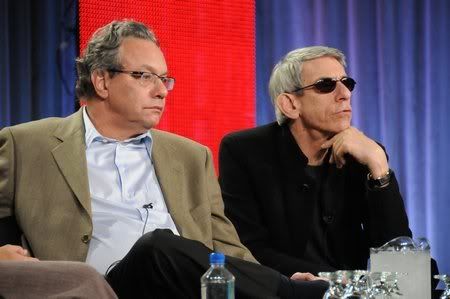
As you can imagine, it didn’t take much effort to accumulate a star-studded list of names to pay tribute to Carlin, and the PBS panel to promote “George Carlin: The Mark Twain Prize” included two of them: Richard Belzer and Lewis Black.

The first question posed was one that should’ve been expected by anyone familiar with Carlin’s work: how can PBS properly pay tribute to a man whose most famous routine involved the seven words you can’t say on television?

“I learned a long time ago that if you’re in a church, you don’t do certain things, and if you’re in someone’s home, you don’t do certain things,” said Belzer. “If the philosophy of the network is not to offend people who they think might be offended, I don’t think this hurts this show. George Carlin is so brilliant, his use of language is vast and compelling, that a few bleeps might even be enticing. I don’t think it diminishes how great George is, how important the show is, and the function that PBS serves over time. I mean, civility in manners are defined in different ways. If it were up to me, we’d have all the words you’d want, but I am not a network.”

Executive producer Peter Kaminsky followed up on Belzer’s comments, clarifying, “It goes beyond the
network. It’s the law. The Supreme Court will come down on you heavy. This case is…I mean, I think one of the legacies of George is he started something in the Supreme Court and 40 years later, or whatever, 30 years later, we’re still arguing about it. It’s very much front burner, and we hope to see that change in a new administration.”

Black, unsurprisingly, chimed in on the matter as well. “What will happen if the words were actually said?” he asked. “Children would panic? They don’t hear the words at home? I think what Richard
said is absolutely true, and I think it’s bullshit.”

For her part, Kelly Carlin McCall – George’s daughter – finds the whole matter hilarious. “My dad’s view on this was that if you actually bleep the words, they become dirtier, so it’s a beautiful irony for me,” she said. “I just find it very strange.”

She also acknowledged that her father was extremely happy when he got the news about the Twain prize, which is impressive, given that he didn’t tend to take awards very seriously. “He saw the game of it all,” she said. “It was a bunch of bullshit. But there was something about this prize that meant something to him. He did call me when he found out about it; he was very excited. I think in the last five years he really started to take in that he was the elder statesman of this genre, of these people. He took that seriously. I think he was really getting that, wow, these people really want to honor him in that way. I don’t know how he would have sat there and taken it all in. I would love to have known.”

The best series of comments from the panel…?

Continue reading »

TCA Tour, Jan. ’09: “Great Performances: King Lear”

I wouldn’t want to dismiss several generations of Shakespearean actors with a single statement, so let me see if I can phrase this just right: we’re getting to a point where it just doesn’t feel like there are as many greats as there used to be. That’s not to say that there aren’t greats, of course, but…well, surely you know what I mean. Olivier, Gielgud, Richardson…all are gone, and for all the talents that have arisen in the intervening years, few are quite as immediately associated with the Bard in the same way, where you hear their name and immediately say, “Oh, yes, of course, he’s the Shakespearean actor.”

With that said, however, it’s fair to say that Sir Ian McKellen falls into the category of those who, despite roles ranging from Gandalf and Magneto to James Whale and Kurt Dussander, is still very much recognized as a Shakespearean actor. Granted, the reputation is probably significantly greater in the UK, where he’s done television productions where he’s played the title roles in “Hamlet,” “Macbeth,” and “Richard III,” as well as Iago in “Othello,” but after his unique cinematic interpretation of “Richard III,” in which he co-starred with Robert Downey, Jr., and Annette Bening, even Americans began to associate him with Shakespeare.

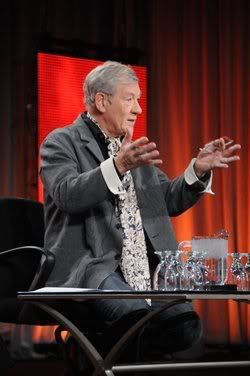
As such, the idea of seeing McKellen appearing as King Lear in an upcoming “Great Performances” production is one that intrigues me considerably, particularly after experiencing his enthusiasm for the play firsthand.

“King Lear” has fascinated McKellen throughout his acting career, particularly because of the wide variety of ages amongst its characters. “As a young man, I was very intrigued by the part of Edgar, which I played,” he said. “And there are a lot of young people in ‘King Lear’ that a young audience could identify with, good and bad. Then there are a lot of good middle-aged characters. But what’s perhaps special about ‘King Lear,’ as opposed to a ‘Hamlet,’ is that the central part is for an old person. And so if, like me, you’ve worked your way through Shakespeare as an actor, you know, waiting up there is ‘King Lear’ and, beyond him, a shadowy Prospero, maybe and, oh, dear, a Falstaff too.

“I’ve been in the play twice before as Edgar and as Kent. I’d seen what it cost the person — the
actors playing King Lear: Brian Cox, on one occasion, giving his all a hundred percent every night and discovering in himself depths and heights that he hasn’t necessarily had to use in any other part. And the late Robert Addison played King Lear, when I played Edgar, in his mid-60s and frail at the end of the evening because the performance had taken so much out of him. So I suppose it’s the challenge. It’s the expectation that it will complete your journey through Shakespeare.”

With that said, however, McKellen admitted that he hadn’t actually been spending his career with a burning desire to play the role of King Lear.

Continue reading »

TCA Press Tour, Day 12: The CW

Well, as I mentioned a few posts ago, I wasn’t around for any of The CW’s panels after their “90210” presentation…which, as it happens, was their very first panel. Fortunately, however, the beauty of being a member of the TCA is that I can still provide you with highlights from the panels I missed. God bless transcripts, that’s what I say…

Even before we offer up the “90210” coverage, however, let’s take a gander the info that emerged from the executive session hosted by the President of Entertainment at The CW, Ms. Dawn Ostroff.

* Like last year, The CW brought us details of a new reality show. This time, however, it’s not as underwhelming a pitch as “Crowned” or “Farmer Wants A Wife.” Not that I didn’t end up watching those shows, but “13 – Fear is Real” is one that I actually want to watch, since it’s executive-produced by Sam Raimi and Jay Bienstock. “The best way to describe this show is ‘The Blair Witch Project’ as a reality show,” said Ostroff. “It’s a competition show, but there’s certainly a lot of tension, a lot of fear, and it’s different. There’s an environment that they created in the bayou of Louisiana where, of course, they know it’s a reality show, but the intensity of the situation that they’re living in and the kinds of challenges that they’re faced with really feel real to them while they’re in it. This is hot off of the editing bay…this week, as a matter of fact…and it was shocking to see how invested these contestants were. I mean, they really felt the horror.”

* There wasn’t much “Reaper” news, unfortunately, except that it definitely has a place on the schedule in mid-season. “It’s a great show for us to have in our arsenal,” said Ostroff. “It’s a show that we believe in, which is why we picked it up.” Yeah, but let’s call a spade a spade: they only believed in it enough to pick it up as a mid-season replacement, not for a full season. We can only hope that, come mid-season, the show’s fanbase has built up enough steam to keep it rolling for a third year.

* There is currently no plan for another season of “Beauty and the Geek.” There is also no formal word of cancellation, however.

* And I’ve saved this bit for last because, frankly, I don’t want to believe it, but…ugh…Ostroff claims to have been happy with the time-jump on “One Tree Hill.” “Our expectations were we would do something different that felt, certainly, in line with the show, because the actors had gotten older,” Ostroff said, “and they were excited about the idea of playing characters closer to their real age. We know that when characters often go into college years on a show, it’s sort of hard to keep them together, and the storylines aren’t quite as relatable, so the idea of jumping the show four years forward, having the characters outside of college, in the working world, being young adults, just felt like the time was right. We knew we would have interesting storylines for each of the characters, and Mark Schwahn is just a really good writer. He took all of these characters and put them into young adulthood, created new arcs, new situations, and the show had a renaissance. I mean, it was a great idea, and it really did pay off for us.”

Pft. The results still felt trite to me, and I’m not backing down on this.

Okay, now we move on to…

Continue reading »

« Older posts Newer posts »

© 2026 Premium Hollywood

Theme by Anders NorenUp ↑