Category: TV Sci-Fi (Page 16 of 81)

Doctor Who 5.2 – The Beast Below

After gushing over the season premiere last week, it pains me to find “The Beast Below” is lacking. One element of the episode I found to be a huge letdown, and one that’s critical to the story is “the children,” and I had a bad feeling about this as soon as the episode started in a classroom. Now it’s not necessarily that the children angle of the story is sloppily plotted, it’s that I’m annoyed by Steven Moffat’s ongoing insistence at using kids as pivotal elements in his stories. I realize that last week I went on and on about how magical the stuff was between the Doctor and the young Amelia Pond – and make no mistake, it was – but with “The Beast Below” I found myself instantly bored with the angle. Of the four stories he crafted during the Davies era, three of them involved children to one degree or another, and the first two stories of his own era have now featured children.

My problem with this is that even though “Doctor Who” is a family series, and that children are a large part of the viewing audience, that doesn’t mean children must be a component of the narrative. It becomes doubly irritating when you’ve already got a lead character who acts like a kid much of the time anyway. Somebody might argue that they’re used as audience identification figures for younger viewers, to which I say balderdash. For 26 years “Doctor Who” hummed along quite nicely, rarely making anyone younger than a teenager part of the storyline. Kids, I believe, are perfectly content to watch adults on the tube and in film. They don’t long to see other children involved in these types of adventures. Somebody else might argue that Moffat uses children in order to help adults find their inner child. I can actually buy that more than the former proposed argument, but it needs to be used sparingly and smartly, and hot on the heels of the young Amelia Pond is hardly sparing, and the climax of “The Beast Below,” which hinges on crying children doesn’t strike me as particularly smart.

Once again I’ve gotten ahead of myself and jumped to the end of the episode, but once again I reiterate – you’ve no business reading these pieces if you haven’t seen the episode being written about. Events kick off in the 29th century where the entirety of the Britain (apparently save Scotland) exists on a giant spaceship appropriately named the Starship UK. Due to solar flares, humanity has been forced to relocate from the planet’s surface. (They’ll one day head back down to the planet once the danger is gone.) We’ve seen so many different periods of Earth’s future on the series so far, in episodes like “The End of the World,” “The Long Game,” and “New Earth,” that it isn’t a stretch to buy into this, yet at the same time there’s a certain “been there, done that-ness” to it all.

The post opening credits sequence with Amy floating in space outside the TARDIS, while the Doctor holds onto her leg is really rather splendid, as is her voiceover about her imaginary friend who has come back to her. Before the duo travel to the ship, he gives her a very goofy speech about his one rule, which is to never interfere in the affairs of other people. Ha!! Who does this cat think he’s foolin’? But it’s interesting nonetheless, because in telling Amy that, it demonstrates how little she actually knows about this man whom, we, the viewer, actually know a great deal about. These are early days for Amy, and there are many adventures yet to come. What causes the Doctor to break the rule he just set down? A crying girl seen on the scanner. Amy follows him, still dressed in her nightie, which has a certain Arthur Dent-ness to it. (If so, then is the Doctor Ford Prefect?)

The world of Starship UK is a dreary place, and the residents live in fear of these figures called Smilers, which are frankly one of the dumbest elements of the entire episode, as I still, after seeing it twice, have no real idea what their function is other than to look scary. A water glass comes in mighty handy, when the Doctor uses it to deduce that there is no engine running the ship. The Doctor and Amy split up only to each find clues leading them closer to the great mystery of the Starship UK. Tentacles, voting booths, and a masked woman who knows the Doctor are parts of the equation. The masked woman is eventually revealed to be Liz 10 (Sophie Okonedo), or Queen Elizabeth the Tenth, who’s heard all the stories of the mysterious, wise Doctor. She’s been working against the government to get to bottom of the “this ship has no engine” problem as well, but hasn’t made much headway.
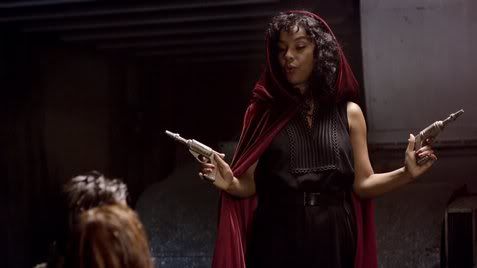
There are so many seemingly random elements knocking up against each other in this episode, that by the time it’s revealed that the ship has no engine because an enormous space whale has been carting it across the stars, I’d all but lost interest in what was going on, despite the fact that I actually sort of like the space whale idea, as well as the bigger, more important idea of a society in denial. But when it was revealed that the whale was doing it for the crying children, I just rolled my eyes. If this were any show other than “Doctor Who,” I never would’ve made it through the entire episode. In the end, Amy saves the day and proves her worth, while the Doctor is left with just a little bit of egg on his face.

What saves the proceedings is Matt Smith. I can’t turn this recap series into a Smith gushfest every week, so it’d be best to keep it short: This guy’s incredible. Even though Amy had a lot more to do in this episode, I’m still not finding her character to be all that. I’m not sure Karen Gillan has found her yet, either. Ultimately this episode didn’t come close to living up to the promise of “The Eleventh Hour.” I hope that Moffat is building up to something big, as was evidenced by the crack from Amy’s wall appearing on the side of the ship as the episode came to a close. We’ve had duff entries in the first act of many a season of new “Who,” so I’m not worried about this stumble, but it’s a shame that such a lackluster offering should be the second of this new era. I guess it goes to prove that even with Steven Moffat there are bound to be missteps, and that not everything is going to work perfectly. In any case, the tag at the end with Winston Churchill and the Dalek was great fun, and hopefully next week will be better.

___________________________________________________
NEXT TIME: It’s back to the Blitz for the TARDIS, when the Doctor and Amy visit Churchill in “Victory of the Daleks.”

Classic “Who” DVD Recommendation of the Week: I can’t be bothered to recommend any classic “Who” this week, so instead I’ll recommend Terry Pratchett’s “Hogfather,” which features an entire world floating on the back of an enormous turtle.

(Thanks as always to Sonic Biro for the screencaps.)
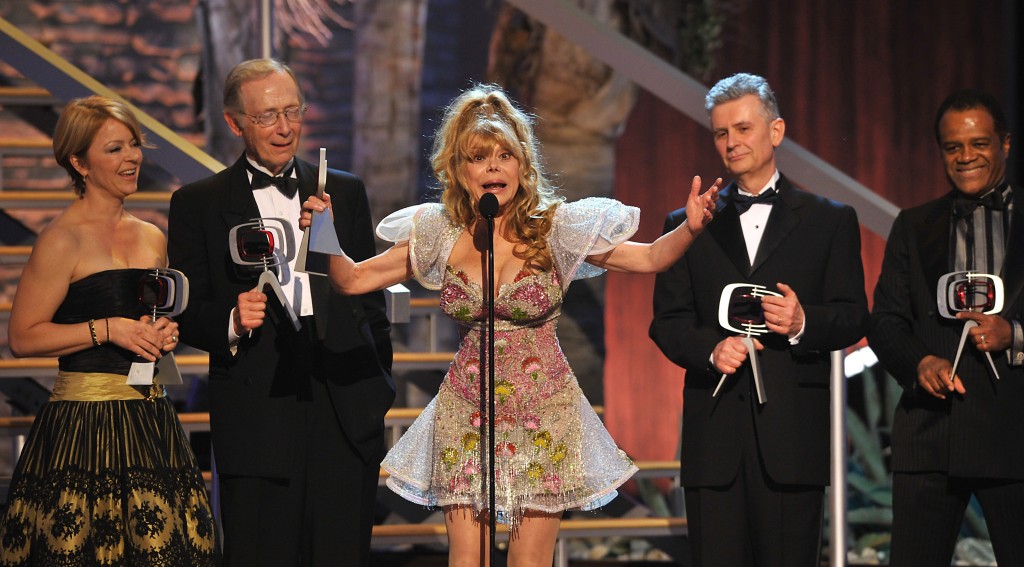
A day at the TV Land Awards

Cast Of The Love Boat

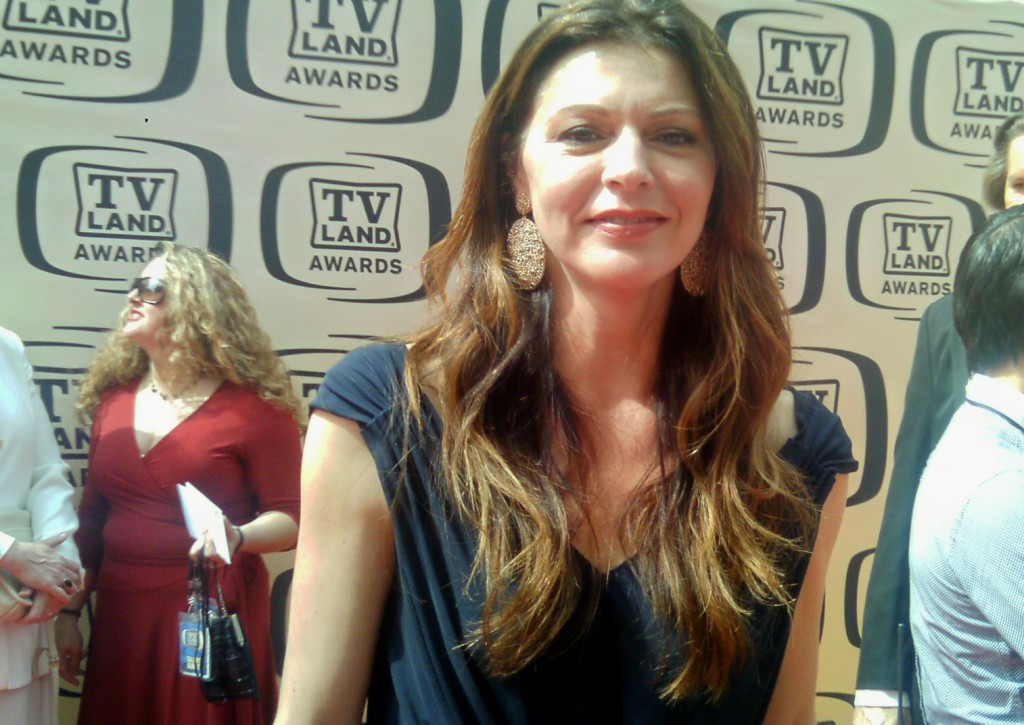
The TV Land Awards are not an “and the winner is…” kind of award show extravaganza. They’re more a series of honorary nods to the very popular shows of television’s illustrious, time-killing past with an emphasis on glitz. And so a bunch of us media types were invited to add to the hub-bub at the Sony Studios back lot on a breezy April, waiting on a red carpet for whichever celebrity was escorted to our assigned spots, with those from famed print and broadcast outlets obviously getting the first dibs. In the case of this lowly pixel stained wretch, I felt honored to chat with a few really terrific performers who, each in their own way, had made quite an impression on me personally.

That most definitely applies to Jane Leeves, the comedically gifted actress best known as Daphne, Niles Crane’s Manchester-born one-true-crush and eventual wife from “Frasier.” After confessing that I’d had a crush of my own on her since before her famed “Seinfeld” turn as “Marla, the Virgin” her response was typically blunt-yet-charming. “I’m not that old!”

“Neither am I!,” I blurted. (I later learned that Ms. Leeves birthday was the following day. My own birthday was two days prior. I guess age was on both of our minds.)

Aside from being no non-TV star herself, Ms. Leeves was there to promote her now show, coincidentally to be aired on TV Land in a rare foray into original programming, “Hot in Cleveland.” The show teams Leeves with Wendy Malick (“Just Shoot Me”) and Valerie Bertinelli (“One Day at a Time”). The three play “very L.A.” career women with show business-related backgrounds of various types. (Leeves plays an “eyebrow plucker to the stars.”) Feeling a bit aged out of the L.A. game, they attempt a trip to Paris, but instead find themselves marooned at the home of the Rock and Roll Hall of Fame. They quickly realize that beautiful, middle-aged women who can refer to celebrities by their first name are actually in fairly short supply in the midwestern metropolis and they decide to stay and be big fish in a smaller glamor pond. Betty White costars as a neighbor, perhaps a wacky one. Cue the glib comparisons calling this a “younger ‘Golden Girls.'”

Nevertheless, fans of Ms. Leeves should rest assured that her character is no retread of Daphne Moon. “She’s focused her whole life on her career and has forgotten to have a life. She’s the sort of smart aleck, wise-ass of the group, so it’s very different.”

janeleeves2

Then, perhaps feeling a bit star-struck, I went with the fallback question I frequently steal from our esteemed Will Harris. What project has she done that she doesn’t feel has gotten enough attention.

“It’s my cooking, quite frankly.”

Continue reading »

Lost 6.13 – The Last Recruit

We’re only three episodes away from the series finale, so why does it feel like tonight’s episode didn’t accomplish as much as it should have? There were no major reveals, and with the exception of the various Earth-2 subplots, no major story development either. There was quite a bit of crossover action on Earth-2, however, with Locke and Sun both arriving at the hospital at the same time. Though neither character was given much attention beyond that opening scene (we later learned that Sun and the baby are just fine, while Locke went under the knife), the most interesting bit about their “meeting” was just how scared Sun looked at the sight of him, horrifically exclaiming “It’s him! It’s him!” I don’t remember Sun ever having flashes of her Earth-1 life, so I don’t understand a) why she’s so scared of Locke all of a sudden, and b) how she even knows who he is.

They weren’t the only two that crossed paths, either. Desmond continued his quest to make the Losties aware of their Bizarro selves by tracking down Claire on her way to the adoption agency. Obviously, he already knew that Jack would be in the same building for an appointment with his lawyer, Ilana, to discuss his father’s will, so all it took was a suggestion from Desmond that Claire should consider seeking council in order to get them in the same room. Neither one had a moment of clairvoyance like Desmond probably believed they would, so it’ll be interesting to see what comes of that in the following weeks. For the time being, Jack has to run off to the hospital for an emergency surgery on a familiar face, and all points lead to him fixing Locke’s back so that he can walk again. Maybe Locke will have a happy ending after all.

lost_6-13

Then again, if Earth-2 is supposed to be about people getting their happy ending, then why are Kate and Sayid both in police custody? Granted, with all the talk about how Kate didn’t actually commit the murder she’s been accused of, I’m sure she’ll manage to get out of her current predictament and even end up with the cop that captured her, but how in the world is Sayid going to get out of this one? Sure, the guys he killed were bad, but no one else knows that – except for Jin, who, as chance would have it, can’t speak English. Something as simple as a language barrier would obviously never get in the way of a police investigation, but it’s enough to cause Sayid to sweat while he waits for someone to come to his rescue.

Continue reading »

“Doctor Who” 5.1 – The Eleventh Hour

It feels like it’s been forever since Steven Moffat was announced as the new showrunner and Matt Smith as the new Doctor. It hasn’t been, of course, but well over a year in both cases is nothing to sneeze at. For some fans, the anticipation has been damn near excruciating. Another very vocal minority had little interest in the continuing adventures of the Time Lord without David Tennant steering the TARDIS. And yet another group – perhaps the most important, due simply to the fact that they comprise a huge segment of the viewing audience – were understandably nervous that a new Doctor alongside a new head honcho might lead to a series that was somehow lesser than what had been seen over the past five years.

I’d like to believe that everybody was as utterly intoxicated by “The Eleventh Hour” as I was, but that’s probably wishing for too much. On the other hand, I can’t really see that it offered up anything that would possibly alienate audiences – not even in the form of the new Doctor, who’s not such a drastic departure from the antics of Tennant so as to drive viewers away. Indeed, the differences between Eccleston and Tennant are far more tangible than the divide between Tennant and Smith. All that said, Smith definitely has something of his own going on, and whatever that “something” is will most certainly grow as the season progresses. Both Eccleston and Tennant each took about a half season to find their Time Lord groove; Smith found it by the end of his first episode. I was wholly won over by him upon his delivery of “I am definitely a mad man with a box,” which was followed by an uneasy cackle that seems to imply this Doctor is not quite as right in the head as his recent predecessors.

But I’ve clearly jumped to the end of the episode far too quickly. The pre-credits sequence with the Doctor hanging onto the TARDIS as it flies over London is utter nonsense – derivative of the worst aspects of the Davies era, and completely different from the tone of the rest of the episode. Maybe that was the point? To reassure viewers right off the bat that they’re still watching the same show? I don’t know, but let’s hope there’s less of that and more of all that follows as the weeks move on.

Of course the sequence is followed by a brand new set of opening titles and a rearrangement of the theme tune. I haven’t done an immense amount of reading reactions to this episode, but even with what little I have read, there appeared to be an immediate backlash to these changes. Every time these basic alterations are made to the series, people complain, which is understandable, because why fix what isn’t broken? But “Doctor Who” thrives on change, and this is just another aspect of it. Eventually they get over it and move on, realizing that it probably isn’t quite the disaster their fanboy gut had told them on first viewing. Having seen the sequence numerous times now, I’m already digging it. Unlike the previous credits, the lightning bolts and cloud tunnel seem to indicate the TARDIS is travelling through some sort of space as opposed to time, and the rearrangement has grown on me with each subsequent viewing.

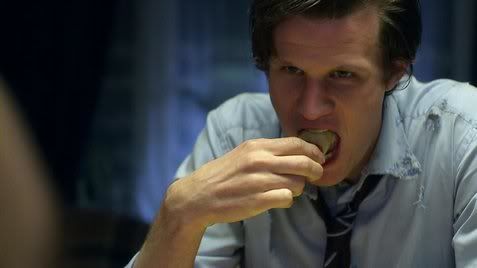
The next 15 minutes, which detail the first meeting of the Eleventh Doctor and the 7-year old Amelia Pond (Caitlin Blackwood) are deliriously charming, and it kicks off with the girl praying to Santa on Easter, and it’s nice to see Moffat’s keeping things on a vaguely secular level. Using children as a big part of the narrative has been a Moffat hallmark (“The Empty Child,” “The Girl in the Fireplace,” “The Silence on the Library”), and here it once again works as a wonderful means to cement the Doctor/companion relationship (although you may not find me as supportive of this gimmick in the coming weeks). No doubt the highpoint of this section is the search for food, which is something that’s never been done before during the post-regenerative state. If every cell in the body of a Time Lord rearranges itself during regeneration, then it’s perfectly reasonable to assume the tastes buds have changed, too. The Doctor thinks he knows what he likes, but it turns out he finds most of it disgusting. In the end, he finds a thoroughly revolting dish – fish fingers and custard – the most tasty and appetizing, which is a gas (or surely will be once it passes through his digestive tract).

Continue reading »

Lost 6.12 – Everybody Loves Hugo

After back-to-back weeks of great episodes, tonight’s Hurley-centric story was a bit dull in comparison, but it did have a few WTF moments that definitely made up for some of the slower sections. I mean, did anyone even see that death coming? It was straight out of a “Final Destination” movie. One minute, Ilana is lecturing Hurley about how she’s been training her whole life to serve as Jacob’s bodyguard (all while Hurley warns her to be careful with the unstable dynamite), and the next minute, kablooey! And with Ilana out of the way, it makes it a lot easier for Hurley to plan his next move: blowing up the Black Rock (and all the dynamite inside it) by order of Michael’s ghost. On a related note, I love how Michael has literally been relegated to a whisper.

Richard didn’t seem all that happy with Hurley’s decision to suddenly take a stand, but after he realizes that there still might be explosives at the Dharma camp, he leaves determined to blow up the plane. Of course, that only begs the question, if there were still other explosives on the island, why the hell did they try using the dynamite with a history of blowing up prematurely? It’s about as nonsensical as Hurley’s decision to meet up with the rest of the Losties so he can have a chat with Smokey. Jack, Sun and Lapidus also tag along, but aren’t they just playing into Smokey’s hands by walking right into his camp? Granted, he can’t harm the three of them since they’re candidates, but I’d hate to see Hurley go through all that trouble only to get Lapidus shot. Then again, they’re going to need someone to operate that plane when they leave the island, so I think it’s safe to say that Lapidus doesn’t have to start looking over his shoulder just yet.

lost_6-12

Plus, Smokey has far more important things to worry about right now, like Desmond. Though he tells the truth for the most part when Smokey interrogates him, I don’t think he was able to completely fool him into thinking he didn’t know why he was there. After all, he even admitted that he was well-informed about his immunity to the electromagnetism coursing through the island, and I don’t think Smokey is willing to take any chances with a wild card like him. His solution? Toss him down a well. Of course, that’s hardly going to stop Desmond, who’s already following through with a plan of his own back on Earth-2.

While most of the Earth-2 story was dedicated to Hurley’s reconnection with Libby, (a sweet subplot that finally saw the two characters going on their big date while also progressing the concept behind the merging realities), it was Desmond’s brief appearance that made it so memorable. After watching their reunion from a distance, I couldn’t help but feel like Desmond was fast becoming the new Jacob of the “Lost” universe. He obviously has a vested interest in getting the Losties to realize the connection they have with one another, and I think he’s using that in order to convince them to make the best of their lives in this reality. In order to do so, however, he might need to hurt a few people in the process – like, say, running over John Locke with his car.

It sucks to think that Locke might not get his happy ending, but considering that he already had to sacrifice himself once, he may need to do it again. I think Desmond understands the connection between the two realities, and in order to prevent Smokey from getting off the island and wreaking havoc on the world, he needs to kill Locke from Earth-2 as well. It’s just a theory, but with only a few more episodes before the series finale, it’s becoming painfully obvious that the two realities have a connection for a reason. Then again, maybe Desmond was just having a case of the Mondays.

« Older posts Newer posts »

© 2026 Premium Hollywood

Theme by Anders NorenUp ↑