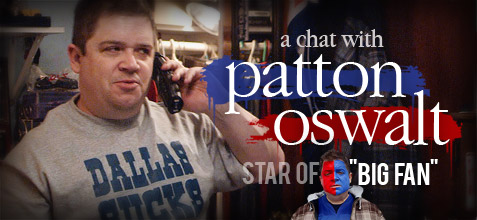
In the past several years Patton Oswalt has plotted an admirable career arc, going from being “that guy on ‘The King of Queens'” to the voice of Remy in “Ratatouille” to a progressively more well-known stand-up comedian. His hot streak continues this month with the theatrical release of the positively reviewed “Big Fan” and his latest comedy CD, My Weakness Is Strong — all of which means now is a pretty great time for Bullz-Eye’s Will Harris to have a chat with Mr. Oswalt.
“Big Fan” was naturally a main point of discussion, and Oswalt opened up about taking on a dramatic role after spending so long building his comedy chops, saying:
A lot of my instincts as an actor, I had to kind of sit on (during ‘Big Fan’). Like, my instinct was, ‘I need to end this scene with a funny look or a button of some sort,’ and I couldn’t do that. So that was certainly odd for me to not have that resource in this role, but…it was kind of cool to be in that situation for once in my career, where I’m just totally outside of my comfort zone. I mean, unbelievably outside of my comfort zone. It was kind of thrilling.
But don’t worry — Oswalt isn’t abandoning his funny side. In fact, as he discusses in the interview, his standup is evolving as he gets older, something illustrated on My Weakness Is Strong:
I think most comedians go through that, where you have to change or evolve. You don’t want to just keep doing variations on the same themes. And, besides, it would look kinda creepy for a guy my age to be doing stuff that, like, a 20-year-old would do. ‘Yeah, this is bullshit!’ It’s, like, ‘Really? You don’t have bigger concerns at this point in your life?’
To read more of the interview — including some of the performances Patton feels never got the attention they deserved, favorite unheralded films, and what it was like to work on Joss Whedon’s “Dollhouse” — click on the image above or follow this link!
“How Bruce Lee Changed the World” originally aired on the History Channel, and it’s a great documentary for Bruce Lee fans. It tracks his short life until his mysterious death at the age of 32, just months before the release of his only U.S. film – “Enter the Dragon.” The documentary features interviews with some of the many people he influenced – from Jackie Chan to John Woo, Brett Ratner, LL Cool J, and Stan Lee. It also features seldom-seen interviews with Bruce Lee as he discusses his craft. Check it out!
Illustration by Brian Smith, Copyright Bullz-Eye.com, LLC
I knew less about “Occupation” than any of the four series that were being spotlighted during the course of BBC America’s time at the TCA tour, but I certainly recognized the actor who was in attendance to promote the show. James Nesbitt’s been working steadily since he turned up at the 2007 TCA tour to sing us a song or two and tell us about “Jekyll,” having played both a tabloid journalist (“Midnight Man”) and Pontius Pilate (“The Passion”), but this time he’s part of the ensemble of “Occupation,” a series which takes a look into the lives of three soldiers who all return to Iraq for the wrong reasons: one for love, one for money, and one for duty.
We do see at least one American within the context of “Occupation,” but for the most part, we’re offered the British perspective of the war in Iraq. It’s a side of the story that we haven’t really gotten to see before, but creator Peter Bowker (“Viva Blackpool”) believes that the themes of his series are fairly universal.
“I think it’s about love, about what it is to be a man, and it’s about doing the right things for the wrong reasons and the wrong things for the right reasons,” said Bowker.
He is not, however, going to hazard a guess as to how Americans will respond to the series. “I think fairly typical things happen in any wars that are engaged in,” he said, “and I think that in this particular war, although it took awhile longer in Basra for the local population to become alienated from the Brits, I think it did happen. I think maybe the surprise will be that it’s not a war drama in that the whole thing isn’t set actually in the war. One of the starting points for this for me was ‘The Deer Hunter’ and noticing in ‘The Deer Hunter’ how little screen time, relatively speaking, is spent in Vietnam. As a writer, ultimately, for me what happens afterward is a far more interesting dramatic field than actually what happens during wartime.”
In order to acclimate himself to the material of “Occupation” as much as possible, Bowker worked with the charity Combat Stress, which counsels traumatized ex-servicemen.
“What the counselors said there was that the mind-set of soldiers who were seeking help was very similar to the mind-set of soldiers coming back from Northern Ireland, in that it didn’t seem entirely clear what the aims of the war were, and going in to ostensibly help a civilian population, which then became hostile…and with good reason, in lots of cases,” said Bowker. “That seemed to be the mind-set. The thing they said that was most significant was the speed with which ex-servicemen were seeking help from the Iraq war. They had never seen that before. They thought of a new intensity, but they said that was partly because young soldiers were no longer seeking solace in alcohol, they were seeking solace in drugs…and we do touch on that in the piece.”
If you’ve never been a situation such as this, then it may strike you as a bit unlikely that a soldier would make a concerted effort to return to the country where he once fought a war. Nesbitt has a theory about that.
“In the arena of war there is, sort of bizarrely, a sense of security for soldiers, because they’re more comfortable in their uniforms, I think, than they are in their civis,” he said. “I think the rhythm that war gives them with the camaraderie, which we discovered, was so important to them – that they can confide in each other, that they are completely together – is in stark contrast to them coming away from that situation losing the uniform, going back into a family life where they feel terribly displaced because of what they’ve seen and what they’ve gone through. They can’t really share that with their partners and their families. I was struck very much by how they’ve lost the rhythm of how to behave physically and emotionally at home. In our piece quite early on, you see when my character comes home he just doesn’t know how to be with his family. They don’t know who turns the kettle on. They don’t know how to react. It was something about the human element of the impact of war that it has on the families that struck me as something that I think is and will hopefully be universal.”
* Some of the best, or at least most interesting, news I’ve heard in a while regarding the film business is the announcement, as reported by Indiewire‘s Eugene Hernandez, of the formation of DF Indie Studios. Presumably named for the project’s two chief executives, Mary Dickinson and Charlene Fisher, the group’s press release says the company plans to release 10-12 “multi-genre” films annually with a budget of $10 million or less. The group’s slogan is “Indie Style – Studio Dependability,” which I think a lot of filmmakers might describe as something like heaven on earth, relatively speaking. Among the big names who’ve become publicly involved with the project are indie mainstay producer Ted Hope, whose associated with most of Ang Lee’s films, among many others, and “Michael Clayton” Oscar winner Tilda Swinton (also “The Chronicles of Narnia,” and numerous indie productions you’ve never heard of).
Personally, I think most mainstream films are way too costly, and I’d like to see a variation of this idea applied to all kinds of films, not just traditional indie subject matter. So, I like the idea that they say they’ll be doing “multi-genre” films that will be, of course, “commercially viable.” (They still need investors.) Personally, I’m hoping that they take a fairly loose approach and include a bit of the old wild and wooly Roger Corman ethos alongside more refined productions. If they’re a success, maybe the big studios might want to copy them. They copy everything successful.
* This simply stinks. Whoever’s responsible for releasing the material (which I haven’t seen and absolutely won’t be linking to) should be ashamed. As for those who’ve raised moral/health objections, I ask: Would we critize straight show business types and call for the sexual responsibility police like this? All around very not cool.
I’m perhaps a little extra mad about this because back in 2003 I interviewed Dustin Lance Black for this way-geeky piece. (It’s got a very long set-up, explaining my personal connection to the very good documentary Dustin had just finished at the time, the actual interviews starts here.) The guy couldn’t have been nicer or more unassuming, we had a great talk, and I’ve been rooting for his success ever since. (He even mentioned to me, post interview that he was starting work on a script about Harvey Milk, to which I said sagely, “good idea.” Now, I ask: Where’s my profit participation?!) He does not deserve this.
On the other hand, when was the last time anyone was interested in a writer’s sex life?
I’m all for off-kilter comedy, but getting through three episodes of IFC’s “Food Party” was damned near painful. The series, which appears as part of the network’s Automat line-up (which is loosely translated as the IFC equivalent of Adult Swim), is the brainchild of one Thu Tran, a Cleveland-based artist.
Here’s how the network describes the show:
“Food Party” is a mind-bending, non-reality cooking show with Thu Tran as your hostess, a cast of unruly puppets as culinary aides, and a cavalcade of fictitious celebrities as surprise dinner guests. Shot on location in a Technicolor cardboard kitchen as well as other foreign and exotic cardboard locations, each episode will or will not instruct you on how to prepare wild gourmet multi-course meals with ingredients you probably have on hand in your kitchen already, such as pretzel rods, eggs, narwhal lungs, bizarre plot twists, secret ingredients, and pizza. After all, you never know who might show up for dinner.
Each episode lasts about 12 minutes, and although I endured all three episodes provided by the network (“Thu Become One,” “Cave Duck,” and “Horrorsode”) in the name of TV criticism, it was such an excruciating experience that I feel obliged to warn off any who might consider watching it for themselves. While there’s certainly something to be said for the “Pee-Wee’s Playhouse”-inspired look of the show, all I kept thinking while I was watching it was, “I don’t know a single person who would be able to sit through this without saying either ‘this isn’t funny’ or ‘this is gross.'” (The latter would almost certainly be uttered during “Horrorsode,” in which we see Thu’s water break, bear witness to all manner of disgusting liquids flowing forth from her nether regions, and eventually give birth to a pie filled with kittens.)
If you’ve ever watched “Tim and Eric’s Awesome Show, Great Job!” and thought, “You know, this would be great if it was just a little bit more out there,” then maybe you’ll enjoy “Food Party.” Personally, I found it ranging from terribly unfunny to legitimately disconcerting, but that’s me.
Feel free to make up your own mind by watching this clip from the show’s first episode: