Category: Movies (Page 349 of 498)

Watch four minutes from “Terminator Salvation”!

The highly anticipated new installment of “The Terminator” film franchise is set in post-apocalyptic 2018. John Connor is the man fated to lead the human resistance against Skynet and its army of Terminators. But the future that Connor was raised to believe in is altered in part by the appearance of Marcus Wright, a stranger whose last memory is of being on death row. Connor must decide whether Marcus has been sent from the future, or rescued from the past. As Skynet prepares its final onslaught, Connor and Marcus both embark on an odyssey that takes them into the heart of Skynet’s operations, where they uncover the terrible secret behind the possible annihilation of mankind.

Watch the new four-minute Web promo below — and follow Bullz-Eye’s coverage of the movie here!


New clip for Jennifer Aniston’s “Management”

“Management” is a romantic comedy that chronicles a chance meeting between Mike Cranshaw (Steve Zahn) and Sue Claussen (Jennifer Aniston). When Sue checks into the roadside motel owned by Mike’s parents in Arizona, what starts with a bottle of wine “compliments of management” soon evolves into a multi-layered, cross-country journey of two people looking for a sense of purpose. Mike, an aimless dreamer, bets it all on a trip to Sue’s workplace in Maryland – only to find that she has no place for him in her carefully ordered life. Buttoned down and obsessed with making a difference in the world, Sue goes back to her yogurt mogul ex-boyfriend Jango (Woody Harrelson), who promises her a chance to head his charity operations. But having found something worth fighting for, Mike pits his hopes against Sue’s practicality, and the two embark on a twisted, bumpy, freeing journey to discover that their place in the world just might be together. Watch a new clip from the film below!


Star Trek: The Motion Pictures – The Cinematic Voyages of the Starship Enterprise

The new “Star Trek” movie is almost here, my friends, and the excitement is palpable. What has J.J. Abrams done to Kirk and company, and will his efforts live up to the high expectations of the notoriously-picky “Trek” fans? We’ll all know the answer on May 8th, but in the meantime, the anticipation has led many to take a step back and revisit the previous films in the franchise…which, as it happens, is exactly what yours truly has done. In addition to the motion pictures, your trusty Bullz-Eye contributor has also gone back and re-read the novelizations for each film, and you might be surprised to find just how much good stuff never actually made it past the printed page…even if it probably should have.

Check out the piece by clicking right here…or, of course, you could click on the big ol’ graphic directly below.
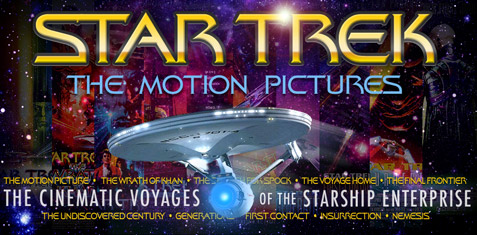
Just in case you’re still on the fence about clicking over, here’s an excerpt from the feature to give you an idea what to expect…

Star Trek: The Motion Picture (1979)
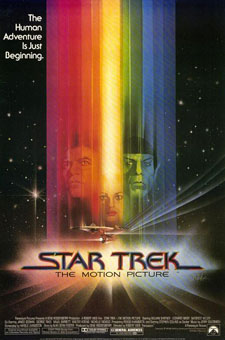
Storyline: When an alien force of inconceivable power sets its sights on Earth, Admiral James T. Kirk emerges from retirement, swipes the refurbished U.S.S. Enterprise from its new commander, Willard Decker, and sets off to save the planet. Spock, who had left Starfleet in favor of purging his emotions on his home planet of Vulcan, decides that the answers to his spiritual quest may be found with this alien and rejoins his former crewmates. Oh, and there’s also this bald chick…
Villain: V’ger. That’s short for Voyager 6, a space probe launched from Earth way back yonder in the 20th century. The probe was found by an alien race of living machines that interpreted its programming as instructions to learn all that can be learned, and return that information to its creator. Unfortunately, it can’t imagine that its creator can possibly be a “carbon unit,” a skepticism which proves highly problematic for the human race.
What’s good: At the time of its release, the best part was simply seeing the cast together again for the first time since the series’ cancellation, and having a noticeably bigger budget to work with. Nowadays, however, the film is driven by the interaction between the eternal trifecta of Kirk, Spock, and McCoy, whether it’s Spock’s pure logic battling against McCoy’s emotions or Kirk’s inability to accept that Decker might actually know something that he doesn’t.
What’s bad: ven Robert Wise’s Director’s Cut of the film still contains some seriously interminable shots, most notably as Admiral Kirk sees the refurbished Enterprise for the first time. There’s a reason my friend Donnie found it more interesting to count the tiles on the movie theater ceiling than watch the film…but, then, he always was more of a “Star Wars” guy. “Trek” fans, meanwhile, have long groused – and rightfully so – that the first big-screen adventure for Kirk and company was, at its heart, little more than an expanded version of an original episode, “The Changeling.”
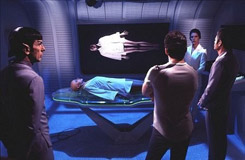
Most surprising cast member: Stephen Collins as Commander Willard Decker. Collins went on to starring roles in “Tales of the Gold Monkey” and “Tattinger’s,” then followed it up with a recurring role on “Sisters,” but his most memorable role is almost certainly that of Rev. Eric Camden, the patriarch on “7th Heaven.”
“Yeah, but the book was better.” – The novelization of “Star Trek: The Motion Picture” was actually written by “Trek” creator Gene Roddenberry, and it provides several details which, though they aren’t actually in the movie itself, have nonetheless become accepted as fact throughout the “Trek” universe. Most notable is that the character of Willard Decker is actually the son of the late Captain Matt Decker, from “The Doomsday Machine,” an episode of the original series. One that hasn’t taken off, however, is the suggestion that Kirk had a significant romantic relationship with a woman named Lori Ciani during the so-called “lost years” between the series and the movie. Oh, and you really need to read the book’s footnotes. Roddenberry treats the novel like it’s a historical record, and when Spock refers to Kirk as his “t’hy’la,” a Vulcan word which apparently can mean either “brother” or “lover,” it results in a response from Kirk that has spawned one hell of a website.

Now are you tempted? C’mon, just click right here. Go on, you know you want to…

What Doesn’t Kill You

Some people may wonder why “What Doesn’t Kill You” didn’t receive a proper theatrical release, and to be completely honest, it all comes down to luck. Over the last few years, there have been a number of gritty crime dramas released in the same vein as Brian Goodman’s directorial debut, and though a majority of them weren’t any better or worse, they had the good fortune of being made first. That’s really the only thing standing in the way of the film, a based-on-a-true-story tale about two lifelong friends (Mark Ruffalo and Ethan Hawke) making a living as soldiers for the local crime boss in Boston. When a job gone wrong lands the pair in prison, however, one struggles to make the most of his second chance under the haze of drugs and money.

If there’s one thing going for “What Doesn’t Kill You” that some of the other likeminded films didn’t have, it’s a strong performance from its lead actor. Mark Ruffalo has been on the brink of breaking out for what seems like a decade now, and yet he continues to hammer away with quality roles where he really gets to flex his dramatic muscle. Ethan Hawke isn’t quite as memorable in what could easily be viewed as a copycat of his character in 2007’s “Before the Devil Knows You’re Dead,” but he still does his best work in films destined for the festival circuit. Unfortunately, though “What Doesn’t Kill You” may claim to be based on a true story, it’s simply too far-fetched to be believed. Goodman should have had the good sense to ignore that aspect of the tale and just focus on crafting a movie that we haven’t already seen countless times before. Maybe then it would have never gotten lost in the shuffle.

Click to buy “What Doesn’t Kill You”

How TiVo revolutionized the way we watch TV

The idea was pure genius. Provide customers with a set-top box that could record analog video from any source onto a hard drive for easy access and instant viewing. Prior to DVRs, the main way to record television was a little thing called the Video Cassette Recorder (VCR) which used VHS tapes. (I’m mentioning this for any of the tweens out there who may not know life without TiVo.) Recording to tape was nice in the mid-80’s, but once huge hard drives came down in price, it became feasible to turn a computer into a recording device. No more hunting around for that certain show, no more (usually, anyway) missing episodes when the network changes the schedule, and no more fast-forwarding through the commercials and being faced with the decision of whether or not to rewind back to the end of the commercial break so as not to miss first 30 seconds or a minute of the show.

I bought my first TiVo sometime in 2000 or 2001, but the company had been in existence since 1998. My first box worked with my cable box. It wasn’t the most elegant option, but it got the job done. Changing channels was a bitch, but I never did much channel surfing anyway. I would miss the occasional episode because my TiVo’s infrared commander didn’t properly change the channel on the cable box, but with TiVo’s “season pass” feature, I caught a lot of episodes that I might have otherwise missed. I loved it so much, I even bought a second TiVo so that I could record two things at once.

With the advent of HD, TiVo ran into something of a roadblock. Once I went HD, I pretty much had to go with the cable company’s version of the DVR, nicknamed the “MOXI.” The TiVo HD was just too pricey at the time. The MOXI had an okay setup, but I loathed cable company’s advertisements that made it seemed like they invented the DVR. (Give me a break.) Anyway, with the MOXI, I could record two HD shows at once, but I still kept a TiVo so that I could record a third show at the same time if need be.

Once the TiVo HD became affordable — again, we’re talking about huge capacity hard drives falling in price — I got rid of Time Warner’s DVR (no longer the MOXI, I was forced to switch), which had a ridiculously poor interface. I had a couple of cable cards installed by Time Warner, and bang — I had a box that could record two HD programs at once.

As time continues to wear on, TiVo has added more and more features to its software. I can now use my TiVo to listen to the music library on my computer (granted, not in a very elegant way), watch video that I downloaded from the internet, stream (older or indie) movies from my Netflix queue and rent new release movies (in HD!) from Amazon Video.

By zipping through the commercials and being able to easily and instantly queue up the show I want to watch, I’m able to watch more television in less time. And, ultimately, that’s what TiVo is all about.

« Older posts Newer posts »

© 2026 Premium Hollywood

Theme by Anders NorenUp ↑