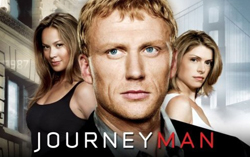
If the only names that catch your eye during a television show’s opening credits are those of the actors, you probably aren’t aware that Kevin Falls is the creator and an executive producer (not to mention show runner) of NBC’s “Journeyman.” And if that’s the case, then you almost certainly wouldn’t have been aware that he’s also had a hand in “Sports Night,” “Arli$$,” “The West Wing,” “The Lyon’s Den,” “North Shore,” and “Shark” over the years as well. Given recent rumblings that Falls’ current gig isn’t nearly as secure as “Journeyman” fans would prefer, I jumped into action to give the show as much publicity as possible, starting with an attempt to secure an interview with the man who created the series. Things fell into place quickly, but after the established time of our conversation came and went, I got a little antsy. I needn’t have worried: Falls readily set up a new time for us to chat, and within moments of getting on the line, he had launched into an apology for the delay.

Bullz-Eye: Hello?
Kevin Falls: (Laughs) Hey, Will!
BE: Hey!
KF: I’m all yours! I’m so sorry about yesterday; there was a communication breakdown, and it was my fault. I just totally dropped the ball, so I apologize. But how are you?
BE: I’m doing good. How are you?
KF: Good!
BE: I think we met for about two seconds back in July, at the TCA Press Tour.
KF: Oh, right! I met a lot of people, but I think I do vaguely remember you. But it’s been a wild couple of months!
BE: I’m sure! Well, I’ll start off with some specific questions about the show before I move into the inevitable writer’s strike questions.
KF: Sure! And, hey, I checked out your site today, and it’s really cool! It’s kind of like a “Maxim”-styled website!
BE: Yeah, that’s usually the point of reference we give people, to kind of sum it up in a nutshell.
KF: Hey, man, that’s where I wanna live!
BE: Yeah, the bikini girls pay the bills, but they give us the opportunity to do whatever pop culture stuff we want to tackle on the site.
KF: That’s great! Well, I was flattered that you guys put us in your TV Power Rankings. That was a shot in the arm, and we really appreciated it.
BE: Absolutely. We love the show. Ross (Ruediger) is our resident blogger for the show, but there are several fans among the writing staff, including myself.
KF: Great. Well, that’s nice. Thanks!

BE: Well, when I was at the panel for “Journeyman” back in July, one of the big points of discussion was the comparison to “The Time Traveler’s Wife,” which led you to pointedly declare for the record that you’d absolutely never read the book… (Laughs) …but did those comparisons finally start to die down once critics actually had a chance to watch the show beyond the pilot?
KF: Yeah, I think once they started watching it…you know, certainly, early on, actually, when the issue was more of the domestic problem of time traveling and its impact on the marriage, I think we kind started there ‘cause we wanted it to start with how it would feel to a family, and then get into more of the mythology of it. But once we got deeper into it, all that stuff fell away. And the “Quantum Leap” (comparison) hung around for awhile, and then that fell away, and it seemed like everybody kind of realized it was its own show.
BE: So were you indeed influenced by any specific shows, or just kind of the concept of time travel in general?
KF: No, the whole genesis of the idea came from my agent. Every spring, I would meet with my agent, and he would ask, “What are you going to do for pilot season?” And I said, “I don’t know. I’m just out of ideas.” (Laughs) I didn’t want to a law show or a cop show, and I just didn’t know what to do. And he said, “How about trying something different and breaking into a new genre?” And that’s how we got into time travel. I’ve seen movies I’ve liked, like Malcolm McDowell in…what was that movie called?
BE: “Time After Time”!
KF: Yeah, “Time After Time,” which I thought was really good. And some other shows. And my brothers were the sci-fi geeks in my house, and I was always impressed but never converted. It was, like, my brothers were always smarter than me, so I felt like, “Okay, these guys get it, but I’m not worthy,” y’know? But I’ve always been someone who likes to do things over, whether it’s a bad date or a job or a rewrite. Whatever. But I’m definitely one of those guys who likes to look in the rear view mirror a lot.
BE: Okay, I should probably warn you that some of these questions might come off as a little disjointed, since they’re coming from a couple of different writers.
KF: No problem. I’m in a car on the L.A. freeway.
BE: So you’ve got all the time in the world, then.
KF: Yeah. And I don’t have a job at the moment. So it’s perfect.
BE: Well, there you go. Okay, so what challenges does the time travel part of the show present as far as story and continuity, and how do you go about tackling them?
 EB: I thought it was a lukewarm reaction, honestly. But I’m not really the guy who, you know, we just had a little clip reel, I’ve never done a horror film or sci-fi, so, I don’t know how many “[Brothers] McMullen” fans were in the audience. They really weren’t giving it up for the Irish guys from Queens.
 Zack Snyder: (continuing his conversation from the previous roundtable) One of the things that I think is important about “Watchmen” is that it have resonances of cinematic pop culture, as well as superhero culture, because I believe there’s a relationship between Rorschach and Travis Bickle in “”Taxi Driver.” I believe that there’s a relationship between the war room in “Doctor Strangelove” and NORAD. There are cinematic relationships in the graphic novel, and I really think that the movie, this movie, “Watchmen,” is able to comment on both things in a way that other movies can’t, because it really does observe pop culture all the time while it’s telling the story. And I think that part of the influence on the characters themselves is the culture that they’re in. And for that part it’s something hugely fun to explore and, just from a visual standpoint, is hugely fun to say ‘Well, what does that mean?.’ Like, when you’re in the war room, how do you make it “Doctor Strangelove,” without making it “Doctor Strangelove”?
