Category: Documentaries (Page 29 of 43)

Michael Jackson movie deal finalized

I’m sure I’ll be seeing the film, but something about this makes me feel unclean, and I’m not even sure exactly why. I’m sure it’ll be a hell of a show.

I certainly can’t disagree with Nikki Finke’s characterization below:

Randy Phillips, president and CEO of AEG Live, ghoulishly boasted to The Associated Press he had “more than 100 hours of footage that could be turned into live albums, a movie and a pay-per-view special. He was our partner in life and now he’s our partner in death.”

Some of the footage will be in 3-D. According to Variety, like the unpresented Jackson show, the film will be directed by Kenny Ortega (“High School Musical,” “Newsies.”)

For All Mankind

Reissued by Criterion to coincide with the 40th anniversary of the Apollo 11 moon landing, this documentary from journalist-turned-filmmaker Al Reinert is comprised of truly remarkable, extremely high-quality footage from NASA’s own vaults. Featuring all 24 of the Apollo program astronauts who went to the moon, the film impressionistically leaps back and forth in time, covering both the mundane day to day preparations for the various trips by both astronauts and mission control personnel and moving forward to the ecstatic reveries brought on by traveling through space and ultimately reaching the moon. Since the only narration is provided by comments from the astronauts themselves and much of the footage has a fly-on-the-wall feeling to it, “For All Mankind” feels very much like a vérité documentary. The effect can be prettymind-blowing at times, as we realize that we are watching science fiction become living history, and with a visual clarity that the millions who watched the original Apollo landings on their television sets never imagined was even possible.

Still, for an 80-minute documentary, “For All Mankind” plays a bit long. First-time director Reinert does a solid job here of assembling the footage, but the film’s impressionistic structure makes it feel a bit more arty and, yes, spacey than it really needs to be. Also, with all due respect to the great musical innovator, musician/composer/producer Brian Eno, his atmospheric score, while often beautiful, at times lends an air of unwelcome pretension to certain scenes. Still, no space enthusiast is going to want to go through life without perpetual access to this remarkable film and some reliably awesome DVD extras from the folks at Criterion.

Click to buy “For All Mankind.”

Remembering McNamara and “The Fog of War”

I ordinarily wouldn’t be writing here about the death of a highly controversial former Secretary of Defense, no matter how crucial his role in history. However, the death of Robert S. McNamara is very much worth a brief post even in a mostly lighthearted entertainment blog because of his involvement in one of Errol Morris’s best documentarys, 2004’s “The Fog of War.” Here’s a clip that might be a bit of a bummer for a Monday after a holiday weekend, but it raises more important questions in four minutes than I could write in a month of really serious posts.

.

In a really creepy bit of timing, The House Next Door has just posted a lengthy (I’ve only read about half, so far) but I’d say very worthwhile consideration of documentarian Morris’s entire film career by Jason Bellamy and Ed Howard, including an appropriately skeptical consideration of McNamara’s attempts at self-rehabilitation in this film. You can also see if I was one of those critics Ed and Jason mention who took him at face value in my review from late 2003.

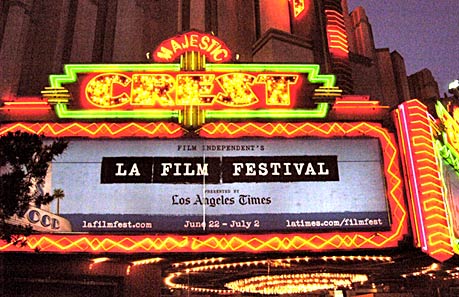
Wrapping LAFF

The Los Angeles Film Festival ended Sunday and I’m not sure what I want to say about it. I saw several films and wanted to see more, but circumstances, and trying to blog about most of what I did see, kept me to a one or two movie per day average on the days I attended. Most of the films were as good as their buzz at least, but most of them had already screened at Sundance.

For me, the highlights were “Black Dynamite” — which was by far the most fun screening all around despite happening within hours of Michael Jackson’s death (which happened to be a less than a mile from where I was working on my posts) — and “We Live in Public” which was simply the most interesting film with the most interesting post-screening discussion. “Branson” was a highlight of another sort for the electrifying performer/one-man-drama, Jackson Cash. The film geek/native West Angeleno in me went moderately wild for a film I haven’t written about here, Curtis Harrington’s melange of romance and dark fantasy “Night Tide,” which was shot in late fifties Santa Monica and Venice.

Los Angeles is, of course, an extremely large city with strong neighborhoods but no true urban core (which is not to say that we aren’t trying to grow one) and a place where all kinds of movies screen all the time, if you know where to find them. It’s also, of course, the place on earth with the largest concentration of people involved with actually making movies or doing things related to making them. Getting them to spend a lot of time actually watching new films probably requires enticing them to go elsewhere and break their usual, already way too busy, routine.

Continue reading »

They’re “wild” alright, but are they “wonderful”?

Confession time: Being a bit sleep deprived and apparently under-caffeinated, I nodded off for probably 10-20 minutes of MTV/Dickhouse’s “The Wild and Wonderful Whites of West Virginia.” Therefore, I have to be a bit careful about making any sweeping statements about this documentary from filmmaker Julien Nitzberg, a sort of follow-up to Jacob Young’s 1991 short, “The Dancing Outlaw,” which became a viral cult hit. It’s safe to say that judging from what I heard from the crowd — many of whom were fans of the earlier documentary and/or the “Jackass” TV series (which has some fans in the cinegeek world, though I’ve never been moved to watch it) — I might have been the only person in the theater who didn’t have a great time with the film.

The earlier film deal with Jesco White, a gas-huffing Elvis Presley fan whose brain-damaged schizoid psychology and criminal tendencies tend to overshadow his talent as a “mountain dancer,” a sort of bluegrass forerunner to tapdancing. Executive produced by Johnny Knoxville, “The Wild and Wonderful Whites” deals with the ongoing struggles of Jesco’s extended family, led by super-tough, extremely shrewd, ultra-raspy voiced occasional singer Mamie White and on into the more violent third generation members of the clan. There are some captivating moments, in particular Jesco dancing to music provided live by punk country’s own Hank Williams III and the sugary soda-fueled gyrations of one of the youngest Whites, who just might be a dancing chip off the old Jesco White block.

However, apparently somewhat like Slant’s Nick Shager, I was largely left cold by the portion of the film I managed to stay awake through. I’m not sure I’d be as critical of its moral stance, or lack thereof, on the Whites, but I found myself wondering just what the vignettes about the various family members — who are perhaps too numerous for clarity — and their purportedly fun-loving dysfunction add up to. I’m not sure how I feel about the way director Nitzberg flirts with celebrating a clan whose members abuse themselves and each other to this degree. It’s still possible I might find something more there in a less tired state and, if this sounds in any way interesting, you’d be well advised to check out the not so safe for work trailer.

I should also add that, in terms of a crowd vibe, the mood at the Los Angeles Film Festival screening could not have been a happier or more upbeat one. I spoke to some really nice people there who really seemed to enjoy it and “get” the film a lot more than I — and the post-screening dancing by Jesco White, backed up by a terrific bluegrass trio, was something else.

« Older posts Newer posts »

© 2026 Premium Hollywood

Theme by Anders NorenUp ↑