Category: Actresses (Page 121 of 258)

Box office preview: The comedy calm before the “Transformers” storm?

Awaiting the coming midweek arrival of the next big fanboy franchise entry, “Transformers: Revenge of the Carniverous Unicorns” or whatever it’s called, a couple of high concept comedies with theoretically strong potential sail into the nation’s multiplexes this weekend. While both should do okay business, the “meh” to “Cathy”-style “ack!” reactions from critics (I know we don’t really count but, hey, if you tickle us, do we not chuckle?) might indicate somewhat limited potential against the ongoing one-two punch of “The Hangover” and “Up.” I expect a close one. But then, I’m always wrong.

Of the two new comedies, “The Proposal,” starring Ryan Reynolds as a put-upon assistant cajoled into a sham marriage with his you-know-what-on-wheels boss played by Sandra Bullock, appears to be the somewhat stronger contender. This initially struck me as something of a gender-reversed redo of Mike Nichols’ similarly high-concept 1988 Melanie Griffith vehicle, “Working Girl,” with the executives originally played by Harrison Ford and Sigourney Weaver mushed into Bullock’s publishing bigwig. However, the reviews indicate something darker at times, but probably less entertaining for a mass audience. With a 44% “fresh” at Rotten Tomatoes, mirrored by our own David Medsker’s split critical decision, critics are turning no cartwheels. The Hollywood Reporter however suggests that the film has some pretty serious date-movie appeal and that might be enough for $20 million or so, which might be enough to hit the #1 spot. Certainly many women may feel that, to paraphrase Griffith 21 years back, Reynolds has a mind for comedy and a body for sin. It’s therefore a good bet they subtly encourage their significant others to attend with them, who themselves might not mind looking at the adorable, if now fully adult, Ms. Bullock for a couple of hours themselves. We shall see.

Jack Black and Michael Cera react to  reviews of If critics were unconvinced by “The Proposal,” they were hurling ancient curses at what sure seemed to me like a promising comedy concept but, then, there’s the me-always-being-wrong thing. I speaketh of the hunter-gatherers-go-biblical “Year One,” directed by comedy veteran multi-hyphenate Harold “Egon Spengler” Ramis. The critics seem to agree that this vehicle for two of the best known names in youth-targeted comedy, Jack Black and the gifted savior of dry humor among the young, Michael Cera, is a million miles away from being Ramis’s best work. (That would include probably one of the beloved films of the last twenty years, “Groundhog Day” as well as the frat-boy touchstone, “Caddyshack.”) On the other hand, Variety offers the thought that it’s “tracking” is improving. I’m still trying to figure out what “tracking” actually means, but I guess that’s supposed to be a good thing.

Nevertheless, our own Jason Zingale heaps some pretty serious 1.5 star scorn on a film which mixes some fairly extreme-sounding scatological humor with some pretty big comic prey in taking on some of the best known characters from the ever-popular first half of Jehovah’s bestselling two-part epic. He’s hardly alone, as only 19% of the RT gang saw much of worth in it and some saw the opportunity to hurl a few would-be comic zingers of their own. CHUD’s Devin Faraci commenteth:

Year One is so dedicated to being historically accurate that it only uses jokes that are at least two thousand years old.

Entertainment Weekly‘s Owen Glieberman went the contrarian root and actually awarded the film a relative rave with a B- rating, and appears to be one of the few (only?) critics to heap praise on Jack Black’s performance while attacking the dryness of Cera. He also offers what the film’s many detractors will take as a terrifying thought:

Every era gets the prehistoric comedy it deserves.

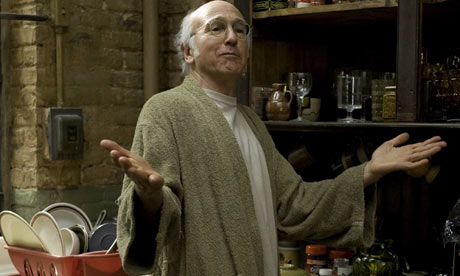
Meanwhile in arthouse land: The would-be prestige comedy “Away We Go” widens to 132 screens this weekend. Also, the week’s new limited release is yet another promising sounding attempt at America’s funnybone, the latest from Woody Allen (though apparently the original script dates back to the seventies), “Whatever Works” starring HBO’s own Larry David. Allen’s films are almost the definition of review-driven hits-or-misses and this one has engendered what is at best a split decision with 53% (only 9% among “top critics”!) at RT. That’s low enough to (forgive me, Lord, for what I’m about to say) curb filmgoer enthusiasm.
Musical redemption or Escape from 1978

Albert Walker over at Den of Geek has a fun article of “Top 10 worst musical moments.” I can’t argue with the abject metaphysical badness of any of Mr. Walker’s choices, but I’m a guy who prefers to emphasize the positive. Below are a couple of great performers who essentially disgraced themselves in Walker’s selections, redeeming themselves musically on film.

****

First, though decades later I’m still healing from the scars inflicted by the legendarily god-awful 1978 juke-box film musical, “Sergeant Pepper’s Lonely Heart Club Band,” I had forgotten how bad Steve Martin’s performance of Paul McCartney’s black-humored romp, “Maxwell’s Silver Hammer” really was. On his only musical, director Michael Schultz clearly had not clue what do do with Martin. His performance is painful to watch and entirely unfunny.

Now contrast this with Martin’s performance in 1986’s “Little Shop of Horrors,” which Albert Walker and I agree is about a million times better. Director Frank Oz also only made one musical, but it wasn’t a problem. I’m sure Martin was probably eager to redeem himself after the atrocity eight years prior, and Oz matched his spot-on interpretation of the song with a pretty huge degree of wit and imagination. I speak, of course, of the “Dentist” song.

Also, there’s no getting over the embarrassment of future James Bond Timothy Dalton crooning the Captain & Tenille to early screen comedy superstar Mae West from another film from 1978, “Sextette.” A definite contender for most brazenly ill-advised movie of all time, the musical comedy featured an 80-somethng West playing sexpot one last time to costars like Dalton, Dom DeLuise, and Ringo Starr.

Now, even at the height of her fame 35 years previously, by today’s standards the generously proportioned Mae West might strike most people as an odd choice for a sexpot, and many of her jokes have become cliches over the decade. (“Is that a gun in your pocket or are you just happy to see me?”, etc.) Even at the time, I’m sure male filmgoers would lean pretty strongly towards such thirties sirens as Jean Harlow, Joan Crawford, or Bette Davis whose sexiness seems more usual to us today. Mae West, however, was unique in that she played a woman aggressively and openly obsessed with sex at a time when only males were allowed that role, and people were barely allowed to even allude to it in public. It seems clear that men found the idea intriguing and West also was blessed with a great deal of wit and confidence and…something.

Just watch her sing “I Wonder Where My Easy Rider’s Gone” in 1933, and know that she’s not really singing about horse racing. And, yes, that really is a young Cary Grant romancing her.

Good News, Bad News

* Some of the best, or at least most interesting, news I’ve heard in a while regarding the film business is the announcement, as reported by Indiewire‘s Eugene Hernandez, of the formation of DF Indie Studios. Presumably named for the project’s two chief executives, Mary Dickinson and Charlene Fisher, the group’s press release says the company plans to release 10-12 “multi-genre” films annually with a budget of $10 million or less. The group’s slogan is “Indie Style – Studio Dependability,” which I think a lot of filmmakers might describe as something like heaven on earth, relatively speaking. Among the big names who’ve become publicly involved with the project are indie mainstay producer Ted Hope, whose associated with most of Ang Lee’s films, among many others, and “Michael Clayton” Oscar winner Tilda Swinton (also “The Chronicles of Narnia,” and numerous indie productions you’ve never heard of).

Personally, I think most mainstream films are way too costly, and I’d like to see a variation of this idea applied to all kinds of films, not just traditional indie subject matter. So, I like the idea that they say they’ll be doing “multi-genre” films that will be, of course, “commercially viable.” (They still need investors.) Personally, I’m hoping that they take a fairly loose approach and include a bit of the old wild and wooly Roger Corman ethos alongside more refined productions. If they’re a success, maybe the big studios might want to copy them. They copy everything successful.

* This simply stinks.  Whoever’s responsible for releasing the material (which I haven’t seen and absolutely won’t be linking to) should be ashamed. As for those who’ve raised moral/health objections, I ask: Would we critize straight show business types and call for the sexual responsibility police like this? All around very not cool.

I’m perhaps a little extra mad about this because back in 2003 I interviewed Dustin Lance Black for this way-geeky piece. (It’s got a very long set-up, explaining my personal connection to the very good documentary Dustin had just finished at the time, the actual interviews starts here.) The guy couldn’t have been nicer or more unassuming, we had a great talk, and I’ve been rooting for his success ever since. (He even mentioned to me, post interview that he was starting work on a script about Harvey Milk, to which I said sagely, “good idea.” Now, I ask: Where’s my profit participation?!) He does not deserve this.

On the other hand, when was the last time anyone was interested in a writer’s sex life?

Break out the Bloody Marys, “The Hangover” Lingers at #1

As I was too chicken to more than implicitly predict last time, “The Hangover” held on to its #1 spot with a cool $33.4 million. Variety reminds us that this is only a 26% drop, very rare in today’s opening-weekend-centric turn-’em-and-burn-’em movie world. The star-free ensemble farce is clearly benefiting from excellent word of mouth so that folks who might ordinarily avoid an R-rated comedy about a Vegas bachelor party gone off the rails are being attracted. Good work.

Also Pixar/Disney did fabulously with its unbeatable, yet rare, principle that if you work really hard and imaginatively to provide quality family entertainment with a heart and soul as well as a bit of show-biz razzle-dazzle, people will actually show — you should pardon the express — “Up.” The CGI 3-D animation-fest with a cranky elderly protagonist that no sane executive would ever have greenlit were it not for Pixar’s unprecedented track record, earned $30.5 million and dropped a low 31%.

Denzel Washington, Meanwhile, in star-driven product land, “The Taking of Pelham 123” met the rather modest expectations for a lavish, all-star, action-remake and hit $25 million, while the Eddie Murphy family flick, “Imagine That,” netted a sad $5.7 million for the #6 spot on its opening weekend at over 3000 screens.

Now, I want to add that, while trashing movies I haven’t personally seen is against my religion (for all I know, I’ll end up sorta liking Tony Scott’s “Pelham” — stranger things have happened, I’m the guy who liked “Domino”), even more against my religion is trashing the concept of remakes, though on the whole they tend to be less good than earlier successful versions.  True, it doesn’t exactly scream “originality” to take on a property that’s been previously successful, but no one says, “Oh God, not another remake of ‘Romeo and Juliet.'” There is absolutely nothing wrong with restaging an old concept, as long as you have something of your own to say with that property and are not simply going with something that looks likes a safe bet in a business where safe bets don’t exist. Lack of “originality” is not the problem; abject creative cowardice is.

Movie remakes go back to Hollywood’s youth. Probably my single favorite little-known Hollywood factoid is that the 1941 “The Maltese Falcon” starring Humphrey Bogart and directed by John Huston was actually the third adaptation of Dashiell Hammett’s great detective novel made over a period of about ten years. I also happen to think that Philip Kaufman’s 1978 version of “Invasion of the Body Snatchers” is arguably even better than the rather great original version directed by Don Siegel in 1956. And, moving to TV land for just a second, is there any human being on the planet who thinks the recently concluded “Battlestar Gallactica” (don’t tell me how it ends!) isn’t a million times better than the unbelievably awful original? As Roger Ebert likes to say, movies are not what they are about but how they are about it. If you have something fresh to say by revisiting an old story, by all means say it, just make sure you’re not kidding yourself.

Anyhow, returning to this weekend’s b.o., what I think harmed both “Pelham” and “Imagine That” was that, as far as was visible from either the marketing or the response to it, these were movies that offered not one thing fresh or exciting or in any way of a great deal of interest other than the services of its stars. That’s good for something — big stars are the closest thing on the planet to a certain level of guarantee of public interest and sometimes that’s all you really need. But if you really want to hit it big, you’ve got to gamble a little bit that the audience is more interested in being genuinely entertained than lulled by the presence of name entertainment brands.

On the other hand, “Terminator Salvation,” which nobody seems to like too much, is actually doing very well abroad and the very honestly entertaining “Drag Me to Hell” isn’t exactly burning up the U.S. box office. So, who knows?

Drum Boogie

Continuing our A Blog Supreme-inspired series of great jazz-on-film moments, here’s a sequence featuring Barbara Stanwyck and legendary jazz/swing drummer Gene Krupa — pretty much the Keith Moon of his day — from one of my personal favorite classic-era comedies, Howard Hawks’ 1941 “Ball of Fire.” You’ll also notice Gary Cooper in there, playing an extremely sheltered professor researching the urban slang of the time.

One hallmark of classic era films is that you can be watching a noir mystery, a western, or a non-musical screwball comedy, and sometimes things will just stop for a song.  As you’ll see here, that wasn’t a bad thing if the right talent was available. And, whatever you do, don’t stop watching before seeing what Krup could do with a matchbook cover, starting at about 4:17 or so.

In case anyone’s wondering, no, that’s not Ms. Stanwyck singing. The terrific vocals are by Martha Tilton.

And here’s a bonus — Krupa with the Benny Goodman band in an amazing performance of their signature tune, Louis Prima’s “Sing, Sing, Sing.”

« Older posts Newer posts »

© 2026 Premium Hollywood

Theme by Anders NorenUp ↑