Author: Bob Westal (Page 241 of 265)

Writer guy Bob Westal was literally born in Hollywood and has commented on the worlds of movies, popular culture, politics, and food ever since. His interest in cocktails is more recent, but he made up for lost time with hundreds of “Drink of the Week” blog posts for Bullz-Eye. In addition to writing and editing, Bob also talks a lot.

La Finke’s Deadline Hollywood Acquired

I’m on the second day of my L.A. Film Festival break (partly inspired by not getting into a key screening tonight), and trying to catch up on other work, so posts today will be smallish. I will be doing a mini box office preview later today for tomorrow’s release of “Transformers: Revenge of the Fallen.” (Just because I don’t care about it doesn’t mean it’s not a big deal, right?)

However, this may strike some as a bit overly “meta,” but I think some attention should be paid to the announced acquisition of Nikki Finke’s Deadline Hollywood blog by Mail.com Media Corporation (MMC). As mentioned by THR, the move appears to be about expanding the reach of the kind of muckraking showbiz journalism that’s made her such a fact of life, like her or not, for those in and around the picture business.

Finke promises that this is no sell out. Also, the addition of a New York-based reporter is, all in all, good news for those of us interested in show business being treated with at least the same seriousness and depth as sports.  They’re both big businesses and the fact that most entertainment coverage is either commentary (like what I do), trade journalism (which by its very nature is supportive of the industry and not particularly interested in investigation), or gossip is not sufficient. I’m still waiting for an entertainment equivalent to “Sports Center” to show up on my TV screen, but in the meantime this may be a very good start for expanding the base of real entertainment journalism in a niche way.

“Branson” and the world outside LAFF

There’s an idea out there that documentary filmmakers require more good luck to make a successful project, and though Brent Meeske took some three and half years to complete his work after another film died aborning, he clearly made some remarkable luck for himself with “Branson.” It starts out somewhat slowly, but what emerges is a compelling chronicle of the ups-and-downs of several talented but far from famous performers trying to make a life in the small city in Missouri that could best be described as Las Vegas, but with a vastly lower budget and constructed to Ned Flanders specifications.

At times, the hugely corny but enthusiastic performances may make us feel we’re in Christopher Guest/”Waiting for Guffman” territory. The post screening discussion revealed that at least one of the performers chronicled, evangelical Christian and New York transplant Geoffrey Hastings Haberer, was more than aware of the Guffmanesque aspects of Branson performances. Still, though its connection with Jack Black might worry some, this is not a film that in any way condescends to its subjects. At the same time, I’m not sure I’d be writing so favorably about it were it not for the far more troubled, yet also incredibly talented, performer who walks away with the film, Johnny Cash impersonator Jackson Cash. His Olympian personal struggles and powerhouse performances have moved even relatives of the late legend of American music to marvel at the similarity.

As he proved in a remarkable live performance following the film, Jackson Cash is really not impersonating Johnny Cash at all in any normal sense of the world. He simply performs Cash’s material with such clarity, honesty, and with such a remarkably similar voice (the result, Cash says, of damage to his larynx delivered by an angry drug dealer), that the differences between this man in black and the earlier one dissolve.

He wowed the film festival audience at a post screening concerted, which included at least one clearly enthralled well-known director, so things may be looking up for this remarkable performer, whose personal demons (drugs, possible bipolar issues, etc.)  make up a significant portion of the more dramatic material in “Branson.” I hope real success and stability are in the offing for Cash, as a brief conversation with the man indicated that he is very much as advertised: the real deal.

***

A few brief items from more or less outside the world of the L.A. Film Festival:

* Den of Geek passes along a Reuters report of director Michael Bay critiquing the marketing of the “Transformers” sequel about to hit theaters. (Hint, he apparently doesn’t think it’s a sequel at all, but an “event.”)

* Nathaniel R. has sixty ways to celebrate Meryl Streep’s birthday. (Guess how old she is.)

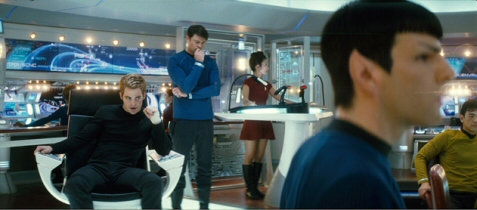
* Box Office Mojo has the “actuals” from last weekend. No big surprises, but they report that “Star Trek” is now officially the most successful “Star Trek” film of all time, adjusted for inflation. For once, I agree with the masses. I might quarrel at times with the hyperactive visual style of the film and I wouldn’t make any particular claims to greatness for it, but nor would I for “The Wrath of Khan.” All in all, it couldn’t happen to a nicer little space opera.

The boy-men of LAFF, Part 2: “Humpday.”

As stars Mark Duplass and Joshua Leonard admitted during the post-screening LAFF Q&A on Friday night, Lynn Shelton’s improvisational comedy “Humpday” was “reverse engineered” from a premise that a lot of straight guys, at least, will no doubt have a hard time swallowing. However, if you take the film as it goes, it develops its premise believably.

The film opens from the point of view of Duplass’s Ben, a happily married guy trying for his first baby with wife, Anna (Alycia Delmore). At 1:30 one morning he is greeted with a surprise visitor, Andrew, an impetuous artsy type who has been traveling the world and having various sorts of bohemian adventures. The film sets up two simple ideas that, in a more normal world, should not come into conflict: Ben and Anna love each other quite a bit as husband and wife; Ben and Andrew love each other quite a bit as best friends.

The problem is that Ben may not be quite as thoroughly comfortable in committing to a lifelong domestic role as he might first appear. The following night, a party with Andrew’s cute new hook-up, her lesbian girlfriend, and various bohemian friends of various sexual preferences leads to a discussion of Seattle’s real-life amateur art-porn video contest, Hump Fest. In turn, that leads Ben, attending without Anna, to an inspiration. With pretty much everything under the sexual sun already committed to video, the only thing left with which you can make any kind of statement or push any envelope would be the spectacle of two straight guys somehow managing to have sex with each other.

Instead of dying the death you’d expected an idea like that to die once the booze and the pot wears off, it takes on a life of its own as Ben pushes Anna to the margins and winds up in the most humorously counterintuitive macho pissing contest ever committed to film. During a rough basketball game, he and Andrew nearly come to blows, and the issue somehow turns out to be who has the artistic/creative gumption to actually commit to the “project.” It’s an inherently funny premise for exploring the old issue of competition between close male friends, explored to more dramatic effect in “Jules and Jim,” Joachim van Trier’s “Reprise,” and probably a bunch of other movies I can’t remember right now. It’s also more poignant than you might think, because, for all his artistic aspirations, Andrew hasn’t actually completed any projects yet.

For an improvised film, this is a nicely-acted, witty, and thoughtful piece of work with plenty of laughs, even if Ben’s beyond-shabby treatment of the very tolerant Anna stretches believability for a guy who’d perhaps like to stay married.  The only real problem with “Humpday” is that this is a story with no satisfactory resolution. If the guys go ahead and do the deed, then we’ll likely always question whether they were both really all that completely hetero to begin with, and we’re left with no premise. If they don’t do the deed, it’s a bit of a cheat.

I won’t give it away, but it’s telling that, in a film where the plot points were laid out in advance but the dialogue was generally improvised with actors Leonard and Duplass (one half of the improv-comedy filmmaking Duplass brothers) effectively acting as writing collaborators, the decision was made to improvise the resolution as well. Naturally, the result was a let down. Like the rest of the film, however, it is funny and feels fairly real in its disappointment, which might actually be the point.

[Note: If you happen to be reading this on Monday afternoon, 6/22, at about 2:30 p.m., PDT, you have just over two hours to get to Westwood to see the second and final LAFF screeening of “Humpday.” Hurry.]

The boy-men of LAFF, Part 1: “Big Fan.”

The Los Angeles Film Festival is really just getting started for me, but already I’ve seen two movies that are definitely noteworthy, both having to do the age-old issues of males delaying maturity and I’m sure there’s more of that coming. I’ll discuss the mostly insightful and funny “Humpday” tomorrow. Today, I have a darker task.

In the case of last night’s screening of “Big Fan” — a last minute addition to the festival which, in Los Angeles, will be opening at the Nuart Theater in September as part of a limited release — we have a case of Peter Pan as absolute worst case scenario. Written and directed by Robert D. Siegel, who wrote last year’s terrific, and not entirely unrelated, “The Wrestler,” the film stars thinking man’s comic, one-time CGI gourmet rat, and, we’re now learning, skilled dramatic actor, Patton Oswalt as Paul Aufiero, (i.e. every fanboy’s worst nightmare of what he might become), who eventually encounters something beyond every fan’s worst fear.

An utterly single-minded follower of the New York Giants, a random remark to his favorite player (Jonathan Hamm) during an encounter at a strip club sets off a brutal attack by the stoned player, which sends him to the hospital and the player to suspension.  Paul is hurt by the attack, but he seems more concerned that the suspension might be destroying the Giants’ chances for a good season. In this situation, most of us would have dollar signs and/or rage in our eyes, but all poor, embittered, yet absurdly loyal Paul has is concern that he won’t be belittled by “Philadelphia Phil,” (Michael Rappaport), an equally strong fan of the Philly Eagles with whom Paul does nightly battle on a sports talk call-in show.

This might sound like an interesting setup for a comedy, but while “Big Fan” is extremely funny for fairly long stretches,  Paul, who lives at home with his despairing mother (Marcia Jean Kurtz, whose performance is too real for comfort), exists in an emotional horror show. Those who found “The Wrestler” a bit dark will see that that sometimes bleak and tragic film really was “Rocky” in comparison to this grim, utterly unredemptive, but oddly cathartic tale. If you can see this pretty extraordinary directorial debut for Siegel and not think of Martin Scorsese’s “Taxi Driver” and “The King of Comedy,” you haven’t seen them.

It’s only a shame that people who see the film in its theatrical run this September, mostly won’t have the pleasure of a live appearance by Patton Oswalt following the film. The comedian, who in real life is a pretty serious cinephile, had the audience in stitches and was probably the best antidote to what might have been the most thoroughly sad and hopeless film most of us have seen in a long time.

Sunday box office update — “The Proposal” makes it to the altar

It’s a gorgeous and breezy afternoon as I type this from the relatively bare business center of the otherwise swanky W hotel which abides in the shadow of UCLA and, during the Los Angeles Film Festival, a small but select chunk of the film industry. That may include some of those who could be effected by the news, apparently first reported by the redoubtable Nikki Finke, that perceived poor management skills and excessively neurotic behavior have led studio chief Brad Grey to commit to a major management shakeup at Paramount. (The Hollywood Reporter has a considerably more staid version of the story up.)

I’ll finally start writing about some of what I’m seeing and hearing at the festival later tonight, but first it’s time for the numbers. Those were especially good for Ms. Sandra Bullock who, with the help of Ryan Reynolds and what Variety sees as “pent-up demand” for rom-coms, scored an estimated $34.1 million with “The Proposal.” That would be Bullock’s biggest opening ever.

Following with a really outstanding estimated $26.9 million in its third weekend, “The Hangover” dismissed it’s newer male-appeal comedy competition, “Year One,” which came in only at the #4 spot, but nevertheless managed $20.2 million in its first week. Ms. Finke described the hunter-gatherers-go-biblical film’s performance as “disappointing,” but The Hollywood Reporter deemed it “solid,” perhaps reflecting the  budget. In any case, it surely reflects that a perception of poor quality caused by bad reviews (as discussed on Thursday’s pre-weekend post) and perhaps more or less matching word-of-mouth might actually have some impact on a film’s performance.

Up” did its bit for the power of family entertainment, remaining aloft at the #3 spot for yet another week with $21.3 million, say the estimators, and is within a hair’s breadth of the $225 million mark for its entire run.

Happy Father’s Day.

« Older posts Newer posts »

© 2026 Premium Hollywood

Theme by Anders NorenUp ↑