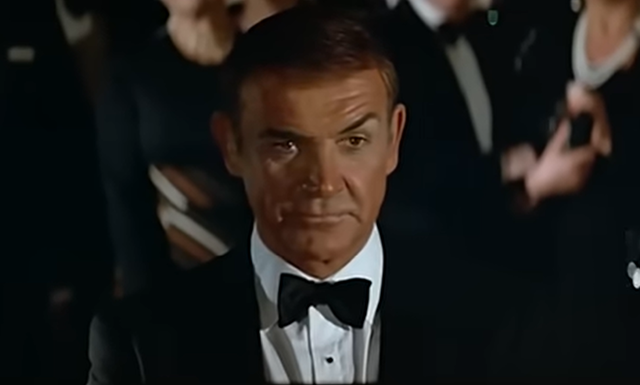
I had seen every James Bond film other than “Never Say Never Again,” released in 1983. That omission probably wasn’t accidental. The film occupies a strange and controversial place in the Bond canon: an unofficial, non-Eon Productions entry that marked Sean Connery’s return to the role of 007 after a twelve-year absence. When Netflix recently licensed all 26 Bond films from Amazon in a somewhat surprising move, including this odd, non-Eon outlier, I finally took the opportunity to check it off the list.
Unfortunately, the experience was a letdown. “Never Say Never Again” is a complete mess, and it has aged terribly. Some scenes are so misguided that they feel like unintentional parody, with the Blofeld scenes and dialogue standing out as particularly cringe-worthy. To be fair, many of the Bond films leading up to “Never Say Never Again” haven’t aged especially well either. Their pacing often drags, and Bond’s “cool” factor we all love is frequently buried under long, dull stretches and strained attempts at humor. This film suffers from all of those problems, only here they’re compounded by a weak script and thoroughly schlocky production values.
The Backstory
How did this film ever get made? The premise isn’t bad – an aging Bond comes back from another adventure. But Eon Productions was also releasing a new Bond film in 1983, the also forgettable “Octopussy” starring Roger Moore. Needless to say it was quite strange to have competing Bond films released in the same year.
The story behind the film traces back to the early 1960s and a long-running legal battle over the rights to Ian Fleming’s novel Thunderball. In the late 1950s, Irish producer Kevin McClory collaborated with Fleming and screenwriter Jack Whittingham on a screenplay titled “James Bond of the Secret Service” (later “Warhead”), which introduced SPECTRE and villain Ernst Stavro Blofeld, centering on stolen nuclear warheads. When the partnership soured, Fleming turned the script into the novel Thunderball (1961) without crediting McClory or Whittingham. McClory sued Fleming for breach of copyright, leading to a 1963 settlement that gave McClory film rights to the Thunderball story. Eon Productions (run by Albert R. “Cubby” Broccoli and Harry Saltzman) then struck a deal with McClory to produce the 1965 “Thunderball” film, but McClory agreed not to remake it for 10 years after its release.
Fast forward to the late 1970s, as McClory tried to exercise his rights to Thunderball, SPECTRE, and Blofeld. He wanted to make his own film and Eon fought to block it. Eon even killed off Blofeld unceremoniously in “For Your Eyes Only.” In the early 1980s, producer Jack Schwartzman partnered with McClory to revive the project. They secured Sean Connery, who had quit the Bond franchise after “Diamonds Are Forever” (1971), vowing he’d “never again” play Bond. A lucrative deal reportedly worth $3–5 million plus script/casting approval and profit shares apparantly changed his mind. Connery’s return was partly motivated by financial needs after some box-office flops and lingering resentment toward Broccoli (whom he reportedly felt had shortchanged him on earlier profits).
Directed by Irvin Kershner (“The Empire Strikes Back”), the film was shot as a remake of the “Thunderball” plot, with Bond recovering stolen nukes from SPECTRE. They tried to add in modern updates and humor about Bond’s age (Connery was 52), but there would be no gun-barrel sequence in the opening or classic title song due to legal restrictions. Production was notoriously troubled: constant clashes between Kershner, Schwartzman, and Connery; budget overruns; and Connery later calling it a “bloody Mickey Mouse operation” full of “incompetence, ineptitude, and dissension.” There were constant script rewrites and it shows.
Bad From the Start
The film’s weak opening sets the tone immediately. The theme song is just terrible, and the rest of the score isn’t much better. Without the iconic gun-barrel sequence, the whole thing feels like a pale imitation rather than a legitimate Bond film.
As we said, the premise isn’t bad, and Connery handles his business well here. He’s very comfortable as an older Bond, and while some of the jokes about his age fall flat, he still offers up plenty of charisma and is believable as an older secret agent who can still score with the ladies.
Things truly go off the rails with the introduction of Blofeld. Max von Sydow, an actor capable of real menace and gravitas, is saddled with some of the worst dialogue imaginable. In his brief appearance addressing SPECTRE, he outlines the nuclear extortion plot through an absurd, leaden speech that serves as clumsy exposition rather than dramatic threat. He then doubles down with an even more ridiculous monologue delivered to British and American officials, spelling out the scheme in cartoonishly blunt terms:
“A terrible catastrophe now confronts you. However, it can be avoided by paying a tribute to our organization, amounting to twenty-five percent of your respective countries’ annual oil purchases. We have accomplished two of the functions that the name SPECTRE embodies: terror and extortion. If our demands are not met within seven days, we shall ruthlessly apply the third: revenge!”
Edward Fox doesn’t help matters with his buffoonish portrayal of M. It’s hard to say whether the blame lies with the script or the direction, as Fox is usually a fine actor. The supporting cast fares no better. Even a cameo by a young Rowan Atkinson as a bumbling British diplomat fails to generate more than a token chuckle.
Another low point arrives with the often mocked video-game duel between Bond and Maximilian Largo (Klaus Maria Brandauer). Someone clearly thought this was a clever way to appeal to the video-game generation. It wasn’t. The sequence drags on far too long, cycling through repetitive visuals, painfully slow tension-building via electric shocks, and exposition-heavy explanations of the rules. Once again, the dialogue is clumsy and overworked. In theory, the scene is meant to show Bond and Largo sizing each other up psychologically and physically; in practice, it plays like tedious filler that brings the film to a halt.
Bright Spots
Any film featuring Sean Connery as James Bond is bound to deliver at least a few genuinely enjoyable moments, and “Never Say Never Again” is no exception. Connery doesn’t disappoint; his ease in the role and natural screen presence give die-hard fans plenty to appreciate. Brandauer also clearly relishes his turn as Maximilian Largo, injecting the film with energy and providing Bond with a villain who, at least conceptually, feels worthy of the matchup.
There’s also no shortage of action, even if it’s unevenly paced. The shark sequence is a clever set piece, and the motorcycle chase stands out as one of the film’s more effectively staged moments. I also enjoyed Bond’s elimination of Fatima Blush (Barbara Carrera), particularly the use of one of Q’s gadgets — a reminder of the playful ingenuity that, at its best, defines classic Bond.
Bond Girls
Which brings is to the Bond girls. It’s hard to screw this part up, as there’s no shortage of beautiful actresses who would jump at the chance to be in a Bond film.
Barbara Carrera was an inspired choice to play Fatima Blush, bringing a strong physical presence and exotic beauty to the part. As a Nicaraguan-born former model who had graced the covers of over 300 magazines and worked with the prestigious Eileen Ford agency since her teens, she had the glamorous, striking looks that fit the Bond franchise’s tradition of alluring villainesses. Her statuesque figure, intense eyes, and commanding screen charisma made Fatima visually memorable and convincing as a dangerous femme fatale who could threaten Bond both physically and sexually.
Fatima herself is vain, psychotic, and completely unhinged, and Carrera commits fully to the excess. The performance is wildly over the top, but deliberately so—and she clearly revels in it, right up until the character meets her explosive end.
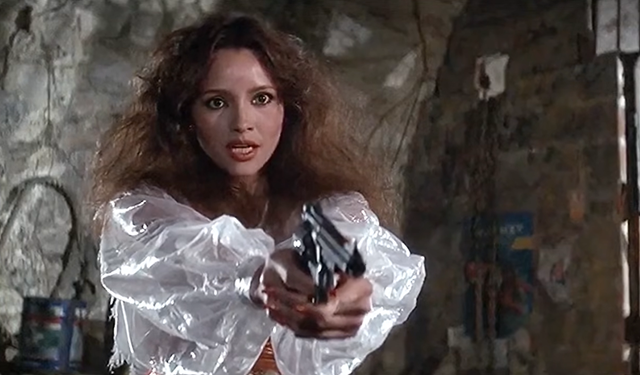
For the role of Domino Petachi, Kim Bassinger was personally selected for by Connery after his wife suggested her. Domino is the glamorous, sophisticated mistress/girlfriend of the villain Largo. She is also the sister of Captain Jack Petachi (Gavan O’Herlihy), a U.S. Air Force pilot brainwashed and used by SPECTRE to steal two nuclear warheads. After Bond infiltrates Largo’s world in the Bahamas and learns of the scheme, he seduces Domino (of course) and reveals the truth about her brother’s fate (including that Largo orchestrated his death). This betrayal turns Domino against Largo. She defects to Bond’s side, providing key information and ultimately participating in the climax of the film.
Basinger handles the role well, though it’s clear she would deliver far stronger work later in her career. She looks gorgeous, as expected, and that ultimately covers most of what the part demands.
Aftermath
“Never Say Never Again” performed respectably at the box office, earning roughly $160 million worldwide. By most measures, that made it a commercial success—though it was still outpaced by Octopussy, Roger Moore’s official Eon entry, in what was widely dubbed the 1983 “Battle of the Bonds.” The underlying rights disputes didn’t end there. Kevin McClory continued to pursue additional remakes for years and even partnered with Sony in the 1990s in an effort to relaunch the property. Those legal entanglements were finally resolved in 2013, when McClory’s estate reached a settlement with Eon, clearing the way for the official return of SPECTRE and Blofeld in the series—most notably in “Spectre” (2015).
As for the film itself, “Never Say Never Again” is probably required viewing only for hard-core Bond fans. For everyone else, it’s largely skippable. The film currently holds a 71% critics’ score on Rotten Tomatoes, contrasted with a far less forgiving 37% audience score. One suspects that many of the critical reviews came from Bond-friendly writers revisiting the film years later, while the audience reaction more accurately reflects the disappointment of sitting through it.

