Month: April 2010 (Page 9 of 20)

“Doctor Who” 5.1 – The Eleventh Hour

It feels like it’s been forever since Steven Moffat was announced as the new showrunner and Matt Smith as the new Doctor. It hasn’t been, of course, but well over a year in both cases is nothing to sneeze at. For some fans, the anticipation has been damn near excruciating. Another very vocal minority had little interest in the continuing adventures of the Time Lord without David Tennant steering the TARDIS. And yet another group – perhaps the most important, due simply to the fact that they comprise a huge segment of the viewing audience – were understandably nervous that a new Doctor alongside a new head honcho might lead to a series that was somehow lesser than what had been seen over the past five years.

I’d like to believe that everybody was as utterly intoxicated by “The Eleventh Hour” as I was, but that’s probably wishing for too much. On the other hand, I can’t really see that it offered up anything that would possibly alienate audiences – not even in the form of the new Doctor, who’s not such a drastic departure from the antics of Tennant so as to drive viewers away. Indeed, the differences between Eccleston and Tennant are far more tangible than the divide between Tennant and Smith. All that said, Smith definitely has something of his own going on, and whatever that “something” is will most certainly grow as the season progresses. Both Eccleston and Tennant each took about a half season to find their Time Lord groove; Smith found it by the end of his first episode. I was wholly won over by him upon his delivery of “I am definitely a mad man with a box,” which was followed by an uneasy cackle that seems to imply this Doctor is not quite as right in the head as his recent predecessors.
But I’ve clearly jumped to the end of the episode far too quickly. The pre-credits sequence with the Doctor hanging onto the TARDIS as it flies over London is utter nonsense – derivative of the worst aspects of the Davies era, and completely different from the tone of the rest of the episode. Maybe that was the point? To reassure viewers right off the bat that they’re still watching the same show? I don’t know, but let’s hope there’s less of that and more of all that follows as the weeks move on.
Of course the sequence is followed by a brand new set of opening titles and a rearrangement of the theme tune. I haven’t done an immense amount of reading reactions to this episode, but even with what little I have read, there appeared to be an immediate backlash to these changes. Every time these basic alterations are made to the series, people complain, which is understandable, because why fix what isn’t broken? But “Doctor Who” thrives on change, and this is just another aspect of it. Eventually they get over it and move on, realizing that it probably isn’t quite the disaster their fanboy gut had told them on first viewing. Having seen the sequence numerous times now, I’m already digging it. Unlike the previous credits, the lightning bolts and cloud tunnel seem to indicate the TARDIS is travelling through some sort of space as opposed to time, and the rearrangement has grown on me with each subsequent viewing.

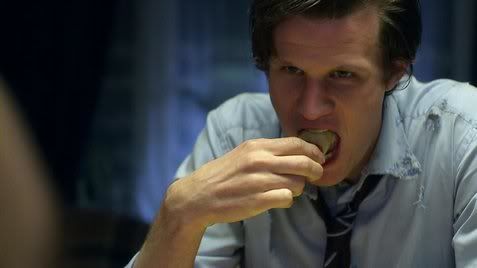
The next 15 minutes, which detail the first meeting of the Eleventh Doctor and the 7-year old Amelia Pond (Caitlin Blackwood) are deliriously charming, and it kicks off with the girl praying to Santa on Easter, and it’s nice to see Moffat’s keeping things on a vaguely secular level. Using children as a big part of the narrative has been a Moffat hallmark (“The Empty Child,” “The Girl in the Fireplace,” “The Silence on the Library”), and here it once again works as a wonderful means to cement the Doctor/companion relationship (although you may not find me as supportive of this gimmick in the coming weeks). No doubt the highpoint of this section is the search for food, which is something that’s never been done before during the post-regenerative state. If every cell in the body of a Time Lord rearranges itself during regeneration, then it’s perfectly reasonable to assume the tastes buds have changed, too. The Doctor thinks he knows what he likes, but it turns out he finds most of it disgusting. In the end, he finds a thoroughly revolting dish – fish fingers and custard – the most tasty and appetizing, which is a gas (or surely will be once it passes through his digestive tract).

Continue reading »

Maximum Miramax

If you’ve been reading the various hard-news entertainment blogs and sites over the last few days, you’ve no doubt noticed the continuing drama of the sale by Disney of Miramax, the “mini-major” studio which once bridged the gap between indie and mainstream filmmaking. The studio was pretty much the creation of mogul brothers Harvey and  Bob Weinstein, who famous named it after their parents (Mira and Max Weinstein). Now, they may well be poised to reclaim the studio they once sold to Disney and ran for them, before leaving to start The Weinstein Company in 2005.

You also may have noticed Nikki Finke’s attempts to lay claim to the latest on the story and crudely and not very convincingly bash her competitors. THR writers Elizabeth Guilder and the man I always call “Jolly Carl DiOrio” may have been guilty of jumping the gun or overstating the case a bit since the negotiations do appear to be ongoing. Also, I didn’t get the e-mail alert of which she speaks and can only see the story I linked to, which duly notes Disney’s denial of the apparent scoop. However, right now it sure looks to me like they got the story essentially right  and it’s not like La Finke has never slightly overstated things on a news story herself — though she does get some very good, detailed inside dope, there’s no doubt of that. To Finke’s credit, she has left up the offending piece and not tried to hide the evidence of her being the mean girl much of her audience, but not me, wants her to be.

Anyhow, at a time like this, it might be appropriate to consider the compelling admixture of quality, marketing, and occasional appeals to a certain kind of middle-brow film snobbery that highlighted Miramax, courtesy of Mad TV, who bring you the ultimate Miramax trailer from the day.

Well, maybe this will tide you over, Tolkien-adaptation wise. No, probably not.

I was really hoping to have time for a decent Friday night/end of week movie news dump, but the truth of the matter is that I’ve no time to do one of my usual semi-comprehensive end of week looks at movie news tonight. Fortunately, outside of continuing discussions of how the receipts of “Kick-Ass” will turn out over the weekend, not a huge amount that’s too earth shattering is going on.

However, I do have time for one item that will definitely put a mild damper on the days of hobbit-heads of all shapes and sizes, and aren’t almost all of us at least slightly hobbit-headed. We have word — really more in the nature of a reminder — from none other than producer Peter Jackson that the all-but promised twin film adaptations of J.R.R. Tolkien‘s unintended prelude to The Lord of the Rings books, The Hobbit, to be directed by Guillermo del Toro aren’t exactly a 100% completely done deal yet, though I’d be beyond shocked if they somehow didn’t happen considering the talent involved and the success of the earlier films.

Nevertheless, the films have not been greenlit and, therefore, no start date has been set. For the same reason, no actual casting has been done. Oh, and by the way, the script was only finished last week. (Well, some movies don’t have a script when shooting starts. Some good ones, too — but not too many that weren’t made by Billy Wilder and none that requires this level of technical preparation.)

Of course, considering everything, doing the films should be a slam dunk but, as previously mentioned in many places the ongoing disaster and ensuing sale of MGM has simply gotten in the way. The Playlist has the details and the, er, gentle reminders to be cool, though most of the actual news is contained in this brief interview with Moviefone.

In the meantime, well, any excuse to run this great musical moment from “Flight of the Chonchords.” How often can you summarize over 10 hours worth of movie in under two minutes, and with such a good collection of beats?

The September Issue

This critically acclaimed 2008 documentary is effectively a real-life companion piece to “The Devil Wears Prada.” It depicts the reputed real-life basis for Meryl Streep’s hellish-but-hilarious Miranda Priestly, Vogue Magazine‘s editor-in-chief Anna Wintour, as she assembles what turns out to be the thickest, most advertising-laden, issue in the fashion mag’s long history. The British born Wintour’s reputation, of course, precedes her and, not surprisingly, she comes off a lot milder and more human than either her fictional counterpart or the nickname never mentioned in the film, “Nuclear” Wintour, would indicate. It’s notable that we never really see the fashion doyen with abuse-ready underlings, though we do see her in frequent, reasonably polite, conflict with more evenly matched colleagues — particularly strong-willed, doc-stealing creative director Grace Coddington, a fellow Brit and a former model herself, who went into the behind-the scenes world after a car accident affected her appearance.

It’s a pleasant, if less than spectacularly compelling, package as far as it goes. Director R.J. Cutler and cinematographer Robert Richman, who finds himself becoming a part of the film’s story, deliver a visually sharp portrait of the candy-colored world of high-end fashion and the whiter-than-white Vogue offices. On the other hand, though it admits she’s not what anyone would consider a warm and fuzzy presence, this comes across very much like the film Anna Wintour would like you to see about her. I can’t help feeling that Cutler’s film was made so that a darker, more honest, and more interesting film was not.

Click to buy “The September Issue”

It’s weekend box office time: “Kick-Ass” will kick..nah, forget about it

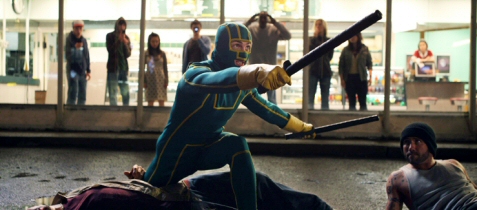
Easily the most ‘net hyped movie of the year not based on a Marvel superhero or collection thereof comes out this weekend, and while a monster hit isn’t expected, there will be some very long faces at Lionsgate if the comic-book adaptation “Kick-Ass” doesn’t collect at least about $20 million. I think they’ll be okay.

Kick-Ass

Indeed, if I were to bet, I’d expect the film to exceed expectations, if not this weekend, then later on in the run as the word of mouth among younger filmgoers gets out. True, as Jolly Carl DiOrio points out, it’s R-rating is a bit of a deterrent to the younger teens who’d no doubt love to see it but will have to come up with some clever maneuvers to check out this ultra-violent action non-super-powered superhero comedy any time too soon.

Of course, there’s more than a hint of controversy around “Kick-Ass.” It raised some hackles on its earlier British release and while getting mostly solid reviews, did so again stateside with a somewhat surprising one-star review from Roger Ebert. He seemed genuinely saddened and not amused by the spectacle of ultra-violence being meted out by, and later visited upon, the character of Hit Girl played by young superstar to be Chloe Moretz. Kenneth Turan, who’s often in the running for the title of the nation’s second most respected/well-known critic, admitted to being just a touch disturbed, but liked it and even declared it a pop-culture phenom. The interesting part is that Tarantino-negative Turan, who cites “Kill Bill” in his review, was utterly horrified by the violence in that film (the piece, or pieces, he wrote about it seem to have disappeared off the ‘net), while Ebert was beyond thoroughly amused.

It’s tempting for me to engage in a long speculation about other movies they’ve reviewed — a long time ago Ebert was somewhat similarly moved to anger by the finale of “The Dirty Dozen” but, much more recently, he defended, in amused but guarded fashion, “The Devils Rejects.”  But all there really is to say that what disturbs us, or doesn’t, and whether it does so in a good or bad way, is a highly individual and idiosyncratic matter and it behooves all of us critical types to remember that. Anyhow, whatever controversy there is will no doubt only feed the beast and expectations are for it to go from anywhere between $20 to $30 milliion this weekend and almost certainly taking the top  spot.

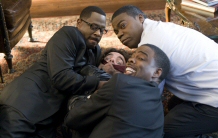
Death at a FuneralThe other major new release this week is Sony’s “Death at the Funeral,” a Neil Labute-directed remake of an identically-titled Frank Oz-directed British comedy from just a couple of years back with a primarily, but not exclusively, African-American cast. (Or, as Carl DiOrio would put it, the cast “skews to urban demos.”) Since the African-Americans in question are Chris Rock, Martin Lawrence, Tracy Morgan, and Danny Glover while Dominican-American Zoe Saldana, white dude James Marsden and little person Peter Dinklage make for a bit of added diversity, this R-rated comedy should play well with a reasonably broad audience.

Jolly Carl says “a debut in the high-teen millions seems doable.” Still, with possible strong showings for holdovers like “Date Night” and “How to Train Your Dragon,” the box office results could be close on Sunday. While the reviews are not at all particularly good, the original did better with reviewers but didn’t exactly make critics do handstands.

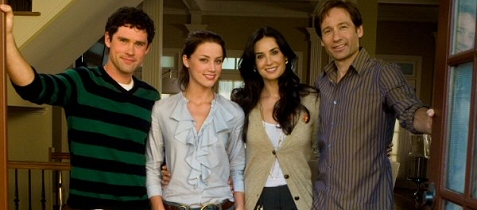
In limited release, we have actually too many interesting small movies to mention this week including the amusingly titled “Rosencrantz and Guildenstern are Undead.” (Shame the trailer isn’t as amusing.) However, “Exit Through the Gift Shop,” looks to be one of the bigger documentaries likely to come out for a while, while the social satire “The Joneses” with David Duchovny and Demi Moore is dividing critics in general, much as it divided our own David Medsker in particular. According to Box Office Mojo, it’s getting a relatively large first week for this kind of film with 192 screens.

The Joneses

« Older posts Newer posts »

© 2026 Premium Hollywood

Theme by Anders NorenUp ↑