Month: April 2010 (Page 13 of 20)

“Date Night” ahead (right now) in titanic weekend box-office photo-finish (updated)

It’s important to remember that the weekend estimates I report every week on these box office wrap-ups are just that, estimates.  “Actuals” come out later in the week and, if there’s a really significant difference I might mention it, but there rarely is.

Nevertheless, considering that I’m writing this on Sunday afternoon, West coast time based on material that was largely written some hours ago, there’s obviously some element of the unknowable, and when the week’s top two films are separated in the current estimates by only $225,000, a reversal is far more likely than usual. However, thank God, this isn’t an election and “almost” here counts even more than in horseshoes and about the same as in hang grenades. For the studios and the filmmakers, the point is to make money, not so much to best the competition.
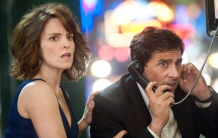
Tina Fey and Steve Carrell in And, in that sense we certainly had more than one winner this weekend as the non-3-D, and therefore more reasonably priced, “Date Night” most certainly won the day in terms of keisters-in-cushions and also, as of now, cash in hand.  As per the mighty Box Office Mojo weekend estimate chart, the Steve Carrell/Tina Fey zany action rom-com earned an estimated $27.1 million for Fox while being seen on about 425 fewer screens than its main competition. Also, since it’s budget was a relatively modest $55 million, not counting the film’s heavy promotion, it will go into the black relatively quickly as well, which should please the bean counters.

UPDATE: Late last night, Nikki Finke had word that the estimates for Sunday’s take were looking significantly off. Today, THR/Jolly Carl DiOrio tell us the current revised estimates has “Titans” collecting $26.7 million and “Date Night” a lower than previously mentioned $25.2. These are, still, however, estimates and not “actuals.” Nevertheless, they are likely more accurate.

Continue reading »

Howard’s End

Featuring Emma Thompson, Helena Bonham Carter, Anthony Hopkins, and a heartbreaking Vanessa Redgrave, 1992’s “Howard’s End” was the third (and most star-studded) adaptation of a novel by E.M. Forster from the famed triumvirate of producer Ismail Merchant, Oscar-winning writer Ruth Prawer Jhabvala, and director James Ivory. With the Merchant-Ivory team’s famed talent for exquisite visuals amidst extravagant period settings, it’s also perfect fodder for a Criterion two-disc DVD set.

Thompson and Bonham Carter are sisters Margaret and Helen Schlegel, affluent early 20th century intellectuals who find themselves embarrassingly intertwined with the crassly wealthy Wilcox family. Eventually, the ailing matriarch, Mrs. Wilcox (Redgrave), starts up an intense friendship with the older and more stable Schlegel sister, Margaret. After her death, wry Margaret unexpectedly falls for and marries Mr. Wilcox (Hopkins), not knowing the ardent capitalist had chosen to ignore a death-bed bequest of enormous import. Meanwhile, the younger Helen’s overweening sympathy for a sensitive clerk with intellectual aspirations (Samuel West) inadvertently threatens everyone’s happiness and proves, once again, that it’s money that matters most. A morally complex blend of complex comedy and drama with florid tragedy reminiscent of another great literary adaptation, George Stevens’ “A Place in the Sun,” “Howard’s End” is everything you could ask for in thoughtful period entertainment, with some highly nuanced ideas from novelist Forster on the interplay of economics and emotional life. Critics sometimes downplay the “tasteful” Merchant-Ivory-Jhabvala films, but this hugely entertaining winner of three Academy Awards, including a Best Actress statue for Emma Thompson, gives Oscar bait a good name.

Click to buy “Howard’s End”

A trailer for a Sunday morning/afternoon: “The Kids Are All Right”

It’s a little sad that what appears to be a really entertaining social comedy with two genuine superstars, a leading man who deserves to be one, and another possible emerging young superstar or two is considered an “indie” flick. Anyhow, “The Kids Are All Right” brings us staid and affluent same-sex parents Annette Bening and Julianne Moore. They find their peace interrupted when Mark Ruffalo turns up as the fun-loving, ne’er do well biological father of their teenage children, played by Mia Wasikowska of “Alice in Wonderland” and Josh Hutcherson of “The Bridge to Terabithia” and the upcoming “Red Dawn” remake.

Except for the lesbian part and the artificial insemination part, this could easily have been an “A” Paramount production in 1951 with, say, Jean Arthur and Rosalind Russell as the two mommies, Robert Mitchum as the bio-dad, and Liz Taylor and maybe Dean Stockwell as the kids. Oh, well.

A big h/t to Dustin Knowles of Pajiba. And, yeah, if I was going to have two mommies, Ms. Bening and Ms. Moore would work for me, too.

Also, of course, this isn’t the first movie with this title, give or take and “L” and a space.

It’s everybody’s bag

In cinephile circles, probably no piece of dialogue and visuals have been so widely dismissed as the plastic bag scene from Sam Mendes Oscar-winning, critically acclaimed, but widely cinephile-hated, “American Beauty.” Well, I’m not here to stick up for “Beauty,” a movie that is undoubtedly simultaneously over- and under-rated, but to present a flying-plastic-bag movie that I can’t imagine cinephiles, or anyone else, not taking to their hearts.

Via Anne Thompson comes the simply titled “Plastic Bag,” starring the voice of director Werner Herzog and an unbranded, beige plastic bag. Written, directed, and edited by up-and-coming feature film-maker Amin Bahrani, this roughly 18 minute short subject is both emotionally powerful and beautiful, a commentary on the human condition and testimony to our ability to anthropomorphize anything. I have no idea how Bahrani staged some of  it, so it also has the appeal of a great magic trick.

Born and raised in North Carolina, Bahrani, who is currently teaching at Columbia’s film school in New York, is a relatively new independent director who has flown under my radar so far. Not any more.

Also, just in case it’s new to you, that oceanic plastic bag vortex is not a science-fictional cinematic invention but entirely real.

A tribute to Dennis Hopper

It’s good to celebrate people while they’re still here, and that certainly applies to Dennis Hopper, a man who has made his mark upon the movies like very few people in film history. From his start as a young ensemble player on innumerable television shows and some very fifties era big Hollywood productions like “Rebel without a Cause,” “Giant,” and “Gunfight at the O.K. Corral” (he’s at 199 credits on IMDb), to his emergence as a controversial counterculture star and filmmaker in the the late sixties, to becoming one of Hollywood’s best character actors with his beyond memorable roles in films like “Apocalypse Now,” “Blue Velvet,” “Hoosiers,” “True Romance” and numerous other films, he’s without a doubt a man to whom attention must be paid. As the director of “Easy Rider,” and the troubled but legendary “The Last Movie,” his influence on the American films of the early seventies, for both better and worse, is probably impossible to measure.

In that spirit, cinephile superstar writer and blogger turned filmmaker Matt Zoeller Seitz, formerly of The New York Times and the great group blog he founded, The House Next Door (now Slant Magazine’s official blog), has crafted the un-narrated cinema essay below for his present gig with the Museum of the Moving Image. It’s fairly long as these things go, but it is definitely worth your time.

Oh, and one thing that has been, and always will be, true about Dennis Hopper — he is most definitely not safe for work, unless, of course, you work somewhere extremely cool or extremely dangerous.

« Older posts Newer posts »

© 2026 Premium Hollywood

Theme by Anders NorenUp ↑