A few more items with a retro cast, starting with a sad one.
* It’s simply too big a show business and media story not to mention that the death of Michael Jackson has been ruled a homicide. Though you can argue that it shouldn’t be more than a legal story, there’s really no underestimating the pop-cultural impact of something like this. Certainly, it won’t be lowering the temperature around the upcoming movie built around Jackson’s last performances.
* On a far more pleasant note, Anne Thompson has casting news on Andrew Stanton’s upcoming non-Pixar film of Edgar Rice Burroughs’ “John Carter of Mars.” I’m not familiar with most of the names, but Samantha Morton is definitely cool with me.
* Anne Thompson also posted a trailer that I’m borrowing below for Christopher Nolan’s new film with Leonardo DiCaprio, “Inception.” Ms. Thompson calls it a “mind movie.” I wonder if everyone doing well in Hollywood from studio heads to head waiters shouldn’t just tithe to the estate of Phillip K. Dick without whom we’d have none of the film’s in this subgenre would exist. If ever a writer’s impact was underestimated in his own lifetime, he’d be the guy.
The newspaper industry has taken another hit as it was announced that Regal Entertainment Group and AMC Entertainment plan to gradually eliminate their show time listings from newspapers.
Looking to cut costs, the theater chains are instead directing consumers to their Internet sites or third-party sites, like Fandango, Moviefone or Flixster, which offer those listings for free and make money from the fees they charge for selling advance tickets to movies. Many of those sites also feature film reviews and movie trailers.
The effort may be gaining some traction, as U.S. Internet traffic to AMC’s Web site rose 21 percent in July compared with a year ago, according to comScore Inc., while visits to Regal’s Web site were up 18 percent.
“For a reader, some things that are ads are actually considered news,” said Mort Goldstrom, the NAA’s vice president of advertising. “Ads for concerts and things at clubs, for restaurants and movies – that’s a reason people read.”
He said the pullback in listings will hurt theaters by reducing their visibility among potential customers, sending those dollars to competitors that still buy listings or to other sources of entertainment like plays or clubs.
It’s hard to find concrete numbers on how much money newspapers actually make from movie theaters for their listings. It’s been obvious that something like this was going to happen. I can’t remember the last time I looked to the newspaper for movie times. Services such as Fandango, Moviefone, and Flixster don’t charge the theaters to run the times and these sites have become the common way to look up when a movie is playing. Thus, theaters don’t need this type of support from newspapers. Instead, they can use this money to advertise theaters deals and coupons through other mediums as well as newspapers. While this may not devastate the financial state of the Los Angeles Times or the Washington Post, local newspapers will surely feel the pinch.
Seems like newspapers are getting smaller and smaller, doesn’t it?
As John F. Kennedy used to say, “success has a thousand fathers and failure is an orphan.” One thing’s for sure, both generate a ton of ink.
* I’m still of two minds on this whole Twitter business in terms of whether or not it really speeds up what we used to call “word-of-mouth” on movies. It seems to me we’ve had texting for awhile now, though the proliferation of iPhone and other communication devices is a new factor and must be having an impact. Unlike texting, you don’t pay on a per-Tweet basis, so maybe. Steven Zeitchik, however, is more certain and guess which movie he thinks is the first to officially benefit. (If you haven’t already been spoiled at all on the not-ripped-from-the-history-books ending of “Inglourious Basterds, you might want to skip this one.)
* Tom O’Neil at “The Envelope” speculates on awards strategy for releasing “Basterds” now rather than closer to award season. To me, Weinstein’s decision to highlight the musical “Nine” over this seems more than self-evident. Assuming the film is not a complete turkey, that film’s Oscar chances should be better.
Quentin Tarantino‘s films are not Oscar-friendly. The older members of the Academy have traditionally leaned strongly towards a very traditional, essentially literary and middle-class, view of quality which is pretty much the antithesis of the Tarantino aesthetic. It’s only been through his widespread acclaim and a subtle loosening of old prejudices that his films have gotten the definitely limited Oscar recognition they have and, considering what some regard as a too lighthearted view of World War II horrors, I wouldn’t expect this one to be much different. Of course, with ten nomination slots for Best Picture, and the universal groundswell of acclaim for heretofore internationally unknown German actor Christoph Waltz, two or three nominations (including the semi-inevitable “Best Original Screenplay” nod) are almost a certainty.
If you want an example of the kind of old-school middle-brow snobbery that’s always stood in the way of Tarantino — and Alfred Hitchcock, Howard Hawks, Don Siegel, Sergio Leone, etc. before him — Peter Bart provides it for you. Some commenters respond aptly.
* Paul Laster at Flavorwire has a revealing interview with production design husband-and-wife team David Wasco and Sandy Reynolds-Wasco about “Inglourious Basterds,” the Jack Rabbit Slim’s set from “Pulp Fiction,” and other films. Considering that they also work with Wes Anderson, these two are crucial collaborators with our most talented masters of movie stylization working, and the current heirs to people like the great Ken Adam, the production design genius of “Dr. Strangelove” and “Goldfinger,” among many others. (H/t David Hudson@Twitter…okay, so maybe there is a Twitter effect on filmgeeks.)
Now is the time at Premium Hollywood vin ve dance.
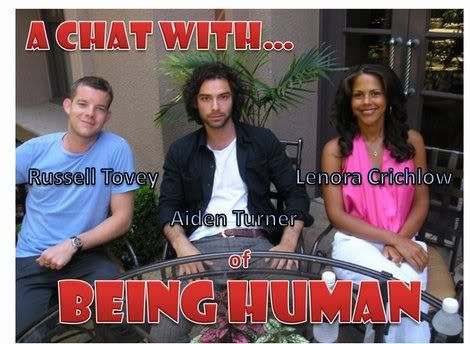
One of the most consistent pleasures of the TCA Press Tour for an Anglophile such as myself is the opportunity to get the scoop on the latest UK imports to arrive on BBC America. In 2007, I was introduced to “Jekyll” and “Torchwood,” and in 2008, I very quickly fell in love with “Gavin and Stacey” and “Primeval.” This time around, the picks to click were “The InBetweeners” and “Being Human,” and although I’ll be waiting a bit to offer up my conversation with the folks from the former, I’m running a bit late in posting my chat with the cast of the latter. “Being Human” actually made its BBC America debut when I was still in Pasadena, but now that I’m playing catch-up, I wanted to share with you the lovely courtyard conversation that I had with the show’s trio of stars: Aidan Turner, Russell Tovey, and Lenora Crichlow.
“How Bruce Lee Changed the World” originally aired on the History Channel, and it’s a great documentary for Bruce Lee fans. It tracks his short life until his mysterious death at the age of 32, just months before the release of his only U.S. film – “Enter the Dragon.” The documentary features interviews with some of the many people he influenced – from Jackie Chan to John Woo, Brett Ratner, LL Cool J, and Stan Lee. It also features seldom-seen interviews with Bruce Lee as he discusses his craft. Check it out!
Illustration by Brian Smith, Copyright Bullz-Eye.com, LLC