Doctor Who 5.10 – Vincent and the Doctor
If somebody asked me to make a short list of my favorite writers and/or directors working today, Richard Curtis isn’t the first person who’d leap to mind. He might not even be the fifth. Despite that, I count myself as a big, big fan of his stuff, going all the way back to “Blackadder,” and right up to his most recent work, “Pirate Radio,” a movie which didn’t do well at the box office and got some fairly tepid reviews upon release. Like Curtis’s “Love Actually” before it, I suspect “Pirate Radio” (or “The Boat That Rocked,” for those of you in the U.K.) will go on to become a favorite of many, many people, because it’s an utterly charming, daffy piece of cinema that doesn’t want to do much more than entertain the hell out of you for a couple hours. And that it does. When it was announced that Curtis would be writing an episode for this season of “Doctor Who,” naturally I was interested in the prospect, but if I’m being totally honest, I didn’t expect all that much from it, and even less so once it came out that it would be about Vincent van Gogh.
For starters, Curtis has no track record writing science-fiction or fantasy (at least not the type one thinks of when bandying about such terms), and while it seemed gratifying to have such a high profile writer onboard, nothing in his works indicated that, with only 45 minutes to play, he’d likely create anything more than an amusing romp. Perhaps it was less Curtis himself, and more the new series having a pretty bad track record when it comes to tackling historical figures, regardless of who’s writing them. In fact, they typically seem to end up…amusing romps. Probably the best was the first one, “The Unquiet Dead,” which featured Charles Dickens, and from there they’ve kind of incrementally gone downhill. I didn’t think the formula could get much worse than “The Unicorn and the Wasp” with Agatha Christie, but along came “Victory of the Daleks” with Winston Churchill to prove me wrong. So imagine my surprise upon discovering that Curtis trashed my expectations by creating a deep, lovely, tortured thing of beauty that reduced me to tears. I have really got to start trusting this guy. His name is a stamp of quality no matter what “they” say.
(Editor’s note: I’ll second that, having interviewed Mr. Curtis in connection with the release of “Pirate Radio.” You can check out the conversation by clicking here.)
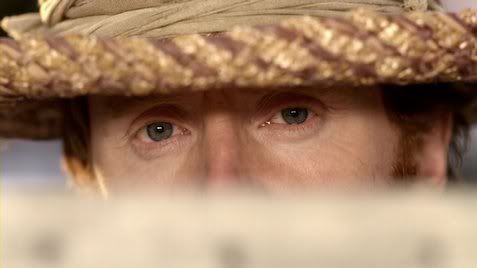
“Vincent and the Doctor” is the new standard by which these types of stories will, or at least should be measured. I have never quite understood the point of the Doctor meeting up with famous figures from the past only so that we can laugh at them and their quaint, backwards ways, all while cramming in little in-jokes that play off of what we know about these people from today’s perspective. Curtis presents us with a fictitious riff on van Gogh that lays waste to the previous approach. His story demands that we feel for van Gogh and his problems, which in turn gives the episode a gravitas that’s lacking in stuff like “The Shakespeare Code,” in which young Will was little more than a smarmy Casanova. Curtis comes from a place that has a huge amount of respect for this artist, as well as understanding that van Gogh’s troubled history was a big part of what made him the artist he was. Curtis also wisely avoids tackling the infamous ear-cutting incident, which is something a lesser writer would’ve worked into the story by having the alien lob it off or some such nonsense.
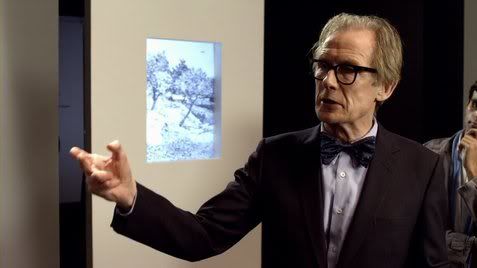
From the very first sequence, the reality of van Gogh (Tony Curran) painting “Wheatfield with Crows” is mixed with the fantastical element of the unknown in the field, disturbing the birds, and thus giving a reason for the crows in the painting in the first place. Quickly the action moves to the present at the Musée d’Orsay in Paris, and before you can say Bill Nighy, there he is, as Dr. Black. At first it seems a somewhat wasted cameo, but lucky for us Nighy returns before the episode is over. The Doctor has taken Amy to see the van Gogh exhibit at the museum. It seems he’s taken her numerous places since their last adventure, and he’s got a guilty conscience about the loss of Rory, who of course Amy no longer even remembers. The painting “The Church at Auvers” catches the Doctor’s eye, as there’s something in one of the church windows that he recognizes as “evil.” And so it’s off to 1890 to get to the bottom of it all.
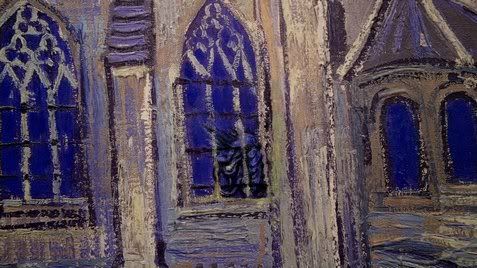
Now this is where things get complicated, because, as we find out later on, the alien in the window, the Krafayis, is not actually evil at all, but is really a rather pathetic creature, blind and abandoned on Earth by his race. But I think this episode is meant to work on another level entirely, and that the Krafayis is a metaphor for van Gogh’s depression. It is, after all, something only he can see, but others can not. So if that is the case, does depression equal evil? It certainly can for the person who suffers from it (and I speak with a fair amount of experience on the matter). This is a story that is in part about an invisible monster, but the Krafayis is merely a vessel for a much more important issue. I’m frankly rather stunned that “Doctor Who” found a way to tackle such a weighty topic under the guise of family entertainment. It goes to show that this can be done on this series, provided you have a writer who’s sharp enough to figure out the proper equation.
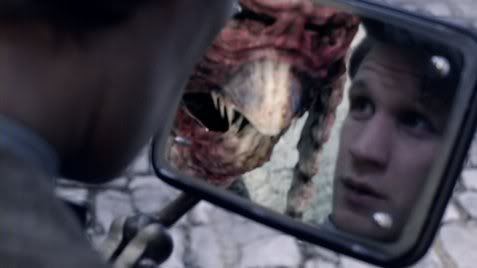
In many ways, “Vincent and the Doctor” is one of the most mature stories this series has ever seen. It’s interesting to note that when it first aired on the BBC, the following message ran over the end credits: “If you’ve been affected by the issues raised in this program, and you’d like details and information and support, go to bbc.co.uk/headroom.” The message also offered up a phone number that people could call for help if they needed it. Once Vincent kills the Krafayis, he momentarily appears to be lost without it, as if the Krafayis gave definition to his life, just as mental illnesses tend to do. But once the Krafayis is truly gone, Vincent is a new man, with a new lease on life. It may be worth mentioning that the episode title is “Vincent and the Doctor” and not “Vincent and The Doctor,” which might refer to the role of the Doctor as a healer in the story, rather than his title and/or name.
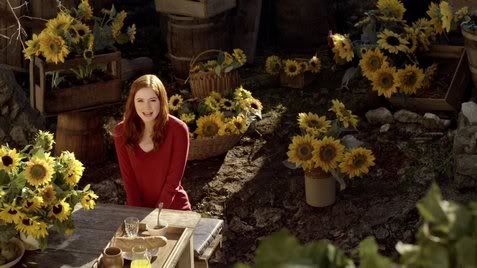
This is also a great Amy episode, maybe even the first great episode for her character, and Karen Gillan really shines here – literally; she looks radiant throughout the piece. Her reaction to Vincent is star struck only at first, and then she quickly begins seeing him as a real, flesh and blood person. There’s that great moment when the two are walking and he senses the loss of Rory in her. His desire to marry and have 12 children with her, and her desire for him to recognize the beauty of sunflowers – lovely stuff. And it’s heartbreaking when she says “I’m not really the marrying kind.” Part of this episode’s triumph is how effortlessly is seems to work through her loss despite the fact she has no memory of it. (Part of me wonders if some of those touches were Steven Moffat’s.)
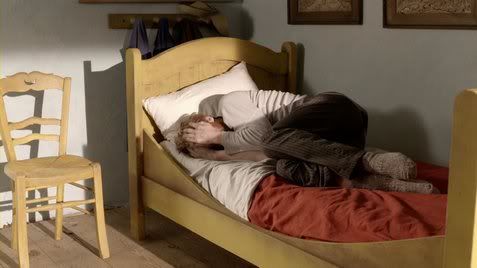
“Vincent and the Doctor” concludes with two stunning sequences. In the first, the Doctor, Amy and Vincent lay beneath the stars, while Vincent orates about the night sky, and the vastness of the universe. As he does so, “The Starry Night” is painted in the sky, which is one of the most unexpected uses of CGI I’ve ever seen in this series. It’s a breathtaking, beautiful scene, full of newfound life and camaraderie. In the second, the Doctor and Amy take van Gogh to the Musée d’Orsay in 2010 to show him the exhibit featuring his work, and all the people who have gathered to partake in it. It’s perfectly scored to a hopeful pop song (“Chances” by Athlete), no less, which is a Richard Curtis trademark if ever I’ve seen one. What happens here is one of those things that the Doctor just isn’t supposed to do. We’re used to him showing off the inside of the TARDIS to unsuspecting folk – but actually taking someone on a trip to see his future? It succeeds because it breaks that rule here and now, and gives this suicidal man some hope in the final months of his life. Just the heartbreak of joy on Curran’s face is enough to justify doing this sequence, but on top of that you’ve got Bill Nighy delivering this stunning, passionate manifesto on van Gogh – in a way that maybe only Nighy can do – that takes it right up over the top. (Please find a way to bring this character back at some point.) Man oh man, it makes the heart swell. Curran, by the way, is surely the greatest guest actor we’ve had all season. What a talent. He’s someone we should all be paying much more attention to in the coming years.
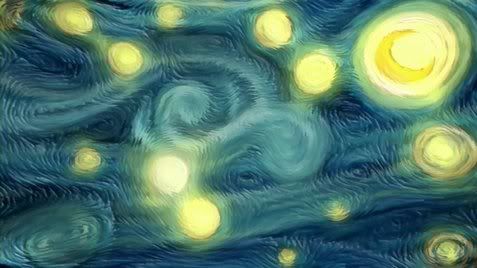
The Doctor: “The way I see it, every life is a pile of good things and bad things. The good things don’t always soften the bad things, but vice versa the bad things don’t necessarily spoil the good things or make them unimportant. And we definitely added to his pile of good things.”
If it isn’t already obvious, I dearly loved “Vincent and the Doctor.” I love it so much that you risk offending me if you offer up a contrary opinion. With the new series, I’ve come to rely on, at the very least, one episode per season blowing me away. Yeah, that’s how low my standards are. As long as there’s that one installment that just changes everyone’s (or at least my) perception of what this show can be about, then it’s doing well by me. Not every single episode can rewrite the book and be brilliant, but 1 out of 13 isn’t terrible in the realm of TV produced for the masses, and make no mistake, “Doctor Who” at this point is designed to appeal to the widest audience it can snag. Of course, I know it’s foolhardy to expect everyone to enjoy this and see it as I did, but if you didn’t, I won’t understand you, and I’ll feel the same kind of slack-jawed amazement I feel when someone tells me they didn’t like “Love Actually,” or that they thought it was schmaltzy crap. I might even suggest that you go invest in a heart.
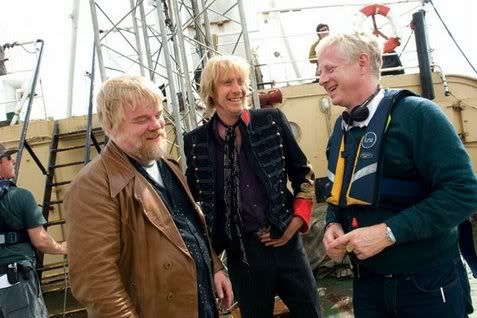
Please Mr. Curtis, come back to the “Who” fold next time you have a great idea for this show, because it needs you, as do we. And, yes, bowties are cool.
__________________________________________________
NEXT TIME: It looks as if BBC America is taking yet another weekend off due to the holiday. We started out this season two weeks behind the U.K. and now we’re going to be a month behind. Ack. The week after, the Doctor rents a room in “The Lodger,” guest-starring James Corden.
Classic “Who” DVD Recommendation of the Week: I don’t know if I’ve ever, in my history of writing these recaps, recommended “City of Death” with Tom Baker and Lalla Ward. Widely considered one the best stories from the entirety of the classic series, it’s written by Douglas Adams (using a pseudonym), involves a plot to steal the Mona Lisa, and has cameos from John Cleese and Eleanor Bron. Exquisite. Absolutely exquisite.
(Thanks as always to Sonic Biro for the screencaps.)
Posted in: Doctor Who, TV, TV Action, TV Sci-Fi
Tags: Agatha Christie, Athlete, Bill Nighy, Blackadder, Chances, Charles Dickens, depression, Doctor Who, Doctor Who Blog, Doctor Who Season Five, Jonny Campbell, Karen Gillan, Love Actually, Matt Smith, Pirate Radio, Richard Curtis, Steven Moffat, The Boat That Rocked, The Church at Auvers, The Shakespeare Code, The Starry Night, The Unicorn and the Wasp, The Unquiet Dead, Tony Curran, Victory of the Daleks, Vincent and the Doctor, Vincent van Gogh, Wheatfield with Crows, William Shakespeare, Winston Churchill


That was brilliant — easily the best episode of the season. I was thrilled to see Bill Nighy, and blown away by Tony Curran. Superb all around.
Even my kids picked up on Amy’s “I’m not the marrying kind,” — my daughter and I sighed in exactly the same way at exactly the same time. I appreciated that the Doctor seems to be suffering doubly over Rory’s loss, since Amy can’t.
Very nice write-up, too, Ross.
Wow, really? You liked it? You didn’t think that the endind was rather trite? then I’m sure you’ll just LOVE the next episode, ‘The Lodger’.
Kit –
I did not think it was trite. I don’t see how a man taking his life because of illness would be considered trite in this context. Had the Doctor and Amy changed van Gogh’s outlook, and he lived a longer, happier life and created many more paintings? Now ~that~ might have been trite. This was fuckin’ poetry.
Joan –
I’ve said before, and I’ll reiterate, I adore it when you post anecdotes of watching with your kids. That’s the testament. Love it.
Ross, your notes here have given me quite an interesting perspective on the episode. I enjoyed it very much, but the layers of the narrative ad the metaphor you spotted were something I must have missed.
[ROT13'ed to avoid spoilage] V guvax gur cnaqben’f obk fgbel yvar vf fvzvyneyl zhygv-ynlrerq.
This was a really good episode for many reasons. We are getting into the other subtext that is running through this season besides the crack in time, which is the Doctor’s guilty conscience. He is in fact starting to come off as a bipolar character. Interesting that the other historical character from this season, Churchill, was also a deeply depressive person and characterized his depression as a “black dog”.
The new series has been putting a lot of weight on the Doctor as both savior and harbinger of doom, much more than I recall in the old series. He is routinely reminded how many people have died on his watch and how things tend to blow up in his presence. In the classic Tennant episode “Human Nature”, the scornful send off he receives from nurse Joan Redfern is typical of the rough treatment he has endured in his thankless job. A funny rejoinder to this is the end of the first Smith episode when Amy asks him if he kept the clothes, now his uniform, that he took from someone’s locker. “Just saved the world, no charge. Yes, I kept the clothes.”
Now that Rory has died/vanished, the way he hovered over Amy on this episode was really heartbreaking. He’s seeing now what she was bottling up when Rory was around and she had doubts about their future. When he drops Rory’s name in the midst of a running scene, it’s so fast it could almost be missed. He has to always keep up a facade that hides who knows what else.
The Dream Lord externalized this when he (a.k.a. the Doctor) challenged Amy as to whether she was privy to all of the Doctor’s thoughts. Basically this was his unguarded, self-defeating aspect telling her she’s not getting the whole story.
Before I go too far with this idea, I have to wonder if the BBC will honor or even begin to explore the premise that there are only 13 potential Doctors. My whole essay depends on whether the Doctor is beginning to contemplate his own death.
See http://www.rot13.com/index.php for rot13 magic decoder ring.
I missed any possible triteness during the pop song montage because we had the captions on, and they consistently appended a “7″ to every line of the song — some kind of glitch, it was clearly supposed to be a musical note. All the 7s distracted the kids, who waited for the singer to finish each line before all chiming in with “7!”
So yeah, we were inappropriately cracking up during what was meant to be a very tender scene. Sorry. I still loved it. The Starry Sky scene was brilliant, and the scene with Curran and Nighy in the museum could’ve been horribly maudlin, but those two are such great actors, they really elevated that scene to where it needed to be.
Plus, what the Doctor said about the piles of good things and the piles of bad things that make up our lives is so very true. This is what good – great – science fiction does, it pushes one or more story elements way outside what we know to be true, expressly for the purpose of illuminating our humanity. Giant space chicken? Absurd. Time traveling to visit then-neglected and abused, now awesomely famous artist? Impossible and cliched. Yes, this story had all those things, but it wasn’t about those things. It was a heart-rending depiction of mental illness, and the possibility of joy in its midst nonetheless. Very well done indeed, and about as far from trite (pop song use notwithstanding) as could be.
John I: thanks for the ROT13 translator, saved me having to google it.
Not merely the best episode of this season, but easily one of the series’ finest moments since its revival.
One element that really struck home for me was the parallels drawn between Vincent, The Doctor, and the Krafayis. Granted, you can say it’s an easy parallel to draw – they’re all stranded in a universe where they’re the last (or only) of their kind – but the genius of the episode is that with an economy of dialogue and expression, Curtis, Smith, and Curran cut right to the heart of what it means to truly stand alone. What a burden it can be, and what a beauty as well…
Of course, I was familiar with Richard Curtis before – I liked what I’d seen of his work, and respected him as a writer – but hadn’t really appreciated his stories’ depth (of both mind and heart) until now. Now I’m rushing “Love Actually” and “The Boat That Rocked” into my queue. There’s a lot of catching up for me to do, so thanks, Ross, for the push.
Joan said : SCIFI “pushes one or more story elements way outside what we know to be true, expressly for the purpose of illuminating our humanity. Giant space chicken? Absurd. Time traveling to visit then-neglected and abused, now awesomely famous artist? Impossible and cliched. Yes, this story had all those things, but it wasn’t about those things. It was a heart-rending depiction of mental illness, and the possibility of joy in its midst nonetheless.”
I could not have said this better Joan. You summarize my sentiment of this episode exactly (although I think I liked it in bits more than a whole). In that quote you also summarized what is pretty much my frustration with DOCTOR WHO since it’s revival: there’s a lot of absurdity to wade through in order to find the meaningful and interesting parts. The show nowadays is like a steak with delicious and tender parts and LOTS of gristle to cut around.
I’ve never been a huge fan of ANY hero meeting up with a historical figure. The concept to me is in fact trite….clever, but trite. George Lucas tried to a fault to do this with the INDIANA JONES tv series….yuck! DOCTOR WHO has done it too many times before. I didn’t buy Shakespeare at all. Dickens was forgettable. Now Madame de Pompadour was the most respectable one and is it a coincidence that her story is depressing as well?
Big Finish did a better job of having Shakespeare in a story in TIME OF THE DALEKS. http://www.bigfinish.com/32-Doctor-Who-The-Time-of-the-Daleks
I couldn’t help but draw a similarity in theme between this episode and FORBIDDEN PLANET where Morbius (not Who’s Morbius) creates the invisible monster attacking everyone out of his ID being enhanced by an alien machine, to which he sacrifices himself to it in the end; another excellent resource where scifi has delved into the human psyche.
I wish this had been two parts and that there’d more of role (in the 2 parts) for Bill Nighy.
I actually thought that the story was going to culminate in the Doctor or Amy actually being “responsible” indirectly or otherwise for Van Gogh killing himself similar to the Doctor being quasi-responsible for the fire of London.
Brilliant + Absurd = Doctor Who
Thanks Joan!
It was a special episode all around, made more personally special because I saw many of the paintings. In 1984 the Metropolitan Museum of Art in NY had one of its early “blockbuster” shows, Van Gogh in Arles. My father got tickets to see it, which was a little unusual, since he wasn’t particularly an art lover. But there we were in the same room as many of the great paintings. My dad died the next year, and those memories of being in the room with Vincent are very important.
Ross, not all the historical episodes are great. But I love kids being introduced to the figures of history in any way possible.
Ross: I re-read my comments and “I enjoyed it very much, but the layers of the narrative ad the metaphor you spotted were something I must have missed.” was not exactly what I wanted to convey. I agree with your assessment and I need to watch it again with fresh eyes, because what you said did no occur to me at the time, but now it’s hard to think otherwise. Thank you for pointing me in this direction.
I liked this episode very much as well. The only criticism I have is that I didn’t care for the very ending. The fact that he dedicates a painting to Amy really kind of ruined a “perfect” episode. It actually throws a pie in the face of Gauguin who Van Gogh always associated the flowers with. What he said as he peered out the window about his thinking “sunflowers are on the cusp between life and death” was accurate, but putting her name in the middle of one of his most famous paintings was a let down to me. They had already “changed time” by getting rid of the monster in the window, and they should have let the “real” time-line of his life alone. Other than this, I thought it was brilliantly written, acted and executed. Bill Nighy was amazing and I don’t think I’ve teared up that much in an episode of DW in a long time. 4 and three quarter stars out of 5.
I am continued to be blown away by your description of the episode. You are a brilliant writer and no one can take that away from you. As far as the depression, I feel he was experiencing fear and loss among his other feelings. I could watch this many times again and still find something new I missed the first time seeing it. It was truly a masterpiece.
Ahhhhhh…where would our egos be without ^^^moms^^^?
A friend points out: “The Doctor asks the curator when the painting of the cathedral was made. The curator says 1-3 June 1890. Wiki says that Van Gogh cut his ear in near the end of 1888. Why didn’t they give the actor a damaged ear?”
Any thoughts?