Since I took a day off earlier in the week, I’ve got probably enough material for fifteen separate blog posts, but just one will have to do…
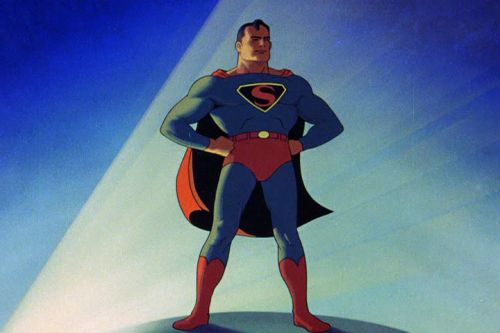
* Since about Wednesday (my day off) items about the upcoming Superman film being presided over by Christopher Nolan have been rolling out. First Latino Review broke the news in Spanglish that writer David Goyer, who has been involved with Nolan’s Batman franchise from the start, would be on board. Now IESB (via Bad Guy Wins) reports what it says are rumors that the director of the Superman film will be Christopher’s writing partner brother, Jonah, making his directorial debut.

That seems reasonable enough especially given that Nolan’s going to be busy with the third instalment in his Batman franchise. I get a bit more skeptical about the idea that Nolan will be sticking around to direct the long-mulled Justice League movie which would presumably include the new Supes (whoever he may be; sorry Brandon Routh), the current Batman (just as long as no one gets into his eyeline), and Ryan Reynolds’ Green Lantern, but I suppose anything is possible.
* I could spend the next week trying to figure this one, but negative PR campaigns against Best Picture Oscar nominees have become de rigeur in recent years and the shrapnel is flying in more than one direction around “The Hurt Locker.” First there were stories from Pete Hammond and a typically voracious Nikki Finke about anti-“Avatar” e-mail blasts by producer Nicolas Chartier. Today there was a far more substantive front page news story in the Los Angeles Times on some disagreements among military people about the film’s putative claims to authenticity. The most serious allegation — which doesn’t appear to be anywhere close to being proven — charges that the crew drove a Humvee into a Jordanian village in order to film angry locals.
Though I think quite highly of Paul Rieckhoff of Iraq and Afghanistan Veterans of America, a frequent guest on Rachel Maddow’s old radio show, I think his criticism is way off-base and was surprised to see him on the anti-“Hurt Locker” side. I don’t think anything in the film indicates that the dangerous-seeking behavior of Jeremy Renner’s character is supposed to be typical, but simply one person’s reaction to an insane situation. Still, it’ s easy to understand why some might kind of forget the movie, though attempting to mirror reality to some degree, makes no claims to being anything other than fiction.
Steve Pond covers the push-back by reporter-turned-screenwriter Mark Boal.

 Love him or hate him, Wes Anderson knows how to make great movies. Though he’s remembered more for his quirky screenplays than his ability behind the camera, Anderson seems to have a hand in every single detail of his movies, and that’s a telltale sign of someone in love with their craft. He also boasts one of the best stables of actors in town (Bill Murray, Angelica Huston, the Wilson brothers, etc.), and more recently, nabbed such in-demand actors as George Clooney and Meryl Streep to voice a couple of talking foxes in a stop-motion animated film that’s actually better than Pixar’s latest. Add to that one of the best comedies of the decade in “The Royal Tenenbaums,” the cult favorite “The Life Aquatic,” and the criminally underrated “The Darjeeling Limited,” and his place on this list suddenly doesn’t seem so unwarranted.
 Sometimes working too much can have a counteracting effect, because while Clint Eastwood was able to bang out nine films over the course of the last decade, it’s his hit-and-miss track record that ultimately prevents him from finishing higher on the list. For every “Letters from Iwo Jima,” there’s a “Flags of Our Fathers,” and while films like “Million Dollar Baby,” “Mystic River” and “Gran Torino” are easily some of the best movies of their respective years, “Space Cowboys” and “Changeling” are some of the worst. His latest film, “Invictus,” falls somewhere in between, and that’s only because he makes the subject material better than it is. Still, if there’s anything we can learn from a guy like Eastwood, it’s that sometimes less is more.
 Apart from making three of the biggest movies of the decade, Peter Jackson also tackled a remake of one of the most iconic movie monsters of all time and a best-selling novel where the main character spends a majority of the story in heaven. If “The Fellowship of the Ring” hadn’t become a worldwide sensation, though, Jackson’s career could have gone down a very different path. After having been entrusted by New Line Cinema to shoot all three “Lord of the Rings” films back-to-back, Jackson returned the favor by delivering a worldwide sensation that kept the studio in business for a few more years (before merging with Warner Bros.), while making a name for himself as a visual maestro. That led to another pet project, “King Kong,” and eventually to a big screen adaptation of “The Lovely Bones.” Neither one is quite as good as the “LOTR” trilogy, but then again, neither are most movies.
 The Brothers Coen got off to a great start in 2000 with the musical comedy “O Brother, Where Art Thou?,” only to follow it up with duds like “Intolerable Cruelty” and “The Ladykillers.” Of course, I’ve resisted from even mentioning “The Man Who Wasn’t There” because, although not exactly a failure, it had absolutely no impact on me. They eventually turned things around with the 2007 Oscar winner, “No Country for Old Man,” which was not only one of the best films of their career, but of the decade as well. “Burn After Reading” saw them revisit their quirkier side, while “A Serious Man,” although much different from their other films in that it doesn’t feature a single big-name actor, is the kind of movie that you need to watch more than once to fully appreciate. That could be considered a negative in this day and age, but it’s exactly that disregard for mainstream audiences that makes their work so memorable.

