Despite the best intentions of my mother, I have never claimed to be a real history buff. Nonetheless, I always try to keep an open mind on the matter, particularly when it’s something produced by The History Channel. (Did you catch their program which focused on the pursuit of John Wilkes Booth? It was fantastic.) But have you noticed how they’re starting to put on shows where the content is only tangentially historical at best? I like “Ice Road Truckers” as much as the next guy, but it’s a reeeeeeeal stretch to suggest that it really fits snugly within the network’s format. I’m glad, therefore, that it isn’t too hard to accept the inclusion of “Sandhogs” into the line-up, since its origins stretch all the way back to the building of the Brooklyn Bridge.
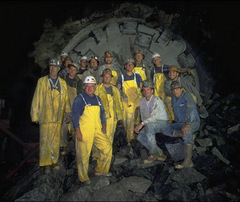
David McKillop, head of programming for The History Channel, set the stage for those in attendance…like, say, myself…who weren’t familiar with the Sandhogs and their long legacy.
“They were the guys that went down under the East River and dug in the currents and the sand to create the foundations that actually support the Brookly Bridge today,” explained McKillop. “Sandhogs are urban miners, construction workers, who generation after generation have literally dug at great personal risk to build and maintain one of the greatest cities in the world. The work is extremely hazardous. Sandhogs toil underneath the streets today, as they did more than 150 years ago. They built the two tunnels that provide water to New York City that were completed in late last century. They built every single subway, traffic tunnel, sewage line, and steam pipe. They’re digging the tunnel that’s going to link the Long Island Railroad to Grand Central Station, and they’re digging New York’s third water tunnel, which when completed will be the largest public works ever undertaken in U.S. history…and it’s all because of these guys. They’re a special breed, a special society, the identity and the subterranean culture they inhabit is a bond that is truly shared as a brotherhood, and few people know they even exist until now.”


