Category: New Media (Page 7 of 14)

Movie theaters begin removing listings from newspapers

paper

The newspaper industry has taken another hit as it was announced that Regal Entertainment Group and AMC Entertainment plan to gradually eliminate their show time listings from newspapers.

Looking to cut costs, the theater chains are instead directing consumers to their Internet sites or third-party sites, like Fandango, Moviefone or Flixster, which offer those listings for free and make money from the fees they charge for selling advance tickets to movies. Many of those sites also feature film reviews and movie trailers.

The effort may be gaining some traction, as U.S. Internet traffic to AMC’s Web site rose 21 percent in July compared with a year ago, according to comScore Inc., while visits to Regal’s Web site were up 18 percent.

“For a reader, some things that are ads are actually considered news,” said Mort Goldstrom, the NAA’s vice president of advertising. “Ads for concerts and things at clubs, for restaurants and movies – that’s a reason people read.”

He said the pullback in listings will hurt theaters by reducing their visibility among potential customers, sending those dollars to competitors that still buy listings or to other sources of entertainment like plays or clubs.

It’s hard to find concrete numbers on how much money newspapers actually make from movie theaters for their listings. It’s been obvious that something like this was going to happen. I can’t remember the last time I looked to the newspaper for movie times. Services such as Fandango, Moviefone, and Flixster don’t charge the theaters to run the times and these sites have become the common way to look up when a movie is playing. Thus, theaters don’t need this type of support from newspapers. Instead, they can use this money to advertise theaters deals and coupons through other mediums as well as newspapers. While this may not devastate the financial state of the Los Angeles Times or the Washington Post, local newspapers will surely feel the pinch.

Seems like newspapers are getting smaller and smaller, doesn’t it?

“Basterds” Redux

As John F. Kennedy used to say, “success has a thousand fathers and failure is an orphan.” One thing’s for sure, both generate a ton of ink.

* I’m still of two minds on this whole Twitter business in terms of whether or not it really speeds up what we used to call “word-of-mouth” on movies. It seems to me we’ve had texting for awhile now, though the proliferation of iPhone and other communication devices is a new factor and must be having an impact. Unlike texting, you don’t pay on a per-Tweet basis, so maybe. Steven Zeitchik, however, is more certain and guess which movie he thinks is the first to officially benefit. (If you haven’t already been spoiled at all on the not-ripped-from-the-history-books ending of “Inglourious Basterds, you might want to skip this one.)

* Tom O’Neil at “The Envelope” speculates on awards strategy for releasing “Basterds” now rather than closer to award season. To me, Weinstein’s decision to highlight the musical “Nine” over this seems more than self-evident. Assuming the film is not a complete turkey, that film’s Oscar chances should be better.

Quentin Tarantino‘s films are not Oscar-friendly. The older members of the Academy have traditionally leaned strongly towards a very traditional, essentially literary and middle-class, view of quality which is pretty much the antithesis of the Tarantino aesthetic. It’s only been through his widespread acclaim and a subtle loosening of old prejudices that his films have gotten the definitely limited Oscar recognition they have and, considering what some regard as a too lighthearted view of World War II horrors, I wouldn’t expect this one to be much different. Of course, with ten nomination slots for Best Picture, and the universal groundswell of acclaim for heretofore internationally unknown German actor Christoph Waltz, two or three nominations (including the semi-inevitable “Best Original Screenplay” nod) are almost a certainty.

If you want an example of the kind of old-school middle-brow snobbery that’s always stood in the way of Tarantino — and Alfred Hitchcock, Howard Hawks, Don Siegel, Sergio Leone, etc. before him —  Peter Bart provides it for you. Some commenters respond aptly.

* Paul Laster at Flavorwire has a revealing interview with production design husband-and-wife team David Wasco and Sandy Reynolds-Wasco about “Inglourious Basterds,” the Jack Rabbit Slim’s set from “Pulp Fiction,” and other films. Considering that they also work with Wes Anderson, these two are crucial collaborators with our most talented masters of movie stylization working, and the current heirs to people like the great Ken Adam, the production design genius of “Dr. Strangelove” and “Goldfinger,” among many others. (H/t David Hudson@Twitter…okay, so maybe there is a Twitter effect on filmgeeks.)

Now is the time at Premium Hollywood vin ve dance.

Warner Bros. and Turner Broadcasting ink deals with YouTube

YouTube

Warner Bros. and Turner Broadcasting are the latest to come to terms with YouTube, allowing the online video sensation to stream clips from their shows and movies.

The pact, done through the home entertainment and television divisions, is aimed at driving digital sales of Warner movies and TV shows online, the company said. Links on some WB shows already on the site point users directly to WBshop.com, where they can buy DVDs of what they’re watching.

Warner said it will offer clips of everything from CNN news programs to Cartoon Network shows and WB TV hit “Gossip Girl” on a number of different Warner-branded channels on the site.

I don’t understand why they only want to show clips. CBS, Sony Pictures, and Starz run complete episodes and movies on the site, which are supported by pop-up ads and brief commercials. That’s no reason to complain, obviously, as you’re getting the content free of charge. Perhaps they are being cautious, as production companies and networks are waiting for a data-tracking system that tallies television, cell phone, and Internet audiences. Warner Bros. and Turner can then gauge if the audience is large enough online and soon proceed to show full-length features and episodes.

HDTVs with an Internet connection

HD TV

As I stated earlier, it’s been evident for some time now that a large portion of television audiences are watching their favorite shows on the Internet. In response, a new wave of HDTVs are hitting the market that allows viewers to reach sites such as YouTube and Picasa, but also video-on-demand services from Netflix, Blockbuster, and Amazon.

So new is this feature that some electronics stores aren’t even aware of it yet. (A random check of stores around the country found retailers in New York and Los Angeles to be the least informed.) Yet Internet-enabled HDTVs are expected to quickly add an Internet wave for couch-based channel surfers. Market researcher the Yankee Group predicts 50 million people will have such setsby 2013.

Another 30 million, it says, will have Web-connected Blu Ray players — and 11 million will have purchased media adaptors, giving nearly 100 million people Web video on their TVs without hooking up a PC.

The sets will come pre-installed with targeted applications for specific websites, somewhat like iPhone apps.

The new technology also could add power to an advertiser’s message, with consumers able to click a link and instantly learn more about a product — and with ads being better targeted based on a person’s viewing and browsing history.

And while, like Hulu, no network or production house has signed with a manufacturer to put an app on new TVsets, it may not be long before programmers line up to get their apps included.

When it comes down to it, computers, TVs, and cell phones are quickly melding into the same device. They each continue to serve their primary functions: computers to access the Internet, TVs to watch shows and movies, and cell phones to make calls. Nevertheless, the goal for the manufacturers is to combine their products with multiple forms of media.

People have been able to access the Internet on their TVs in the past, but it was always in a primitive form and never took off. More importantly, streamlined applications weren’t available. Still, it’s interesting to note if this new and integrated content is better than what’s been available. I’ve just gotten used to having DVR on my cable box, and that works flawlessly. However, the idea of pulling up Hulu on my TV screen is enticing. A DVR box can only hold so much content, after all. Hulu contains hundreds of shows on their site. The customer who has HDTV with Internet is then provided with many more options. Pretty cool.

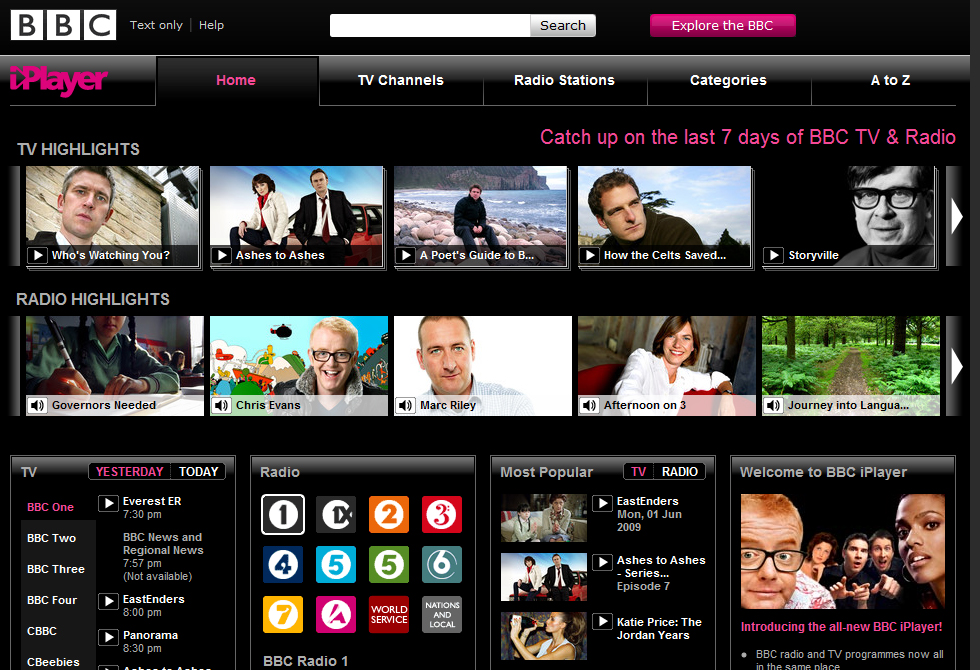
British TV companies reclaim their content on the Internet

BBC TV

A survey conducted by Deloitte and YouGov reveals that British TV fans are more likely to turn to a network’s site rather than YouTube or iTunes if they miss a show when it airs.

The survey said viewers’ awareness of broadcasters’ on-demand sites, such as the BBC’s U.K. iPlayer service, had overtaken that of both YouTube and iTunes at 84% compared with 76% and 64% respectively.

Deloitte’s media and telecoms partner James Bates said: “In an ironic twist to earlier expectations, broadcasters and independent producers may, in the medium-term, be those that benefit most from online television.

“Broadcasters may increasingly use online television to support their core, traditional objective of maximizing broadcast audience size and quality.”

Bates added that online video clips, distributed via TV companies’ own websites and third-party platforms, spark interest in broadcasters’ shows while catch-up services enable auds to keep up with programs they’ve missed.

This has long been evident in the United States, where networks started coming down on YouTube and other sites that were illegally hosting their programming. In a rather smart move, the major networks partnered to create Hulu, a site supported by commercials that allows viewers to watch their favorite shows on the Internet for free. It’s currently impossible to watch a full episode of an American show on YouTube and few fans want to pay the fee iTunes charges. When watching an episode for free on Hulu or the network’s webpage, the viewer only has to sit through about three minutes of commercials. I’m happy this is working out with Brtish TV fans. The networks just have to hope the writers don’t complain.

« Older posts Newer posts »

© 2023 Premium Hollywood

Theme by Anders NorenUp ↑