Category: Movie DVDs (Page 13 of 100)

A Chat with Bill Rebane (“Monster A Go-Go”)

Although the competition for the honor of being declared “The Worst Movie Ever Made” is one of the strongest in all of popular culture, there are some titles which continue to come up again and again. “Monster A Go-Go” is one of them…and, unlike “Plan 9 from Outer Space,” it’s a film so bad that even the man who directed it is willing to concede that it deserves to take home the win. Premium Hollywood had the opportunity to chat with Bill Rebane, who helmed “Monster A Go-Go,” upon the release of a special edition DVD, and even though 45 years have passed since the film’s original release, he still stands by his position on the matter.

Bill Rebane: Hello, Mr. Harris! How are you?

Bullz-Eye: I’m good! How are you?

BR: Hanging in there!

BE: (Laughs) Same here! Well, it’s a pleasure to speak with you. I actually just finished watching the special edition of “Monster A Go-Go” this morning.

BR: Oh, I feel so sorry for you…
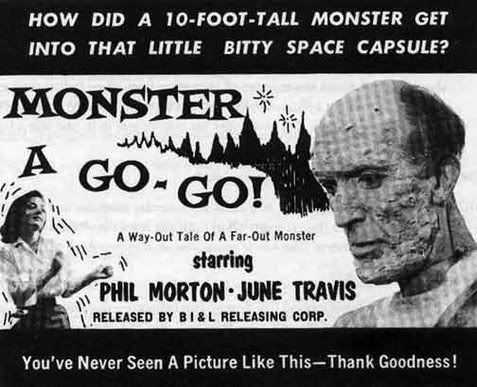
BE: (Laughs) Well, it’s funny: at first, I wasn’t sure how I was going to broach the subject of the film’s reputation, but throughout the special features, you pointedly say that it is the worst movie ever made.

BR: Well, that was my impression when I first saw it. Three years after I gave it to Herschel Lewis to finish, the first time I saw it, I said, “Oh, my God, this is the worst picture I’ve ever seen.” That’s not exactly what we had in mind when we started…

BE: So to jump to prior to “Monster A Go-Go,” how did you get into filmmaking in the first place? Were you a movie buff as a kid and worked your way into the business gradually?
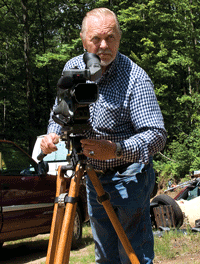
BR: Well, when I came to this country, I was obsessed with movies of that time, the old movies from Hollywood’s golden age, and I went to the theaters and spent maybe half a day…more than half a day…watching movies to learn English. I was a singer and dancer during that time. In fact, I actually started out wanting to make musicals. And then the occasion arose in Germany…I went back to Germany and worked with some filmmakers there, professionals, and learned a little bit, and came back to the States and started making short subjects.

BE: How did you make the move from short subjects to the feature-length?

BR: Well, it was timely. I was a realist. I was acutely aware of the marketplace, what was going, and it seemed very timely to do a science-fiction monster movie at that time for the drive-in theaters. We wrote a pretty cohesive script, a story-oriented project, and I dove into it. But I didn’t know that Chicago wouldn’t… (Hesitates) I made those short subjects with the union, and when they heard that I was making a feature film, they pretty much clamped down on me and said, “Yeah, you’re going to make it union, right?” I said, “Those were not my intentions.” And then they merrily went on to basically confiscate the whole budget, put it in Escrow, and they would take care of it. So we ended up with maybe two hours of good time of shooting, and the rest of it was spent on setting up heavy equipment. There wasn’t much of a break we got in those days. It’s not how independent pictures should be made to begin with. I lost the star, Peter Thompson, a week into production because of time constraints. And then I went on to a second part the same year, actually…1961, ’62…to do the rest of the picture with a non-union crew. And that’s how Herschel Lewis entered the picture. I hired him as a cameraman and a production manager, and we finished all the exteriors and everything that I thought we needed to do, except the actual final ending. We never got to that, which was about 10 minutes or 20 minutes of stuff, again running out of money. Herschel Lewis needed a picture for a double bill at drive-in theaters, and I turned the picture over to him for post-production, not knowing what he would do and what he could do. And about three years later, I looked at it. It was not the same title. It was now “Monster A Go-Go.” It had already run in some theaters in the South. And… (Starts to laugh) …I was more than surprised. I was a bit shocked. I said, “This has got to be the worst picture I’ve ever seen.”

Continue reading »

The Pirates of Penzance

It’s easy to see why this 1983 film version of the famed Joseph Papp production of the 1879 Gilbert and Sullivan comic opera has its fans. As the absurdly honorable orphan hero, Frederic, former teen idol Rex Smith is surprisingly funny and perfectly cast; rock star turned all-around diva Linda Ronstadt warbles tunefully as the lovely Mabel; the great Angela Lansbury as nursemaid-turned-pirate Ruth is, if not quite at a hilarious career high, close enough; and, in the role that made him a star, Kevin Kline is the ideal Pirate King, milking every ounce of cheerful self-regard out of a professional blackguard who is pretty much unable to harm a fly. However, there are big problems. Director Wilfred Leach had the right idea in filming this ultra-silly musical on a lavish, completely non-realistic set, but his staging lacks taste. He often pushes the comedy several steps too far, even resorting to speeding up the film at one point in an ill-advised homage to Mack Sennett’s Keystone Kops. The coup de gras, however, is actually delivered by something that’s very much of this film’s day — its synthesizer driven musical adaptation. The music of Arthur Sullivan is often on the borderline between huge listenability and complete preciousness. The insanely chirpy synths employed by conductor William Elliot and further denatured by Linda Ronstadt’s producer, Peter Asher, destroys the charm of Sullivan’s melodies, for me anyhow. Since “The Pirates of Penzance” is pretty much wall to wall music, that’s a problem.

Click to buy “The Pirates of Penzance”

Back to “Back to the Future”

It’s the 25th anniversary of the science fiction comedy from Robert Zemeckis and Bob Gale. As you might also expect, a 3-disc Blu-Ray set is also hitting stores today featuring the original film and it’s two-sequels.

So, to go with Will Harris’s interview with Gale which includes some more interesting casting details in addition to the ones you’ve probably already heard about, Universal has made available a series of short clips from yesterday’s press conference at New York’s Waldorf Hotel featuring a lot of the cast — Michael J. Fox, Christopher Lloyd, Lea Thompson, and Mary Steenburgen (from “Back to the Future 3”) but not Crispin Glover — as well as Gale and Zemeckis. A lot of them are very brief and I would have been happier if they’d edited it into one clip, but you take what you can get.

We’ve got a bunch of more these after the flip for you diehard “Future” fans.

Continue reading »

The Return of the Five Deadly Venoms

Don’t let the title fool you. While some of the actors from the earlier “Five Deadly Venoms” do indeed turn up in this bit of vintage 1978 Hong Kong action cinema from the Shaw Brothers — the Warner Brothers of Eastern exploitation cinema — this movie is not a sequel and was originally titled “Crippled Avengers,” which was more accurate but also a bit politically incorrect for the current market. I’m sure “Disabled Avengers” or “Differently Abled Avengers” didn’t have quite the same ring. Still, differently abled our heroes truly are as one by one they are wantonly dismembered, blinded, rendered deaf and dumb and, in one bit of impressive kung fu, deprived of roughly 50 IQ points. Naturally, working as a team, these avengers are able to overcome their disabilities for, really, the only good reason there is to overcome one’s disabilities — avenging! The action here doesn’t have quite the finesse and artistry of the Bruce Lee films or the great costume extravaganzas of the late 80s and early 90s, and director Chang Cheh allows the often comically melodramatic story to lose a lot of steam, but the action is consistently well staged and delivers the ass-kicking goods. The main bad guy — himself a disabled avenger of sorts — even sports some kung fu gadgetry that appears to have come out of the 19th century Chinese equivalent of Q branch.

Click to buy “The Return of the Five Deadly Venoms”

Beauty and the Beast: Diamond Edition

They have made many phenomenally successful movies since its release, but “Beauty and the Beast” remains Disney’s last true masterpiece. The combination of story, design, songbook, performance and technical achievement is unparalleled by any animated film of its time or since. The computer animation, a very dodgy art form in the early ’90s, still looks spectacular today. We’d challenge anyone to take modern-day equipment and a better-looking ballroom scene than the one here.

Disney’s Diamond Edition of the film is absolutely worth the upgrade, both for the hi-def transfer and the bushels of new extras. The audio commentary is held over from the original DVD release, but all-new interviews were shot for the featurettes, even roping in Jeffrey Katzenberg to go on the record. Alan Menken sits down at the piano with producer Don Hahn and discusses the origins of several of the movie’s songs, even admitting that the final music for “Be Our Guest” was a throwaway track for lyricist Howard Ashman to use as a base until he came up with a “real” track. Menken also includes his original score that he wrote just before Beast’s transformation, and the studio adds the original opening to the movie, a 20-minute (!) piece where Belle has a younger sister and a cat, and Gaston is a wig-wearing fop. It’s fascinating to watch in retrospect, because the studio was right to scrap this opening and start from scratch. There is also a pencil sketch version of “Be Our Guest,” as sung to Belle’s father. A fitting tribute to a truly game-changing film.

Click to buy “Beauty and the Beast: Diamond Edition”

« Older posts Newer posts »

© 2023 Premium Hollywood

Theme by Anders NorenUp ↑