Category: Interviews (Page 10 of 69)

A Chat with Lisa Cholodenko, director of “The Kids Are All Right”

Lisa Cholodenko isn’t a household name as writer/directors go, but that may change somewhat after her latest film, “The Kids Are All Right,” which was released smack in the middle of the summer, and came out on DVD and Blu-ray last week. The movie features three of our greatest actors – Annette Bening, Julianne Moore, and Mark Ruffalo – doing some of the most astute work of their careers. Expect the movie to snag some Oscar nominations for one or more of the trio, and if there’s any justice, Cholodenko and co-writer Stuart Blumberg will be nominated for Best Original Screenplay as well.

The movie is blisteringly funny while at the same time painfully honest. It tells the story of a lesbian couple (Bening and Moore) who’ve been together for 20 years and raised two children (played Mia Wasikowska and Josh Hutcherson) who are now at an age when they’re interested in meeting their sperm donor (Ruffalo). Human comedy ensues with unexpected results. “The Kids Are All Right” is one of the best movies of the year, and Cholodenko, whose previous films include “High Art” and “Laurel Canyon,” is a huge factor in its success. Now you might be thinking that a movie about two lesbians and their kids isn’t exactly what you’re looking for. If so, you’re exactly the person who should see this film, because it’ll change your ideas of what makes a family in this day and age. And it will make you laugh – loud and hard.

Cholodenko took some time out to talk to Bullz-Eye on the occasion of the film’s home video release and after some introductory chit-chat we discussed the lesbian right, gay porn, and new meanings for the word “tribe.”

lisa_cholodenko

Bullz-Eye: “The Kids are All Right” was like this oasis of reason in an ocean of CGI and fart jokes this past summer. Do you get frustrated when you look around see the types of movies that rake in the big bucks these days?

Lisa Cholodenko: I wish we would kind of go back to the time where there were more interesting, idiosyncratic human kinds of comedies and dramas, and not such the kind of broad and farcical, box office driven fare, but that’s where we are right now, so, I just accept it, and I’m glad that there’s space for films like this.

BE: Well, so am I. There was some fairly vocal criticism of the film from the most unlikely of places – the lesbian community. Where do you think that kind of outrage comes from and, outside of raising awareness for the film itself, does that kind of anger serve any worthwhile purpose for a thoughtful movie like this?

LC: I keep referring to them as the lesbian right (chuckling), and I think that in any kind of group there’s going to be a contingent of people that are more extreme in their views of things, and more politicized and so, I think there’s room for everybody, and I don’t have a problem with that. It’s gets a little tedious speaking to it – not to you – but when I’ve heard it in Q & A’s and stuff, but I’m sympathetic. There’ve obviously been no great representations of lesbians in cinema, or certainly there hasn’t been in a long time, and it’s kind of an old school doctrinaire, “Oh of course the lesbian goes off with a man.” But if you look at the film with any kind of care, it’s really not about that at all.

BE: No, no, it isn’t.

LC: She really goes off with her partner. So it gets a little knee-jerky and tedious for me, but I’m sympathetic that there’s no representation, and with starvation sometimes you get a lot of mixed feelings.

the_kids_are_all_right_1 Julianne Moore and Annette Bening

BE: Well, here’s a weird question, and you gotta help me out here, because it was the one thing in the whole movie that baffled me. Lesbian couples watching gay male porn to get in the mood. Is this common? Is this something that I’m just totally unaware of?

LC: You know, I don’t know because I’m not a social scientist. I just thought, you know, different strokes for different folks, and it’s always fascinating to find out what people do to turn it on. Stuart [Blumberg, co-writer of the movie] and I stumbled on that idea, and wrote a scene, and laughed and I said, “No, it’s too risqué,” and he said, “No it’s not. It’s funny. It’s great.”
Continue reading »

A roundtable chat with director Nigel Cole of “Made in Dagenham”

Nigel Cole is not the kind of director who becomes a hot topic on AICN with his action masterworks, nor is he the kind of helmer who makes cinephile hearts go aflutter with his unusual directing technique and highly idiosyncratic world view. That isn’t to say that Cole’s latest, “Made in Dagenham,” lacks a certain amount of flair. It’s style, however, takes a definite backseat to clever writing and consistently good, and sometimes remarkably outstanding, performances. Nothing at all wrong with that, especially in a world lacking in good movies about women, as well as movies you can, give or take a little British cursing, safely take Aunt Minnie or Uncle Irv to see. Indeed, even hardened cinephiles should appreciate this well-made and intelligent, if comfortably unambitious and deliberately crowd-pleasing, comedy based on a crucial but overlooked episode from late 20th century British history.

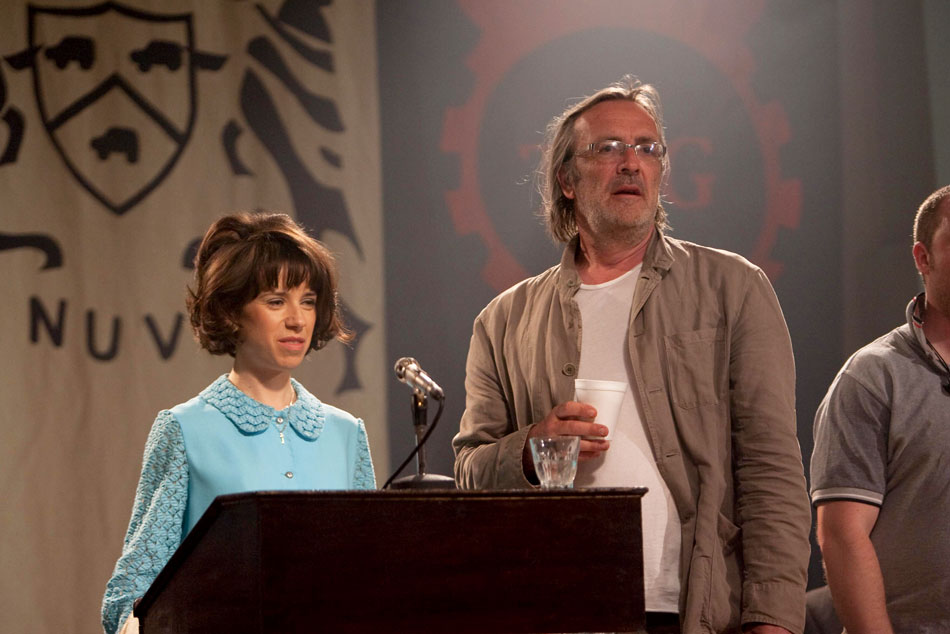
madeindagenham-23

Written by William Ivory and saddled with a ridiculous R-rating, “Dagenham” is the partially fictionalized story of how the entirely fictional Rita O’Grady (Sally Hawkins) moves from anonymous factory worker and devoted wife and mother to working full-time as a leader of what amounts to a nationwide labor movement. Bob Hoskins portrays an idealistic and goodhearted union leader who sets Rita on a path that at first has her leading the opposition to an unfair job classification for female textile workers at Ford Motors, and later has her deeply involved with a nationwide movement taking on the entire idea of paying men more than women simply because they are men.

Though supported by her loving but at times clueless husband (Daniel Mays), an extended strike creates inevitable strains. The story resolves itself as the affair gets the attention of real-life Labour Party legend, Barbara Castle (Miranda Richardson, in a typically biting and hilarious turn), the first woman to attain cabinet status in a British government. Along the way, subplots involve the troubled marriage of her older best friend (Geraldine James) and her chance encounter with the “enemy,” Rosamund Pike as a fellow mom at her son’s school who also happens to be married to a key member of Ford Management (Rupert Graves).

Previously best known for the art-house hit “Calendar Girls” and his first feature, “Saving Grace,” a comedy about an aging pot grower starring Brenda Blethyn and Craig Ferguson, Cole comes across like the down-to-earth bloke you might expect to be behind this kind of a film. Middle-aged and not particularly pretty, he introduced himself as Sally Hawkins, who we’d be meeting a bit later alongside Miranda Richardson, for another roundtable chat, getting the expected laugh from the table full of entertainment journalists.

Continue reading »

A roundtable chat with Sally Hawkins and Miranda Richardson of “Made in Dagenham”

As the press day began for director Nigel Cole and writer William Ivory’s amiable historical comedy, we assembled entertainment writers believed we’d be doing separate roundtable interviews with the film’s best known actresses. When Sally Hawkins and Miranda Richardson entered the room together to promote “Made in Dagenham,” about a 1968 strike by female workers at a Ford plant located in a grimy London suburb, however, it was easy to be a little overwhelmed. Either one of them is worthy of a Russian novel’s worth of questions and our time would be limited.

15

Like so many first-class English actors of her generation, Miranda Richardson is known for her ability to play all ends of the dramatic spectrum. In England, and certain geekier quarters of the U.S., she’s still extremely well known known for her work alongside Rowan Atkinson and Stephen Fry as “Queenie” (i.e. Queen Elizabeth I) and assorted other characters on Richard Curtis and Ben Elton’s historical cult-com, “Black Adder.” Younger geeks, however, might know her better as magical tabloid journalist Rita Skeeter in the Harry Potter films. On the more realistic end of the spectrum, she has also done magnificent work playing a ruthless IRA operative in “The Crying Game,” a maltreated housewife in an Oscar-nominated role in Louis Malle’s “Damage,” a widely praised turn in the Oscar-winning “The Hours,” and a widow investigating her husband’s death on AMC’s recently canceled suspense drama, “Rubicon.” On the other hand, she’s also portrayed the character of Mrs. Santa Claus opposite Paul Giamatti‘s Santa in “Fred Claus.” Despite some resemblance, both physically and in terms of talent, she is not part of the famed Redgrave acting dynasty and no relation to the late Natasha Richardson. She is, in fact, the only actor in her family, which perhaps makes her all the more impressive.

Although Sally Hawkins has appeared in some 34 movie and TV productions since 1999, she broke into the consciousness of most of her fans with her Golden Globe winning performance in Mike Leigh’s 2008 “Happy-Go-Lucky,” in which she dominated the film as a relentlessly happy and, strangely enough, rather bright, elementary school teacher. It was probably an ideal role for a woman who really does come across as cheerful in person, with an approachable demeanor that certainly seems to fit the child of two children’s books authors. Currently starring on Broadway in a new production of George Bernard Shaw’s “Mrs. Warren’s Profession,” Hawkins has continued to mix starring roles with a number of smaller supporting appearances, including a turn in Cary Fukunaga’s highly-anticipated new version of “Jane Eyre.” Her next leading role is as Irish radical politician and activist Bernadette Devlin in “The Roaring Girl” — assuming the real Devlin is not successful in her efforts to prevent the film from being made.

Continue reading »

A Chat with director Patrick Hughes and actor Ryan Kwanten of “Red Hill”

First-time feature directors — especially when they’re essentially financing their films — tend to make low-key stories without much in the way of action. Often, they are offbeat romances or perhaps something about a bunch of guys in their teens or late twenties avoiding the responsibilities of adulthood. Directors who emerge from the world of commercials often wind-up making movies that rely on flashy visuals and employ the worst kind of ADHD editorial approach. To his everlasting credit, Patrick Hughes, a first-time self-financing feature director with a background in commercials, did none of those things in his first feature, “Red Hill,” an often violent suspense tale with elements of classic westerns, monster films, and a strong sense of its Australian heritage.

Its star, Ryan Kwanten, is by far best known as Jason Stackhouse of “True Blood,” an occasionally likable dim-bulb of a character who would pretty much be nothing if it weren’t for his athletic good looks and sexual prowess. But Kwanten as an actor is certainly no mere boy-toy, even if he remains a favorite of young female fans and looks about a decade younger than his actual age (he’ll be 34 later this month). As the rather archly named Shane Cooper, the earnest, violence-averse policeman hero of “Red Hill,” he must be believable dealing with the rampage of revenge waged by an Aboriginal escaped convict (Tommy Lewis) while protecting his loving and pregnant wife (Claire van der Boom), dealing with the barbs of his taskmaster of a new boss (Steve Bisley), and spending a good chunk of the movie marinating in his own blood and believably fighting on. If that isn’t proof that Kwanten is, you know, a real actor, his next non-“True Blood” role appears to be as Charles Manson.

I met with voluble writer-director Hughes and actor Kwanten – who, as befits this film’s low budget provenance, come across as remarkably down-to-earth in person – during a press day held at Strand Releasing’s east Culver City office. A short time later, Kwanten would be chatting telephonically for a solo interview with my colleague, Will Harris, who’d be concentrating on his career, definitely including “True Blood.” No prima dona, and you’ll see just what I mean by that later in the interview, he was fine with surrendering some of the spotlight to director Hughes, who kind of dominates the discussion during the first half of this interview. However, do not fear, Kwantenites: we do hear from the very talented actor starting just past this interview’s halfway point, as he discusses crucial matters of blood, guts, and pig poo.

01._Ryan_Kwanten

Continue reading »

A chat with Greg Nicotero, make-up and effects wizard of “The Walking Dead”

000_TWD_20100608_6405

With 124 make-up credits and 64 effects credits to his name so far, Greg Nicotero is one of the busiest and most respected make-up and effects professionals in Hollywood. Originally inspired to take up special effects after seeing “Jaws,” he broke into the business working for the legendary gore-effects maestro Tom Savini on zombie-master George Romero’s 1985 splatter opus, “Day of the Dead. ”

A few years later, Nicotero had decamped from Romero’s Pittsburgh’s to show-biz’s Los Angeles and formed the multi-award winning KNB Efx Group with friends Robert Kurtzman and Howard Berger. Aside from his intimate involvement in such effects heavy films as “Sin City,” “Kill Bill,” “Minority Report,” “Serenity,” “Spiderman 3” and, yes, “Ray,” Nicotero has also branched out into directing, helming the second unit on Frank Darabont’s “The Mist” and making his own short subject, a funny and endearing homage to several generations of classic movie monsters, “United Monster Talent Agency.”

When I met with Nicotero and last Summer’s Comic-Con, however, it was to promote the already highly buzzed new AMC series, “The Walking Dead,” which reunites Nicotero with writer-director Darabont in an adaptation of Robert Kirkman’s Eisner Award-winning comic book series. Premiering Halloween night, the show will be taking a more dramatic look at the cannibal zombie mythos originally created by George Romero in his 1968 “Night of the Living Dead,” combining slow-moving zombies with the kind of in-depth characterization and complex yarn-spinning that’s making the onetime “vast wasteland” of television into something more like the last refuge of classical storytelling.

There’s only one problem. I’m kind of scared to actually watch the thing. You see, much as I admire the craft of someone like Greg Nicotero, I’m not exactly the usual gorehound media-fan for whom the more, and more realistic, cinematic gore he can create, the better. There was no point in hiding it.

zombie_retouched

Continue reading »

« Older posts Newer posts »

© 2026 Premium Hollywood

Theme by Anders NorenUp ↑