The film adaptation of Maurice Sendak’s beloved children’s book, “Where the Wild Things Are,” has endured a difficult road on the way to the big screen, including reshoots and even rumors that Warner Bros. would be replacing Spike Jonze as director. Now that the movie has a firm release date, however, it looks as if we’ll finally get to see it after all. The first trailer made it’s debut on “Ellen” earlier today, and well, I think it speaks for itself. Check out the preview below and let us know what you think.
Category: External Movies (Page 271 of 336)

The second collection of past Criterion releases – stripped of their DVD extras (and more than half their cost) – presents an even better, more accessible collection of films from the cinephile-sanctified vaults of legendary distributor Janus Films than the prior volume. This boxed set (the titles are also sold separately) is highlighted by three of the most entertaining and emotionally open films by three of the mid-20th century’s most revered filmmaking powerhouses: François Truffaut’s innovative 1959 coming-of-age drama, “The 400 Blows”, starring a 14-year-old Jean-Pierre Léaud, set the pattern for the genre worldwide, while also launching France’s iconoclastic New Wave of the 1960s; Akira Kurosawa’s 1952 “Ikiru” is a deeply moving and gently humorous film about a milquetoast bureaucrat (Takashi Shimura, the fish-faced badass leader of “The Seven Samurai”) facing certain death from stomach cancer without benefit of a billionaire buddy or bucket list; and 1954’s “La Strada” is a wondrous surefire tearjerker by the great Federico Fellini and starring his wife, the even greater Giulietta Masina, as a Chaplinesque waif, and America’s own Anthony Quinn as a very mean muscleman. England’s 1944 “The Life and Death of Colonel Blimp,” starring Roger Livesay and Anton Walbrook – two great actors, too little remembered – and featuring an astonishing film debut by gorgeous 24-year-old A-lister-to-be, Deborah Kerr, is from the still-not-legendary-enough team of Michael Powell and Emeric Pressburger. It’s one of the most enjoyable comedy-dramas ever made, as well as an eye-opening, Technicolor, quasi-wartime propaganda epic, and my current unofficial “all-time favorite movie,” if you really want me to name one.
Definitely worthwhile, but not anyway near the same category, is another British entry, George Bernard Shaw’s “Pygmalion.” Co-directed by star Leslie Howard (“Gone with the Wind”) and stage-to-screen specialist Anthony Asquith, and with Wendy Hiller as the definitive Eliza Doolittle, it’s a solid but sometimes slow adaptation of the Shaw play, which you may know as “My Fair Lady,” but without the music or sentiment, or “Pretty Woman,” but without hookers and with actual wit. Finally, we have 1959’s “Black Orpheus”, Marcel Camus’ retelling of the myth of Orpheus, samba style. It’s a beautiful but slow ride that has millions of fans – just not me. All in all, there’s no faulting this collection. However, the absence of DVD extras makes a strong case for curious viewers to simply join Netflix and rent the original Criterion releases, great bonus features and all.
Welcome to a new feature here on Premium Hollywood…and, believe me, it’s one I’ve been wanting to premiere for quite some time. I’m someone who enjoys trying new foods and new beverages, and I’ve often thought it would be fun to write a column which gave me the opportunity to write about the experience. Unfortunately, I’m forever buried in DVDs that need to be reviewed. Finally, I had an epiphany: why don’t I figure out a way to combine the two?
And, thus, “Concession Stand” was born.
The beverage: Mountain Dew Voltage.
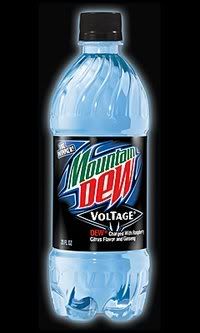
Last year, over a quarter million votes helped Voltage win the so-called “DEWmocracy” election, with the taste, name and color of the product all developed by the customers themselves…well, y’know, with a little help from the folks at PepsiCo. (What, like they’re gonna give the yokels all the power?) As the bottle proudly trumpets, it’s your standard Dew brew, but charged with raspberry citrus flavor and ginseng. The color of the beverage is a slightly disconcerting shade of blue, but the raspberry mixes with the traditional Dew flavor rather well, making the taste not so far removed from a Sweet Tart. If it’s icy cold, it goes down fast and smooth…which is good, since it’s so sweet that drinking it slowly may result in you taking awhile to finish the bottle, but caffeine fiends with a sweet tooth will have no problem chugging it down to score the inevitable rush.
When I was pitched the opportunity to check out Voltage, they sent me three bottles of the stuff, so I scoured my to-be-reviewed pile to see if I had three DVDs featuring the same person in some role or other. Lo and behold, I did…and that person’s name was Lea Thompson.
 A few hundred movie fans got a sneak peek at 22 minutes the upcoming Sacha Baron Cohen comedy “Bruno” at the South by Southwest film festival. Baron Cohen’s Bruno character is a “flamboyantly gay Austrian fashion correspondent hoping to make it big in Hollywood,” and he’s just as crazy and provocative as his now-famous Borat character.
In the first bit of footage, Bruno has decided to achieve celebrity by adopting a black baby, and wants to feature the child in an avant-garde performance art project. (“Ich bin pushing the limits,” he explains in broken German.) He interviews several mothers and fathers to determine whether their children would be suitable to play guest stars, and his questions grow increasingly absurd: Are they afraid of stuffed animals? Reptiles? Hornets? Would they be OK with being dropped off a four-story building, or willing to have liposuction? Regardless of the request, the parents categorically say “yes.”
Part two, which was shot just north of Dallas, finds Bruno appearing on a Jerry Springer-style talk show in leather pants, looking for Mr. Right. Members of the predominantly black studio audience are appalled by his in-your-face homosexuality, and they get even angrier when he brings out his adopted baby and shows them a self-consciously artsy photograph of the child posing as Jesus on a cross. Although it appears there are a few plants in the crowd to ask the right questions, the majority of them seem genuinely disgusted as they storm out.
Finally, Bruno decides to reinvent himself by going hetero and changing his name to “Straight Dave.” Dressed like Ted Nugent in camouflage, long hair and a scruffy beard, he stages a mixed-martial arts contest, which was shot last summer in Arkansas. When Bruno’s ex-boyfriend crawls into the ring and the two start making out, stripping and rubbing all over each other, spectators in the conservative crowd holler, make anti-gay slurs and throw plastic cups of beer at them. They end up storming out, too.
I think he has another smash hit on his hands.

With a share of General Motors running just a bit above the price of a single Hot Wheels car, this seems like an opportune time to catch-up with this surprisingly upbeat 2006 documentary covering perhaps the worst single piece of corporate strategy in business history. Directed by first-timer Chris Paine, with assists from big-time executive producer Dean Devlin and super-documentarian Alex Gibney, “Who Killed the Electric Car?” starts off as an earnest, L.A.-centric, paean to the efforts of activist drivers to fight GM’s very literal trashing of the all-electric EV-1 — launched in 1996 on a lease-only arrangement after California emissions rules forced auto companies to explore non-polluting vehicles. After spending time with such once-satisfied EV-1 customers as actors Mel Gibson, Tom Hanks, Peter Horton, Alexandra Paul, and comedienne Phyllis Diller, the film switches gears to becomes a far more interesting industrial whodunit, examining the corporate and the political forces that led to the car’s passive-aggressive treatment by GM.

Conservatives will likely be irked that the Bush Administration and the oil companies figure prominently as suspects, and will also note that the film is narrated by well-known lefty Martin Sheen. Nevertheless, Paine’s film takes a healthily bipartisan approach and includes neoconservatives James Woolsey and Franklin Gaffney making the national security case for electric autos. The very bad news is that the resistance of GM to its own best technology may have played a huge roll in the near destruction of the company and, along with it, the U.S. and world economy. On the other hand, the electric car may be due for a resurrection – director Chris Paine is working on a sequel.
FOLLOW US!


CATEGORIES
© 2026 Premium Hollywood
Theme by Anders Noren — Up ↑