Category: Documentaries (Page 41 of 43)

Scare of the Day: “The Fly Collection”

Halloween is the time of year when studios decide to empty their vaults of everything even remotely frightening and foist it upon a public who enjoys being scared. As I mentioned yesterday, the quality of the material ranges from legitimately good to downright excruciating, and as the years go on, we’re also finding the market flooded with the same material simply being reissued and re-reissued and rere-reissued. Once in awhile, though, you get handed a film that’s either never been on DVD before or is almost impossible to find anymore, and that’s the case for 1/3 of Fox’s brand new set, “The Fly Collection,” which rounds up the fondly-remembered first two films in the saga of the Delambre family – “The Fly” and “Return of The Fly” – then also resurrects the oft-forgotten 3rd film, 1965’s “The Curse of the Fly.”


David Cronenberg’s 1986 remake of the original film was actually a successful modernization of the tale of a scientist whose attempts to master the technology of teleportation go awry when his DNA is accidentally melded with that of a common housefly. Unfortunately, the special effects of a ’50s film obviously can’t compete with those of an ’80s film (especially not one made for the kind of budget that Cronenberg had to work with), so a lot of people tend to dismiss the original “Fly” because, oh, well, the guy’s got a big, fake-looking fly head.

Don’t be one of those people.

In fact, Kurt Neumann’s 1958 adaptation of the George Langelaan short story worked remarkably well for its era, with Neumann wisely choosing to avoid showing the aforementioned fly head for as long as possible…and, even when we do see it, it’s not the almost-cartoonish creature that you see on the cover of the DVD set, which is actually a shot from “Return of The Fly.” The head of the creature in “The Fly” actually looks comparatively realistic, and because of the emotional build-up to the reveal, we actually find ourselves not focusing on it nearly as much as we otherwise might have. “The Fly” is very much a tale like “The Phantom of the Opera,” with scientist Andre Delambre (Al Hedison) accidentally fusing himself with the fly in the process of testing his own invention, then pleading for his wife, Helene (Patricia Owens), to assist him in finding the other half of his experiment – the fly with a human head and hand, of course – before his brain gives in to the fly side of his being. Naturally, she’s horrified by his appearance, which he hides from her for the majority of the film, but even once she’s seen how he now looks, the bond of love between them proves stronger, which is why she finally agrees to his request to kill him and destroy both his head and hand beneath a metal press (yikes!) so that no-one will know what’s happened. Inevitably, we do see the fly with a human’s head and hand, and although the special effects may be laughable by today’s standards, the horrific, high-pitched shrieking of the creature as it’s being eaten by a spider – “Help meeeeeeeeeee!” – is still creepy stuff in 2007.
Continue reading »

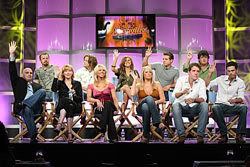
TCA Press Tour: Why Mike Farley isn’t a cast member on “Nashville,” I’ll never know…

Here’s how they introduced Fox’s new docu-soap, “Nashville”: “A high-stakes drama, it features an attractive cast of dreamers and dream makers in Nashville, Tennessee. The unique new series follows a vibrant group of young people as their hopes, lives, and loves unfold in a town that can make or break you.”

Wow.

I don’t care.

Okay, no, sorry, I guess I do. Or, at least, as a music fan, I guess I’m supposed to, anyway. The thing is…and I think the man referenced in the subject line of this posting would agree…that no matter how this series pans out, it’s not gonna be anywhere close to the reality of what it’s like to be a struggling musician. I mean, just about everyone on the panel for this show was pretty. And by that, I mean that you know someone at Fox determined at some point how unattractive was too unattractive, and that the music you’re gonna hear is gonna be about as mainstream as humanly possible. And because of these factors, I just don’t see what this show is going to offer me that I can’t experience vicariously by talking to, say, Mike Farley. Or, for that matter, about 3/4 of the bands who are my friends on MySpace.

Still, I’ll give credit to contestant (or whatever they’re calling them) Jamey Johnson, who, when the panel was asked if they’d seen the film “The Thing Called Love” and how accurate it was, replied, “That movie was pretty authentic. I think it had a great plot to it, but by and large, you just don’t move to Nashville and get everything handed to you. You’ve got to work for it, you know. I think that movie kind of depicted that, but it didn’t really show how long it takes. I know guys that have been in town for seven or eight years and they’re just now getting their first song cut.”

Yeah, but why do I suspect that this show won’t take nearly that long before every member of its cast ends up with a record deal?

Sorry, I don’t really have a lot to say about this show that’s particularly complimentary, I realize. I mean, I’ll check it out and see how the first episode plays, but I’m going in with the reasonable presumption that it will in no way live up to the actual reality of the life of struggling musicians in Nashville…and I’m betting I’ll be right.

TCA Press Tour: History – Fact and Fiction-ish

The next two panels of Sunday were both historical in a way: The History Channel brought us “1968 with Tom Brokaw,” with the former NBC anchor popping in only for the duration of the panel (he had a flight to catch), while AMC brought us the retro stylings of their new ’60s-set drama about the advertising world, “Mad Men.”

First up, Mr. Brokaw:

Brokaw began with a laugh, offering the anecdote that, when he first mentioned to Garry Trudeau that he was planning to do a special on 1968, the “Doonesbury” cartoonist responded, “What are you going to call this, the worst generation?” As it happens, however, Brokaw doesn’t even remotely feel that way about ’68.

“I think that journalists should write about what they experience, what moves them,” explains Brokaw. “’68 — the 1960s — the book is really about the ’60s. ’68 is the nerve center of the ’60s. It’s been an emotional experience for me because I’ve had to review my own life in the course of all this and think about the changes that I’ve gone through. And you have to remember that I arrived in California, working for NBC in 1966, just four years off the Great Plains, working-class family in small towns, a real product of the ’50s, thinking here I am in California, which is on the cutting edge of change, having no idea about how much more change was to come — good, bad, tragic, and triumphant. It’s been tough. This is a big subject. And I want to caution all of you that neither this two-hour special that we do on History nor my book will be the defining history of the ’60s, because we’re still in passage from that time. I am treating this as a virtual reunion, the people who went through it, what they thought then, what they think now. You’ll hear lot of voices. Unfortunately, this is one of those times in American life when everyone has their own prism, and they think what they saw, what they experienced, is the defining experience.”

When it comes to defining the most important historical event of ’68, Brokaw is darkly philosophical, suggesting that it’s the mere fact that we survived at all. “I don’t say that lightly,” he assures us. “This country was up for grabs in many ways. We had this war going on, with kids in the street, marching in Washington, National Guardsmen that you saw there in gas masks, facing them down, that we came out of Chicago where was a breakdown in the streets, and that we were able to have elections, and that people were able to accept the results of those elections, and Richard Nixon was inaugurated, and a lot of the country was unhappy, but a lot of the country had voted for him. And those who had not voted for him, had voted for George Wallace. People forget what a factor George Wallace was in that election. For me, at the time, there were two big lessons. One was how quickly it can change, the fundamental assumptions that we have about society and our government. And then, two, the resilience of the American people. ’68 was the beginning of the — profound distress of the American government, and we’re still working our way through that. That was accelerated by Watergate, but ’68 had a lot to do with it.”

(The folks at The History Channel also had a panel for a new series called “The Human Weapon.” I didn’t stick around for it, but here’s the description of the show: “Human Weapon” follows host Jason Chambers, a top-fighting welterweight champion and Bill Duff, a former professional football player and wrestler, on a remarkable worldwide journey. Over the course of their travel, they reveal the history behind the time-honored tradition of hand-to-hand combat arts. Jason and Bill verse themselves in these fighting cultures, grueling and punishing, to prove that they are worthy by going face-to-face in the ultimate test of their skills. I know, as a guy, I’m supposed to go, “Fuckin’ A!” But it just makes me shrug. Sorry.)

Continue reading »

TCA Press Tour: BET = Best Entertainment Today

“Today,” of course, was actually Sunday, because, shockingly, I’m behind again. Ah, these things happen. At the least information’s continuing to come in at a relatively rapid clip.

I know I said the Dallas Cowboy Cheerleaders were inevitably going to go down as one of the most entertaining panel openings of the trip, and I stand by that statement…but, having said that, the beginning of BET’s luncheon wasn’t half-bad, either. The network provided a full gospel choir to sing us through our salad, then began the panels just as we were working our way through lunch. I couldn’t really tell how many others in the audience dug the music, but, at least for me, it was a case where the choir’s enthusiasm was downright infectious. The panels were introduced by Reginald Hudlin, who you probably know for his directing of “House Party” and Eddie Murphy’s “Boomerang.” Me, however, I’m kicking myself that I didn’t corner him to ask him when he’s gonna write a script for a “Black Panther” movie. Maybe I can get someone from BET to let me talk to him on the phone long enough to get that answer out of him…

But I digress. There were two panels on the BET plate: “BUFU,” an animated sketch comedy show from the minds of Orlando Jones (“Mad TV”) and Ali Leroi (“Everybody Hates Chris”). Now, personally, I love “Everybody Hates Chris,” and I’ve always thought that Orlando Jones was consistently funny, so I’m very psyched to check this out…especially since the clips were hilarious, particularly the one where they mercilessly mock Tyra Banks’ big forehead.

“I’m not saying anything that Tyra, herself, has not said,” swears Jones. “So we are not introducing the notion that Tyra has a big forehead to anybody. She’s said it. She said it to me. She said it on air. So, ultimately, we are just sort of picking up where she left off and taking the joke to the next level as opposed to the statement of fact, which is her going, ‘You know, I’m a model, but I have a big forehead, unlike the rest of you,’ which was essentially her comment. And we are at the next level, but I don’t consider her in any way a target.”

Other things you’ll see:

* “Is Bryant Gumbel street enough?”
* A sketch about Rev. Al Sharpton
* A “devastatingly funny” bit featuring Barack Obama and his hand puppet, Bam. “(He’s) kind of Barack’s alter ego,” explains Leroi, “who will not say things that are respectful and decent. Barack has to go, ‘Don’t say that, man.'”

There is not, however, a bit on Oprah. Why not? “We are afraid of Oprah,” admits Jones. “But we do have a bit on Gayle King, because we are not afraid of Gayle King.” (“That,” adds Leroi, “is the bit.”)

Still, this begged the question, “Why are you afraid of Oprah?” Leroi began to answer the question, throwing out things like her infinite supply of money and power, and started to indicate that, basically, she could make them disappear if she wanted…but Jones immediately shushed him. “Say nothing,” he ordered, telling the reporter, simply, “We are afraid of Oprah because we are afraid of Oprah.” (He then looked around in a panic before moving on to take the next question.)

Continue reading »

« Older posts Newer posts »

© 2026 Premium Hollywood

Theme by Anders NorenUp ↑