Category: Actresses (Page 143 of 258)

TCA Tour, Jan. 2009: “Masterpiece Classic: The Incomplete Dickens”

Charles Dickens is one of those authors whose works manage to be both a part of popular culture while still proving highly threatening to students everywhere. You could probably reel off a list of the man’s works with precious little effort, but – and maybe this is just me here – I still get a chill and a nasty flashback when someone asks me, “Have you read ‘David Copperfield’?” That’s probably why, even at the age of 38, I’d still prefer to watch an adaptation of one of Dickens’ novels rather than actually read one of them. (I know. I’m a philistine. But I’m comfortable with it.)

PBS, of course, has never been afraid to take the work of Dickens and transform it into a major production, so it’s no surprise to find that they’re to be airing three such adaptations – “Oliver Twist,” “Little Dorrit,” and “The Old Curiosity Shop” – as part of what’s being called “The Incomplete Dickens.”

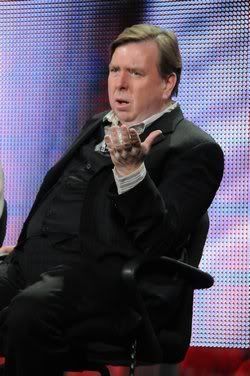
When you look at Timothy Spall, known to “Harry Potter” fans around the world as the man who plays Peter Pettigrew, you have to admit: the guy was born to play Fagin in “Oliver Twist.” And when you see his performance, you’ll be hard pressed to avoid using the word “creepy” when describing him.

That might sound like an insult, but let’s call it more of a left-handed compliment, shall we? Besides, it’s not like Spall isn’t aware of a recurring thread amongst many of the characters he has played.

“They’re sort of all repulsive,” he admitted. “They are somewhat divine, and they are repulsive, aren’t they? Looking at what I do and standing the way I stand and acting the way I do, I’ve always thought it’s part of my job to give people who are undesirable a really good crack at the game. And then I laugh at trying to turn the tables on characters that are perceived as being pariahs or outcasts or repulsive or repugnant in some way and make you realize that even the most reprehensible and undesirables of characters are human beings. If I get a chance, I try to give it a go and make you feel bad about hating them as well.”

He’s amused, however, by how much one of the smallest parts he’s ever played – Peter Pettigrew – is the one that has become one of his signature roles.

Continue reading »

TCA Tour, Jan. 2009: “Make ‘Em Laugh: The Funny Business of America”

Dying is easy, and comedy is hard, but if you really want hard, try putting together a six-hour documentary about comedy in motion pictures and on television without having someone complain about what’s been left out. Can’t be done…and hasn’t been done, if I’m to be perfectly honest. There’s just too much comedy out there. But with that said, PBS’s effort, “Make ‘Em Laugh: The Funny Business of Comedy,” is a damned good attempt at accomplishing the feat, and more importantly, the show’s executive producer, Michael Kantor, is fully willing to concede the impossibility of covering everything.

“Max Welk, who was one of our consultants, is maybe 90 years old, kept saying the two funniest people he ever saw were Jack Benny, who could walk on stage and say nothing and an audience would laugh, and Wheeler and Woosley,” said Kantor. “Jeff Abraham lobbied for the Ritz Brothers. So it was very difficult. Rather than tell the kind of…not standard story, but natural story of, okay, here were the different studios that sprang up and we’ll march chronologically through the silent film era, we decided that a comedy series needs to be surprising and the audience, the viewer, would enjoy it more if they were a little taken aback by the next story, perhaps Paul Lynde following Redd Foxx. It’s surprising, ‘Well, where are we going?’ So we tried to hue to the framework that way rather than comparing, you know, Charley Chase with Harold Lloyd with Buster Keaton. I almost interviewed Rudy Ray Moore, who lived — just died, actually — lived in Vegas. He created Dolemite. And I kept thinking, ‘God, this is an amazing story. It deserves its own AMERICAN MASTER special.’ But it kind of didn’t fit into the six different episodes we created.”

As for the narrator of “Make ‘Em Laugh,” Amy Sedaris made a point of noting that Buddy Hackett didn’t end up making the final cut, either. (There is, however, a quick cut to a shot of Jerri Blank, from “Strangers with Candy,” which made her happy.) Kantor seemed apologetic about the omission, but he explained, “The goal was, once, with a team of consultants, we’d figured out that these six categories or archetypes or – call them what you want — genres that reflected different aspects of American culture were the ones we were sticking with, we wanted to tell the best story we could. And that’s why poor Buddy Hackett didn’t make it.”

Kantor said it was also an issue when it came to trying to figure out what classic clips would fit into the proceedings without feeling shoehorned in.

“There were a couple of sitcoms that we really wanted to include, but we just didn’t have time for,” he said. “One was ‘The Odd Couple.’ We reference it in passing. You see someone talk about it and yet it seemed to so clearly speak to a moment in time where divorces were happening in America and yet we couldn’t give it as much weight, as maybe if we had 72 minutes in an hour, we would have wanted. And Richard Pryor had the ill-fated ‘Richard Pryor Show,’ he only did four of five episodes, and he does this great speech where he’s a black President,” said Kantor. “And it felt like, ‘Boy, wouldn’t that be interesting to sneak in?’ Robin Williams is standing in the back. But that wasn’t for cost or any other reason. It was just the arc of the Richard Pryor story; it didn’t hold. My job as a documentary filmmaker is how to tell the best overall story. Maybe like a baseball manager: you might have a great hitter, but he doesn’t fit in perfectly, so you’ve got to trade him.”

Despite Buddy’s omission, Sedaris enjoyed working on the special and acknowledged that it proved to be an educational experience for her.

“I was never a big Charlie Chaplin fan – I liked Buster Keaton – and it made me appreciate him a little bit more,” she said. “Phyllis Diller, I loved. She made her own clothes, dragged her kids along with her. She really magnified the fact she was unattractive, and I love that. And Mae West. I was never a big fan of Mae West, but I didn’t realize she wrote all that stuff, and I didn’t know about all the problems that she had. And that made me appreciate her. And Jonathan Winters, I love that whole section because he…it seemed like he had a mental disorder and yet embraced it, because his humor came from his characters, and that’s what I always find funny: the characters.”

“Make ‘Em Laugh: The Funny Business of America” begins airing on January 14th and continues on Jan. 21 and 28.
TCA Tour, Jan. ’09: “Great Performances: King Lear”

I wouldn’t want to dismiss several generations of Shakespearean actors with a single statement, so let me see if I can phrase this just right: we’re getting to a point where it just doesn’t feel like there are as many greats as there used to be. That’s not to say that there aren’t greats, of course, but…well, surely you know what I mean. Olivier, Gielgud, Richardson…all are gone, and for all the talents that have arisen in the intervening years, few are quite as immediately associated with the Bard in the same way, where you hear their name and immediately say, “Oh, yes, of course, he’s the Shakespearean actor.”

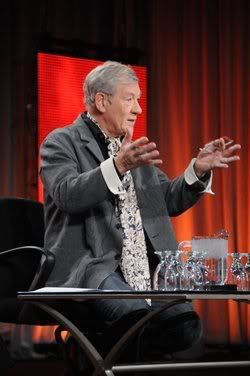
With that said, however, it’s fair to say that Sir Ian McKellen falls into the category of those who, despite roles ranging from Gandalf and Magneto to James Whale and Kurt Dussander, is still very much recognized as a Shakespearean actor. Granted, the reputation is probably significantly greater in the UK, where he’s done television productions where he’s played the title roles in “Hamlet,” “Macbeth,” and “Richard III,” as well as Iago in “Othello,” but after his unique cinematic interpretation of “Richard III,” in which he co-starred with Robert Downey, Jr., and Annette Bening, even Americans began to associate him with Shakespeare.

As such, the idea of seeing McKellen appearing as King Lear in an upcoming “Great Performances” production is one that intrigues me considerably, particularly after experiencing his enthusiasm for the play firsthand.

“King Lear” has fascinated McKellen throughout his acting career, particularly because of the wide variety of ages amongst its characters. “As a young man, I was very intrigued by the part of Edgar, which I played,” he said. “And there are a lot of young people in ‘King Lear’ that a young audience could identify with, good and bad. Then there are a lot of good middle-aged characters. But what’s perhaps special about ‘King Lear,’ as opposed to a ‘Hamlet,’ is that the central part is for an old person. And so if, like me, you’ve worked your way through Shakespeare as an actor, you know, waiting up there is ‘King Lear’ and, beyond him, a shadowy Prospero, maybe and, oh, dear, a Falstaff too.

“I’ve been in the play twice before as Edgar and as Kent. I’d seen what it cost the person — the
actors playing King Lear: Brian Cox, on one occasion, giving his all a hundred percent every night and discovering in himself depths and heights that he hasn’t necessarily had to use in any other part. And the late Robert Addison played King Lear, when I played Edgar, in his mid-60s and frail at the end of the evening because the performance had taken so much out of him. So I suppose it’s the challenge. It’s the expectation that it will complete your journey through Shakespeare.”

With that said, however, McKellen admitted that he hadn’t actually been spending his career with a burning desire to play the role of King Lear.

Continue reading »

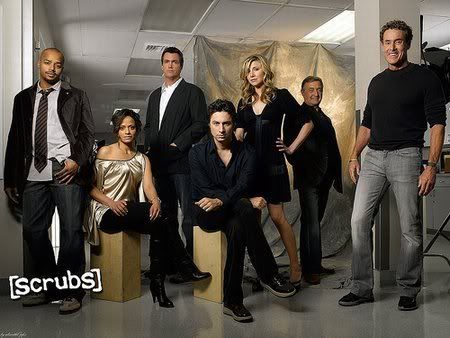
Old Show, New Season: “Scrubs”

Q. Is “Scrubs” funny?
A. It’s a matter of opinion. If you ask Peter Griffin, the answer is “no.” (“You ever watch that show ‘Scrubs’? Lois had it on the other night, and I was kinda fading in and out, you know. I was watching and wondering: which one is the funny guy?”) Personally, though, it’s one of my favorite sitcoms, with a great ensemble cast and an ability to move from laughter to tears without making it feel forced.

Q. Has the writing on “Scrubs” maintained the same level of quality since its premiere in 2001?
A. I think even those most die-hard fans of the show would have to say that the answer is an unequivocal “no.” And so, for that matter, would the show’s creator. Bill Lawrence said outright in his chat with me for Bullz-Eye, “I let it get too broad and goofy in the middle, and, y’know, we got a little lazy sometimes and were a little bit of a caricature of ourselves.”

Q. So given that “Scrubs” just finished up seven seasons on NBC, isn’t the show outstaying its welcome by moving to ABC for an eighth season?
A. Oh, hell, no. And if you think otherwise, then I ask you to at least check out the first two episodes of Season 8 before you make a final decision on the matter, because I’ve seen them, and they’re good.

There’s an immediate change in “Scrubs” from the moment Dr. Dorian…or J.D., if you like…steps onto the screen, sporting what the Janitor describes as a “pre-pubescent ‘Miami Vice’ beard.” (“There are some who say I look like a young Kenny Loggins,” claims J.D., though you’d be a fool to believe him.) Taking a coincidental cue from “House,” the show finds Dr. Dorian dealing with a new class of interns, including Katie the know-it-all suck-up (Betsy Beutler), the incredibly callous Denise (Eliza Coupe), and the awesomely inappropriate Ed, played by Aziz Ansari from “Human Giant.” The powerhouse within the list of guest stars, however, is Courtney Cox, who plays Dr. Taylor Maddox, Dr. Kelso’s replacement as Sacred Heart’s Chief of Medicine.

Continue reading »

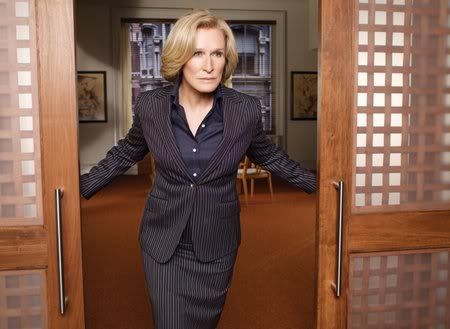
Old Show, New Season: “Damages”

If we were to organize those readers of Premium Hollywood who’ve watched the entire first season of “Damages” into two groups – the ones who watched it when it originally aired and the ones who watched it when it came out on DVD – and took a quick poll about why the latter group watched it on DVD, I’d guess a sizable number of people would say one of two things:

1. I missed the premiere, and when I tried to pick up the series a few episodes in, I felt like I’d already missed too much.
2. I missed an episode during the season, and I knew I’d never be able to figure out what happened, so I just decided to wait for the DVD.

Yeah, it’s true: “Damages” is that kind of show…and I should know, having been one of the people who missed the premiere. But when I got the Season 1 DVD set, I blew threw it as quickly as my schedule allowed. It was an enthralling thriller which managed to be that rare breed of legal drama which almost never set foot in a courtroom, with gripping performances from Glenn Close, Ted Danson, Rose Byrne, and Željko Ivanek and many a moment that left you breathless. In the end, Ellen Parsons (Byrne) went through hell and back, leading her to declare war on Patty Hewes (Close) by teaming with the FBI to bring her down from the inside, all the while maintaining a front and pretending to be her number-one employee.

Season 2 begins in approximately the same chronological manner as Season 1, starting in the present with a jarring opening scene, then jumping back in time to begin the process of explaining how things got to that point in the first place. How odd it feels, though, for the initial flashback scene to show Patty Hewes making an appearance on “Live with Regis and Kelly.” Not that we haven’t gotten the impression that Patty’s a major public figure in the world of law, but it feels rather jarring to see her in the comparatively day-glo lights of the “Live” stage. Still, you can also imagine it setting Patty up for a big fall when she waves Ellen onto the stage and declares to the studio audience and the millions of viewers watching at home that she’d be lost without her.

But will Patty fall this season? Well, if she doesn’t, it certainly won’t be for lack of Ellen trying to make it happen. “You just want to arrest Patti Hughes,” she says to her two FBI contacts. “I want to destroy her.”

Continue reading »

« Older posts Newer posts »

© 2026 Premium Hollywood

Theme by Anders NorenUp ↑