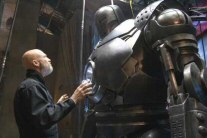
While I got really nervous just before election day — you never really know what those crazy voters are thinking, even if we have polls coming out of every orifice — but I have no compunction whatever in predicting, along with the people who (think they) know, that the #1 movie this week will not be a new release, but last week’s expectations beating megachamp, “Iron Man.” But while Marvel stockholders are counting their money and the rest of us are wondering when Hillary’s going to drop out, there is a race for second place this week, though it’s also pretty easy to call….

*How long has it been since I was puzzling over the identity of “Racer X”? Well, let’s just say it was slightly longer ago than 135 minute runtime for the Wachowski Brothers version of “Speed Racer,” a movie that’s been gestating since I had a full head of hair. 135 minutes is a long sit for most members of the pre-13 set (and many in the post-13 set), and with the Wachowski’s erratic storytelling skills apparently confirmed by a lackluster 34% Tomatometer score, this one might drive some to distraction and have weaker than usual legs for a family friendly film with considerable adult nostalgia/geek appeal.
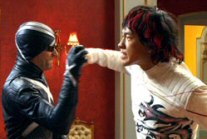 Also, the would be blockbuster’s trailers look less like anime and more like a particularly gaudy video game, and that might not help with the grown-up side of the equation, though J. Hoberman (almost the last critic standing at the Village Voice) has some backhanded compliments. Also, as my esteemed colleague Jason Zingale noted, the casting here is spot on, with Emile Hersh (last seen starving for his art with Sean Penn) as Speed, Christina Ricci (freed from Sam Jackson’s radiator) as galpal Trixie, Matthew Fox (I haven’t watched “Lost” since halfway through it’s first season, so I can’t make a joke) as the mysterious Racer X, and master thesps Susan Sarandon and John Goodman as Mom and Pops Racer. (It’s also got Stephen Colbert’s very special Korean popstar nemesis, Rain, who’s getting okay reviews.) The very strong cast should be good for some tickets, at least until word about the kid-patience-testing length gets out.
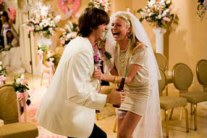 *Since we’ve been basing movies on video games and theme park rides, why not movies drawn from tourism board ad campaigns? That’s the question asked by the makers of “What Happens in Vegas,” a rom-com made even less enticing than usual by the presence of the questionably talented Ashton Kutcher, here paired with the far more able Cameron Diaz, who could really use a bit of respect and a hit without the word “Shrek” in the title. In the case, the premise of a drunkenly married couple forced to spend months of “hard matrimony” might be good for $10 million or so. It would help if its word of mouth is better than the reviews, which have a fairly nasty tinge this time. Even benevolent blurbmistress Susan Granger is brandishing her rhetorical butter knives on this one.
 And, in other news…. After opening in just a couple of theaters last week, writer-director David Mamet’s Redbelt goes wide in over a thousand theaters this weekend. Personally, I think that might be a case of too-much too-soon for this relatively smallish film, but I wish it well and look forward to seeing it myself. “Son of Rambow” is also expanding with a more modest, and possibly shrewder, additional 31 theaters.
In the “ouch” department, the follow-up to Henry Bean’s outstanding 2002 indie, “The Believer,” “Noise,” a comedy of sorts, is opening in two theaters and no one seems to care much, despite starring a couple of our best, Tim Robbins and William Hurt. Shame.
And considering we are aligned with an online men’s mag, I should make mention of the opening of “The Babysitters” in very limited release. The premise of this black comedy is pretty much the premise of the similarly titled film you’re likely to find in the blocked off section in the back of the vid store. The reviews are about what you’d expect, and then some. Take the semi-literate, quasi-grammatical critique by Prairie Miller:
The Babysitters is a pathetic excuse to trot out a procession of teenage girls in the raw, performing graphic simulated sex acts with your basic suburban family man drooling all over himself. Going home and taking a hot, soapy shower after viewing, is highly recommended.
By God, Prairie is right. One needs no excuses, pathetic or otherwise, to show graphic simulated sex acts — they are there own justification. As for “hot, soapy showers” following a viewing, well it’s kind of a waste of water compared to baby oil, but sure.
 Forget what I said