It’s taken the Starz Network quite a while to get on its feet as one of the major movie networks. Okay, fair enough, some would argue that they’re still not there yet, but they’ve been doing some great work with their original documentaries about various film genres, and now that they’re making the move into producing their own original dramatic series as well, it’s clear that they have every intention of playing with the big boys.
The first series on the slate is an adaptation of the Oscar-winning film “Crash,” so you can imagine that there’s going to be a pretty sprawling ensemble cast involved, but there’s one actor’s name that handily stands out above the rest: Dennis Hopper, who plays Ben Cendars, a successful and respected record producer whose fight to remain relevant in the hip-hop world is made more difficult by his self-destructive tendencies. Most intriguing about this particular character, however, is that when placed against all of the total nutjobs on Hopper’s resume, he claims that this guy is “as crazy and probably crazier than any of them. He’s totally out of control. He’s a music mogul who wants to get one last big hit going, and he’s totally off the wall. He changes directions about 20 times in a minute. He seems to have a tremendous empathy and understanding of things, and at the same time, he has no limitations how he addresses other people or other races or other genders. He’s totally a loose cannon; he doesn’t have an edit button. It’s a great part, beautifully written, and we have no language barriers or sexual. It’s as free as television will ever be.”
The proof in that particular pudding would seem to come via a scene between Hopper’s character and, uh, John Thomas, if you take my meaning. And if you don’t…well, I’ll let Hopper describe the scene:
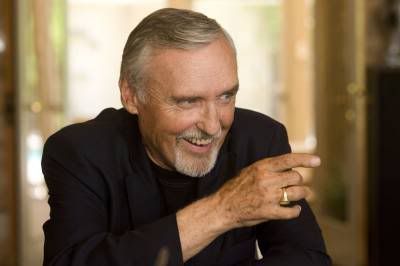
“Well, it’s the first scene I have in the series, and I’m being driven by a beautiful young woman in a big limo. And she thinks I’m talking to her, but I’m really not talking to her, and you can’t really see what’s going on. And I’m having a conversation which sounds a little like poetry, a little like Shakespeare, a little like a lot of things…but, in point, I’m talking to my cock about how it’s not functioning anymore. And it’s a rather private conversation that she thinks is directed to her, about the veins standing out, and she’s starting to look in the mirror to see…whatever. Then she finally stops at the stoplight and looks back and sees me actually addressing my penis. She gets alarmed, jumps out of the car, and I try to convince her that this was a private conversation, and it really wasn’t something that was addressed to her and that she should probably reconsider and come back and drive for me. But she decides that she wants money, and at that point my character goes into a little bit of a…well, you should see it. It’s very funny.”
Hey, I’m sold.
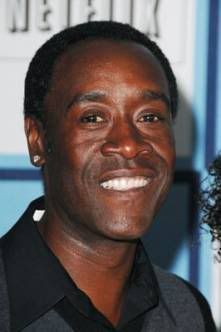
Also involved in the series, though only as a co-executive producer, is Don Cheadle, who also served as a producer on the film in addition to his work in front of the camera. It’s not inconceivable, however, that he could find his way onto the series as Graham Waters, his character from the film, at some point. “Glen (Mazzarra, executive producer and showrunner) and I discussed somehow bringing Graham back and how that would work and how he could come back into the life of this television series. I don’t know specifically if it would be that same character or what he would
be. I mean, that’s a character that kind of left the movie very unresolved and had a very specific goal in mind at the end of that movie to find out who killed his brother. So there’s a potential to bring him back. There’s a way.
“But,” Cheadle added, “I’ve got to feather that in to the other things I’m doing.”
When asked what we can expect from the series, Mazzarra, executive producer and showrunner of “Crash,” gave the impression that it won’t easily be put in a niche…which, of course, can be both a blessing and a curse. Still, the tidbits he offered up made it sound promising, at least.
The cop element: “We’re following the police, and we have a guy who is in a car crash. A beautiful girl steps out, and instead of that being the bad guy that the cop is trying to put away, he’s smitten with her, and the cop’s story is he’s trying to get her in bed.”
The music element: “I would say (Dennis Hopper’s character) is close to death. He is worried that he is going to be irrelevant, and he hires a young African-American driver, and he sees this kid as his redemption. I would say that he is a very sympathetic character, and this relationship, this human interaction, becomes a basis for the character arc in which Ben is trying to mentor this kid. He’s a little crazy. He’s probably a bad influence on this kid, and he’s probably not the man that the kid should be learning from. And yet the kid is trying to, you know, run his own hip-hop label. And so these two guys are trying to get what they want out of each other moving forward.”
The Guatemalan element: “We start in Guatemala, and we have these two young brothers, and they decide that they have to run away — there’s a crime, and they have to run to America. This is their big chance to catch the American dream. And the brothers become separated, and we follow one story — we follow one of the brothers up through Mexico. And so we’re tackling the issue of immigration from a very personal standpoint in which we have a character, and who does he meet this week on the road? How does he make life-and-death choices? How does he struggle to get to Los Angeles?”
The Korean element: “We have a Korean-American character who is an EMT. And instead of playing the franchise element of the trauma every week, we just have that this guy is trying to distance himself from his gang history. He was a criminal, and now he’s trying to go straight. He’s trying to clean up his life. Since he’s out in an ambulance, he runs around town, and he meets our other characters and has his own storyline.”
“So,” concluded Mazzarra, ” I think that this is really a character-based drama.”
Wow, y’think?

