Despite the best intentions of my mother, I have never claimed to be a real history buff. Nonetheless, I always try to keep an open mind on the matter, particularly when it’s something produced by The History Channel. (Did you catch their program which focused on the pursuit of John Wilkes Booth? It was fantastic.) But have you noticed how they’re starting to put on shows where the content is only tangentially historical at best? I like “Ice Road Truckers” as much as the next guy, but it’s a reeeeeeeal stretch to suggest that it really fits snugly within the network’s format. I’m glad, therefore, that it isn’t too hard to accept the inclusion of “Sandhogs” into the line-up, since its origins stretch all the way back to the building of the Brooklyn Bridge.
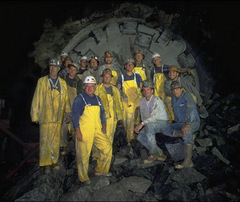
David McKillop, head of programming for The History Channel, set the stage for those in attendance…like, say, myself…who weren’t familiar with the Sandhogs and their long legacy.
“They were the guys that went down under the East River and dug in the currents and the sand to create the foundations that actually support the Brookly Bridge today,” explained McKillop. “Sandhogs are urban miners, construction workers, who generation after generation have literally dug at great personal risk to build and maintain one of the greatest cities in the world. The work is extremely hazardous. Sandhogs toil underneath the streets today, as they did more than 150 years ago. They built the two tunnels that provide water to New York City that were completed in late last century. They built every single subway, traffic tunnel, sewage line, and steam pipe. They’re digging the tunnel that’s going to link the Long Island Railroad to Grand Central Station, and they’re digging New York’s third water tunnel, which when completed will be the largest public works ever undertaken in U.S. history…and it’s all because of these guys. They’re a special breed, a special society, the identity and the subterranean culture they inhabit is a bond that is truly shared as a brotherhood, and few people know they even exist until now.”
Indeed, for The History Channel to be permitted to cover the Sandhogs in such an in-depth manner, one of the show’s producers – Eddie Rosenstein – actually had to become a Sandhog. Another producer, Craig Piligan, also got his hands rather dirty over the course of filming the series, though he quickly clarified, “I was not a career sandhog. I was a career filmmaker. And when I started working for Morgan (Curran, walking boss of the Croton Filtration site) in the shaft, they’re used to it. After two weeks, my nose bled for the next month. There’s dust everywhere, your lungs give in, 80 percent of the guys will be permanently disabled just from lung diseases, and they’re the lucky ones in a lot of ways because at least they’ll see old age.”
For all the hard work they do, though, they don’t really think of themselves as having all that bad a gig. “You said something about it’s a tough job or a hard job, but nobody down there thinks of it that way,” said Chickie Donohue, one of the Sandhogs on the panel. “You have to love it. It’s like going to sea: if you’re going to make a career at sea, you really have to love the ocean. We love being Sandhogs. We’re proud that we’re miners. We know it’s tough. We know it’s dangerous, but honest to God, we truly love what we’re doing. You couldn’t go there every day if you didn’t love going there. They come smiling; they go home tired but smiling.”

Also coming up on The History Channel is “Einstein,” a special which provides one of the most detailed looks into the life of one of history’s most famous geniuses. McKillop assured us that what makes this program stand out is that it’s going to be “contrasting the world that Einstein actually lived in with the hidden and the mysterious world that he imagined, and, as such, “we are able to reveal the unknown story of Einstein and the universe that he discovered. Visually and through interviews, our special gets inside of Einstein’s head. We actually see how he saw the world. It’s a vast international saga of capturing Einstein’s moments of discovery that changed history.”
The big sell for this program, aside from the instant recognizability of Einstein’s name, is that it’s produced by Banks Tarver, who’s also one of the producers on the television version of “This American Life.” Well, okay, maybe that’s not a selling point for you, but I’ve been a big fan of Ira Glass for quite awhile and I’ve really been digging that particular Showtime series, so Tarver’s credit on there works wonders.
If I provided you with too many quotes from the panel, you’d find your mind blown sooner than later – it was pretty heady stuff, to say the least (like you’d expect any less from a program about Einstein) – but I feel like I should at least share this comment from Tarver, who freely acknowledged his stature as the person on stage who knew the least about science but still wanted to clarify that you don’t have to know science to appreciate Einstein’s story.
“What really drew me to this project was really finding out how he became famous,” said Tarver, “and, you know, how did that play out? And it’s not the moment that I thought might provide him his fame, and it’s very different from my expectations. And, most importantly, it’s such a great personal story of struggle and tenacity, and there’s a moment three years before the world at large really finds out who he is, when he’s working relatively alone in Germany, in Berlin. His wife is gone. His kids are gone. His colleagues are supporting a war that he opposes. In fact, one of his best friends and colleagues at the university is sort of leading the charge to use chemical weapons in World War I. And there’s even a moment when he discovers that his own mathematics, his own calculations are wrong. And, yet, three years later he is the toast of the world. And it’s just an amazing, riveting personal story in that regard.”

