Show: “Happy Days”
Episode: “The Howdy Doody Show” (Season 2)
Roles: You will be unsurprised to learn that the most famous puppet of the 1950s and his cowboy-attired “handler” play themselves, if only because, really, who the hell else are they going to play? “Happy Days” enjoyed taking the opportunity to provide a rose-colored look at life in the 1950s, but rarely were they presented with the opportunity to incorporate actual television icons from the era into the fun. Fortunately, wooden puppets don’t age, and people were willing to let it slide that “Buffalo” Bob Smith was sporting a few more wrinkles in 1975 than could be found on his famous visage two decades prior.
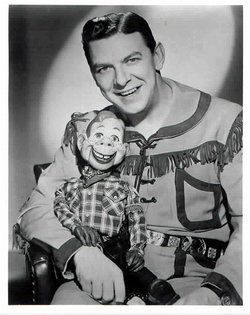
The episode revolves around Richie Cunningham (Ron Howard) trying to impress his editor at the high school newspaper by scoring a scoop, and his first idea is to interview Mr. Doody, whose show was – rather conveniently, it must be said – to be filming in Milwaukee. The Fonz (Henry Winkler) shoots down this idea, suggesting a more controversial alternative: to wrangle a backstage invite and sneak a shot of Clarabell the Clown without his make-up. So how does he get backstage? By entering a Howdy Doody lookalike contest. It’s ludicrous, of course, but seeing Ron Howard dressed in the standard HD attire is almost as funny as experiencing his disgruntlement after losing to a 9-year-old. While backstage with his right-hand man, Potsie (Anson Williams), Richie does indeed score the picture he’s sought, but after that, things immediately snowball at a ridiculous rate. Within hours of snapping the picture, word has already made it from Milwaukee all the way to the offices of Life Magazine, with the publication immediately getting Richie on the phone and making an offer for the photo. Visions of a journalism school scholarship are floating before Richie’s eyes…until the doorbell rings, and Buffalo Bob and Clarabell stand on the stoop.
Mr. C: Well, what brings you to our humble house, huh?
Buffalo Bob: Well…a clown’s broken heart.
Clarabell: (Frowns forlornly)
Mrs. C: He does look sad.
Richie: (Smugly) I guess you heard about my scoop. You know, Life Magazine wants to buy this picture!
Hey, nice, Richie. Way to be a complete dick. What’s next, blackmail? (“You know, Clarabell, for a little bit of dough-re-mi, I could make this photo just, y’know, go away.”) Fortunately, Buffalo Bob decides to take a tactic that only works in sitcoms set in the 1950s: heartfelt honesty.
“Richie, there’s a reason why nobody has ever seen Clarabell without makeup. Y’see, behind that make-up, he’s Clarabell the Clown, and there’s sort of a mystique about him. It’s like the Lone Ranger without a mask: he’s a nobody. Y’see, millions of kids watch television every day to see their favorite clown, and to them, this is Clarabell. Now, if they were to see him as an ordinary man, Clarabell lives no more.”
(Mrs. C attempts to liken the situation to “Tarzan without his loincloth,” but Mr. C assures her, “No, that’s a little different, Marion.”)
Richie is notably unmoved by this plea, trying to play the journalism-school card again, but while Bob makes it clear that it could well be a case of Richie’s future versus Clarabell’s career, he concedes that “you worked hard to get that picture, and I guess you’re entitled to sell it.” And then, with a facer arguably even sadder than the one painted on Clarabell, Bob plays the Ace of Guilt: “Rich, it’s up to you.”
You guessed it: Richie tears up the picture. Cue one very excited clown…and one pissed-off, whiny Cunningham.
After Bob and Clarabell leave, Richie doesn’t take the schmaltzy way out by saying, “Wow, it sure feels good to do the right thing.” Instead, he reacts exactly how a normal teenager would: he pouts and moans, “What about my scoop?”, providing yet another reason why the first few seasons of “Happy Days” are remembered as some of the best television the 1970s had to offer.

